
Close Menu
    Facebook X (Twitter) Instagram
    SciTechDaily
    • Biology
    • Chemistry
    • Earth
    • Health
    • Physics
    • Science
    • Space
    • Technology
    Facebook X (Twitter) Pinterest YouTube RSS
    SciTechDaily
    Home»Earth»The Blast That Shook the Ionosphere – Beirut Explosion’s Atmospheric Wave Rivaled Ones From Volcanic Eruptions
    Earth

    The Blast That Shook the Ionosphere – Beirut Explosion’s Atmospheric Wave Rivaled Ones From Volcanic Eruptions

    By Hokkaido UniversityMarch 24, 20211 Comment3 Mins Read
    Facebook Twitter Pinterest Telegram LinkedIn WhatsApp Email Reddit
    Share
    Facebook Twitter LinkedIn Pinterest Telegram Email Reddit
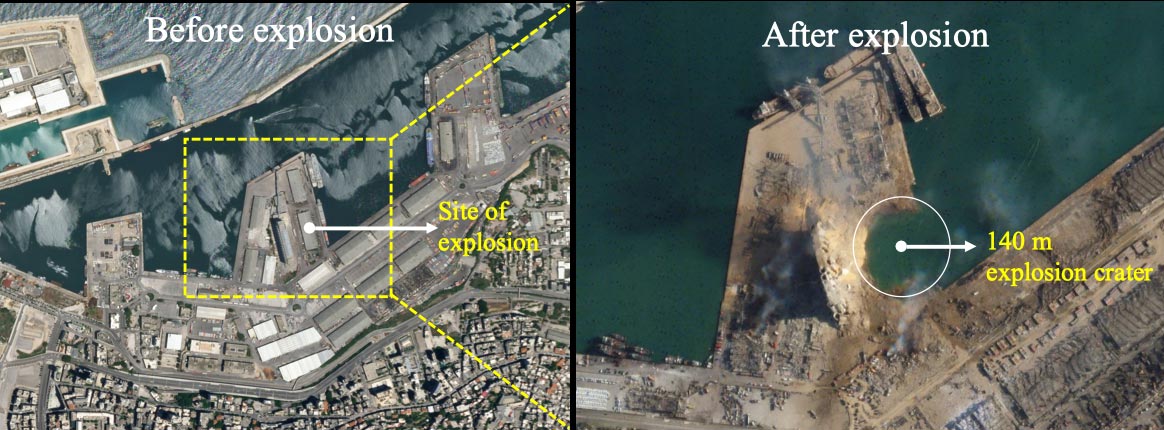
    Epicenter of Beirut Explosion
    The epicenter in Beirut, before and after the explosion. Credit: Bhaskar Kundu, et al. Scientific Reports. February 2, 2021

    A 2020 explosion in Lebanon’s port city of Beirut led to a southward-bound, high-velocity atmospheric wave that rivaled ones generated by volcanic eruptions.

    Just after 6 p.m. local time (15.00 UTC) on August 4, 2020, more than 2,750 tons worth of unsafely stored ammonium nitrate exploded in Lebanon’s port city of Beirut, killing around 200 people, making more than 300,000 temporarily homeless, and leaving a 140-meter-diameter crater in its wake. The blast is considered one of the most powerful non-nuclear, man-made explosions in human history. 

    Now, calculations by Hokkaido University scientists in Japan have found that the atmospheric wave from the blast led to electron disturbances high in Earth’s upper atmosphere. They published their findings in the journal Scientific Reports.

    The team of scientists, which included colleagues from the National Institute of Technology Rourkela in India, calculated changes in total electron content in Earth’s ionosphere: the part of the atmosphere from around 50 to 965 kilometers in altitude. Natural events like extreme ultraviolet radiation and geomagnetic storms, and man-made activities like nuclear tests, can cause disturbances to the ionosphere’s electron content.
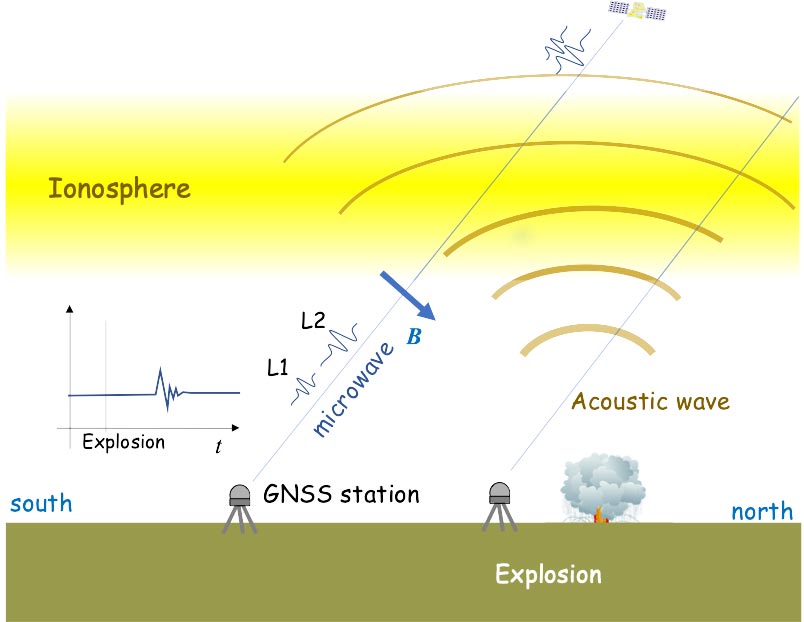
    Detection of the Ionospheric Disturbance Caused by the Explosion
    The ionospheric disturbance caused by an explosion can be detected by differential ionospheric delays of microwave signals of two carrier frequencies from global navigation satellite system (GNSS) satellites. Credit: Bhaskar Kundu, et al. Scientific Reports. February 2, 2021

    “We found that the blast generated a wave that traveled in the ionosphere in a southwards direction at a velocity of around 0.8 kilometers per second,” says Hokkaido University Earth and Planetary scientist Kosuke Heki. This is similar to the speed of sound waves traveling through the ionosphere.

    The team calculated changes in ionospheric electron content by looking at differences in delays experienced by microwave signals transmitted by GPS satellites to their ground stations. Changes in electron content affect these signals as they pass through the ionosphere and must be regularly taken into consideration to accurately measure GPS positions.

    Beirut Blast’s Reach Rivals Volcanic Eruptions

    The scientists also compared the magnitude of the ionospheric wave generated by the Beirut blast to similar waves following natural and anthropogenic events. They found that the wave generated by the Beirut blast was slightly larger than a wave generated by the 2004 eruption of Asama Volcano in central Japan, and comparable to ones that followed other recent eruptions on Japanese islands.

    The energy of the ionospheric wave generated by the Beirut blast was significantly larger than a more energetic explosion in a Wyoming coal mine in the USA in 1996. The Beirut blast was equivalent to an explosion of 1.1 kilotons of TNT, while the Wyoming explosion was equivalent to 1.5 kilotons of TNT. The total electron content disturbance of the Wyoming explosion was only 1/10 of that caused by the Beirut blast. The scientists believe this was partially due to the Wyoming mine being located in a somewhat protected pit.

    Reference: “Atmospheric wave energy of the 2020 August 4 explosion in Beirut, Lebanon, from ionospheric disturbances” by Bhaskar Kundu, Batakrushna Senapati, Ai Matsushita and Kosuke Heki, 2 February 2021, Scientific Reports.
    DOI: 10.1038/s41598-021-82355-5

    Funding: This work was supported by a National Institute of Technology Rourkela (NITR) research fellowship and the Japan Society for the Promotion of Science (JSPS) KAKENHI (JP20K04120).

    Never miss a breakthrough: Join the SciTechDaily newsletter.
    Follow us on Google and Google News.

    Hokkaido University Ionosphere Meteorology Popular
    Share. Facebook Twitter Pinterest LinkedIn Email Reddit

    Related Articles

    Alaskan Nights Aglow: Don’t Miss HAARP’s Spectacular Artificial Airglow Show

    Tonga Volcanic Eruption Sent Ripples Through Earth’s Ionosphere – Equivalent to 4-18 Megatons of TNT

    Lightning Impacts Edge of Space in Ways Not Previously Observed

    A 1,000 km Long River May Be Flowing Deep Below Greenland’s Ice Sheet

    COVID-19 Is Disrupting Weather Forecasts – Here’s How

    Global Food Production at Risk From Large Atmospheric Waves in the Jet Stream

    Controversial Theory on Extinction of Ice-Age Animals Supported by New Evidence

    2015 El Niño Appears Likely to Equal the Event of 1997-98

    NASA Launched Rocket into Aurora Borealis

    1 Comment

    1. Bonnie Davis on March 25, 2021 1:03 pm

      I remember this event and am happy to see the scientific community following up on the data.

      Reply
    Leave A Reply Cancel Reply

    • Facebook
    • Twitter
    • Pinterest
    • YouTube

    Don't Miss a Discovery

    Subscribe for the Latest in Science & Tech!

    Trending News

    Researchers Have Found a Dietary Compound That Increases Longevity

    Scientists Baffled by Bizarre “Living Fossil” From 275 Million Years Ago

    Your IQ at 23 Could Predict Your Wealth at 27, Study Finds

    320 Light-Years Away, a Planet Confirms a Fundamental Cosmic Assumption

    The Crown Jewel of Dentistry? Breakthrough Tech Could Transform Tooth Repair

    Python Blood Could Hold the Secret to Weight Loss Without Side Effects

    Naturally Occurring Bacteria Completely Eradicate Tumors in Mice With a Single Dose

    New “Nanozyme Hypothesis” Could Rewrite the Story of Life’s Origins

    Follow SciTechDaily
    • Facebook
    • Twitter
    • YouTube
    • Pinterest
    • Newsletter
    • RSS
    SciTech News
    • Biology News
    • Chemistry News
    • Earth News
    • Health News
    • Physics News
    • Science News
    • Space News
    • Technology News
    Recent Posts
    • Scientists Uncover Hidden Clues to the Origin of the Genetic Code
    • Scientists Discover Unexpected Role of Alzheimer’s Protein in Cell Division
    • Scientists Uncover Brain Changes That Link Pain to Depression
    • A New Chapter in Chemistry? Scientists Uncover New Way Metals Bind Oxygen
    • New Study Reveals Earth Is Getting Brighter at Night – About 2% Each Year
    Copyright © 1998 - 2026 SciTechDaily. All Rights Reserved.
    • Science News
    • About
    • Contact
    • Editorial Board
    • Privacy Policy
    • Terms of Use

    Type above and press Enter to search. Press Esc to cancel.