

Close Menu
    Facebook X (Twitter) Instagram
    SciTechDaily
    • Biology
    • Chemistry
    • Earth
    • Health
    • Physics
    • Science
    • Space
    • Technology
    Facebook X (Twitter) Pinterest YouTube RSS
    SciTechDaily
    Home»Biology»The Brain’s Alarm System To Suppress Intrusive Thoughts and Inhibit Unwanted Memories
    Biology

    The Brain’s Alarm System To Suppress Intrusive Thoughts and Inhibit Unwanted Memories

    By Society for NeuroscienceApril 18, 2022No Comments2 Mins Read
    Facebook Twitter Pinterest Telegram LinkedIn WhatsApp Email Reddit
    Share
    Facebook Twitter LinkedIn Pinterest Telegram Email Reddit
    Headache Confusion Obsession Dark Thoughts Illustration
    New research shows that to suppress intrusive thoughts, the brain uses an alarm system that alerts other regions to inhibit them.

    A brain region can proactively and reactively detect the need to inhibit unwanted memories.

    Forget what you saw: a brain region detects when you are about to think of an unwanted memory and alerts other regions to suppress it, according to research published in JNeurosci today (April 18, 2022). JNeurosci is the Society for Neuroscience’s first journal.
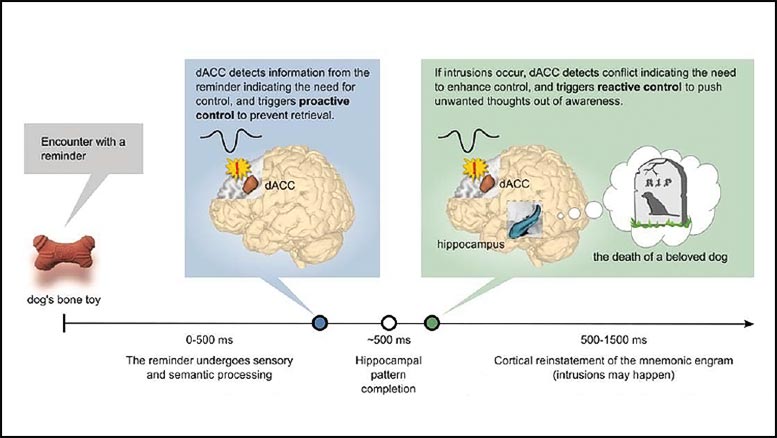
    Brain Employs Alarm System to Suppress Intrusive Thoughts
    A model of how the ACC proactively and reactively signals the need for thought suppression. Credit: Crespo García et al., JNeurosci 2022

    Crespo García et al. measured participants’ brain activity with both EEG and fMRI while they completed a memory task. The participants memorized sets of words (i.e., gate and train) and were asked to either recall a cue word’s pair (see gate, think about train) or only focus on the cue word (see gate, only think about gate).

    During proactive memory suppression, activity increased in the anterior cingulate cortex (ACC), a brain region involved in cognitive control, within the first 500 milliseconds of the task. The ACC relayed information to the dorsolateral prefrontal cortex (DLPFC), which then inhibited activity in the hippocampus, a key region for memory recall.

    The activity levels in the ACC and DLPFC remained low for the rest of the trial, a sign of success — the memory was stopped early enough so no more suppression was needed. If the memory was not suppressed in time, the ACC generated a reactive alarm, increasing its activity to signal to the DLPFC to stop the intrusion.

    Reference: “Anterior Cingulate Cortex Signals the Need to Control Intrusive Thoughts During Motivated Forgetting” by Maité Crespo García, Yulin Wang, Mojun Jiang, Michael C. Anderson and Xu Lei, 18 April 2022, JNeurosci.
    DOI: 10.1523/JNEUROSCI.1711-21.2022 

    Never miss a breakthrough: Join the SciTechDaily newsletter.
    Follow us on Google and Google News.

    Brain Memory Neuroscience Popular Society for Neuroscience
    Share. Facebook Twitter Pinterest LinkedIn Email Reddit

    Related Articles

    Brain Memory Signals Linked to Blood Sugar Levels in New Research

    Scientists Discover a New Class of Memory Cells in the Brain – The Closest Thing to a “Grandmother Neuron”

    Researchers Discover a Molecule Critical to Functional Brain Rejuvenation

    MeshCODE: Revolutionary New Theory for How Memories Are Stored in the Brain

    MIT Neuroscientists Identify Brain Circuit in the Hippocampus That Encodes Timing of Events

    MIT Neuroscientists Discover a Molecular Mechanism That Allows Memories to Form

    What Makes Memories So Detailed and Enduring? Newly Discovered Mechanism of Learning

    Deep Inside the Brain: Neuroscientists Discover the Missing Piece of the Brain’s Multitasking Network

    Reactivation of the Hippocampus Causes Memory Recall

    Leave A Reply Cancel Reply

    • Facebook
    • Twitter
    • Pinterest
    • YouTube

    Don't Miss a Discovery

    Subscribe for the Latest in Science & Tech!

    Trending News

    Scientists Uncover Potential Brain Risks of Popular Fish Oil Supplements

    Scientists Discover a Surprising Way To Make Bread Healthier and More Nutritious

    After 60 Years, Scientists Uncover Unexpected Brain Effects of Popular Diabetes Drug Metformin

    New Research Uncovers Hidden Side Effects of Popular Weight-Loss Drugs

    Scientists Rethink Extreme Warming After Surprising Ocean Discovery

    Landmark Study Links Never Marrying to Significantly Higher Cancer Risk

    Researchers Discover Unknown Beetle Species Just Steps From Their Lab

    Largest-Ever Study Finds Medicinal Cannabis Ineffective for Anxiety, Depression, PTSD

    Follow SciTechDaily
    • Facebook
    • Twitter
    • YouTube
    • Pinterest
    • Newsletter
    • RSS
    SciTech News
    • Biology News
    • Chemistry News
    • Earth News
    • Health News
    • Physics News
    • Science News
    • Space News
    • Technology News
    Recent Posts
    • Not Just Alzheimer’s: Scientists Uncover Clues to a Second, Overlooked Disorder
    • Scientists Uncover Dangerous Connection Between Serotonin and Heart Valve Disease
    • Scientists Discover a “Protector” Protein That Could Help Reverse Hair Loss
    • Powerful Lasers Reveal How Matter Becomes Plasma in Trillionths of a Second
    • A Simpler Path to Super-Resolution: Scientists Reinvent Microscopy
    Copyright © 1998 - 2026 SciTechDaily. All Rights Reserved.
    • Science News
    • About
    • Contact
    • Editorial Board
    • Privacy Policy
    • Terms of Use

    Type above and press Enter to search. Press Esc to cancel.