

The researchers behind an energy system that makes it possible to capture solar energy, store it for up to eighteen years, and release it when and where it is needed have now taken the system a step further. After previously demonstrating how the energy can be extracted as heat, they have now succeeded in getting the system to produce electricity, by connecting it to a thermoelectric generator. Eventually, the research – developed at Chalmers University of Technology, Sweden – could lead to self-charging electronic gadgets that use stored solar energy on demand.
“This is a radically new way of generating electricity from solar energy. It means that we can use solar energy to produce electricity regardless of weather, time of day, season, or geographical location. It is a closed system that can operate without causing carbon dioxide emissions,” says research leader Kasper Moth-Poulsen, Professor at the Department of Chemistry and Chemical Engineering at Chalmers.
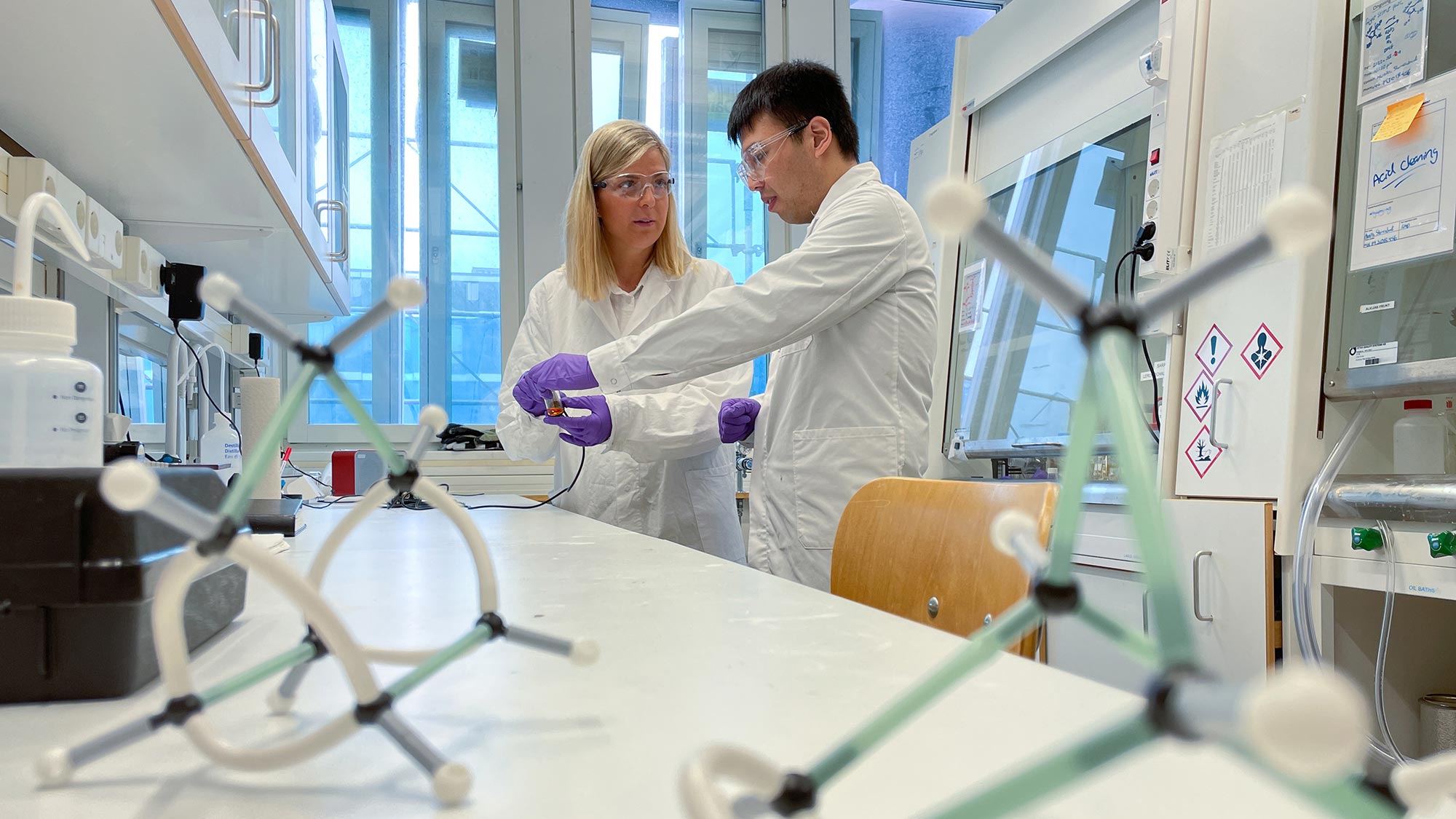
The researchers behind the solar energy system MOST, which makes it possible to capture solar energy, store it for up to 18 years, and release it when and where it is needed, have now taken the system a step further. After previously demonstrating how the energy can be extracted as heat, they have now succeeded in getting the system to produce electricity, by connecting it to a compact thermoelectric generator. The research, which was carried out at Chalmers University of Technology in Sweden, could eventually lead to self-charging gadgets that are powered on-demand by stored solar energy. Credit: Chalmers University of Technology
The new technology is based on the solar energy system MOST – Molecular Solar Thermal Energy Storage Systems, developed at Chalmers University of Technology. Very simply, the technology is based on a specially designed molecule that changes shape when it comes into contact with sunlight. The research has already attracted great interest worldwide when it has been presented at earlier stages.
The new study, published in Cell Reports Physical Science in March 2022 and carried out in collaboration with researchers in Shanghai, takes the solar energy system a step further, detailing how it can be combined with a compact thermoelectric generator to convert solar energy into electricity.

Ultra-Thin Chip Converts Heat Into Electricity
The Swedish researchers sent their specially designed molecule, loaded with solar energy, to colleagues Tao Li and Zhiyu Hu at Shanghai Jiao Tong University, where the energy was released and converted into electricity using the generator they developed there. Essentially, Swedish sunshine was sent to the other side of the world and converted into electricity in China.
“The generator is an ultra-thin chip that could be integrated into electronics such as headphones, smartwatches, and telephones. So far, we have only generated small amounts of electricity, but the new results show that the concept really works. It looks very promising,” says researcher Zhihang Wang from Chalmers University of Technology.

Fossil Free, Emissions Free
The research has great potential for renewable and emissions-free energy production. But a lot of research and development remains before we will be able to charge our technical gadgets or heat our homes with the system’s stored solar energy.
“Together with the various research groups included in the project, we are now working to streamline the system. The amount of electricity or heat it can extract needs to be increased. Even if the energy system is based on simple basic materials, it needs to be adapted to be sufficiently cost-effective to produce, and thus possible to launch more broadly,” says Kasper Moth-Poulsen.
More About the Most Technology
Molecular Solar Thermal Energy Storage Systems, Most, is a closed energy system based on a specially designed molecule of carbon, hydrogen, and nitrogen, which when hit by sunlight changes shape into an energy-rich isomer – a molecule made up of the same atoms but arranged together in a different way. The isomer can then be stored in liquid form for later use when needed, such as at night or in winter. The researchers have refined the system to the point that it is now possible to store the energy for up to 18 years. A specially designed catalyst releases the saved energy as heat while returning the molecule to its original shape, so it can then be reused in the heating system. Now, in combination with a micrometer-thin thermoelectric generator, the energy system can also generate electricity to order.

Reference: “Chip-scale solar thermal electrical power generation” by Zhihang Wang, Zhenhua Wu, Zhiyu Hu, Jessica Orrego-Hernández, Erzhen Mu, Zhao-Yang Zhang, Martyn Jevric, Yang Liu, Xuecheng Fu, Fengdan Wang, Tao Li and Kasper Moth-Poulsen, 2 March 2022, Cell Reports Physical Science.
DOI: 10.1016/j.xcrp.2022.100789

More About the Research and the Scientific Article
The study of Chip-scale solar thermal electrical power generation is published in Cell Reports Physical Science. The article is written by Zhihang Wang, Zhenhua Wu, Zhiyu Hu, Jessica Orrego-Hernández, Erzhen Mu, Zhao-Yang Zhang, Martyn Jevric, Yang Liu, Xuecheng Fu, Fengdan Wang, Tao Li and Kasper Moth-Poulsen. The researchers are active at Chalmers University of Technology in Sweden, Shanghai Jiao Tong University, and Henan Polytechnic University in China, as well as at the Institute of Materials Science in Barcelona and the Catalan Department of Research and Advanced Studies, ICREA, in Spain.
The research has been funded by the Knut and Alice Wallenberg Foundation, the Swedish Foundation for Strategic Research, the Swedish Research Council Formas, the Swedish Energy Agency, the European Research Council (ERC) under grant agreement CoG, PHOTHERM – 101002131, the Catalan Institute of Advanced Studies (ICREA), and the European Union’s Horizon 2020 Framework Programme under grant agreement no. 951801.
Never miss a breakthrough: Join the SciTechDaily newsletter.
Follow us on Google and Google News.
4 Comments
How big is the carbon footprint to manufacture the device.
Nature already “built” century+ solar storage. It is called a TREE.
This sounds like they are converting solar energy into a liquid fuel of sorts. Sounds interesting, but the number of times I’ve read about some supposedly game changing technology for power storage only to never hear about it again has left me somewhat skeptical.
Converting the heat back to electricity is very inefficient. Thermal electric generators usually have an efficiency of only about 5%. That means that 95% of the energy is wasted.
Good grass-touching basic science. For working fluid lifetime that figure too is good.