

A groundbreaking system promises to greatly accelerate research on the fundamental properties of antimatter.
By achieving lower temperatures of trapped antiprotons, they aim to uncover why the universe favors matter over antimatter, a pivotal question in physics.
Antimatter Research Enhancements
A major breakthrough led by RIKEN has taken a significant step toward solving one of physics’ greatest mysteries: why normal matter vastly outweighs antimatter in the universe. The team has developed a cutting-edge cooling system capable of rapidly reducing the energy of trapped antiprotons, enhancing the precision of experiments that probe this cosmic imbalance.
Protons dominate the universe around us. For instance, a single ice cube contains a staggering few septillion (1024) protons, and about half of our body weight comes from them. In stark contrast, antiprotons—particles with the same mass as protons but an opposite charge—are exceedingly rare.
This massive disparity, extending to all particles and their antimatter counterparts, poses a fundamental question in modern physics: why does the universe today consist almost entirely of matter, even though equal amounts of matter and antimatter should have been created in the early stages of the cosmos?
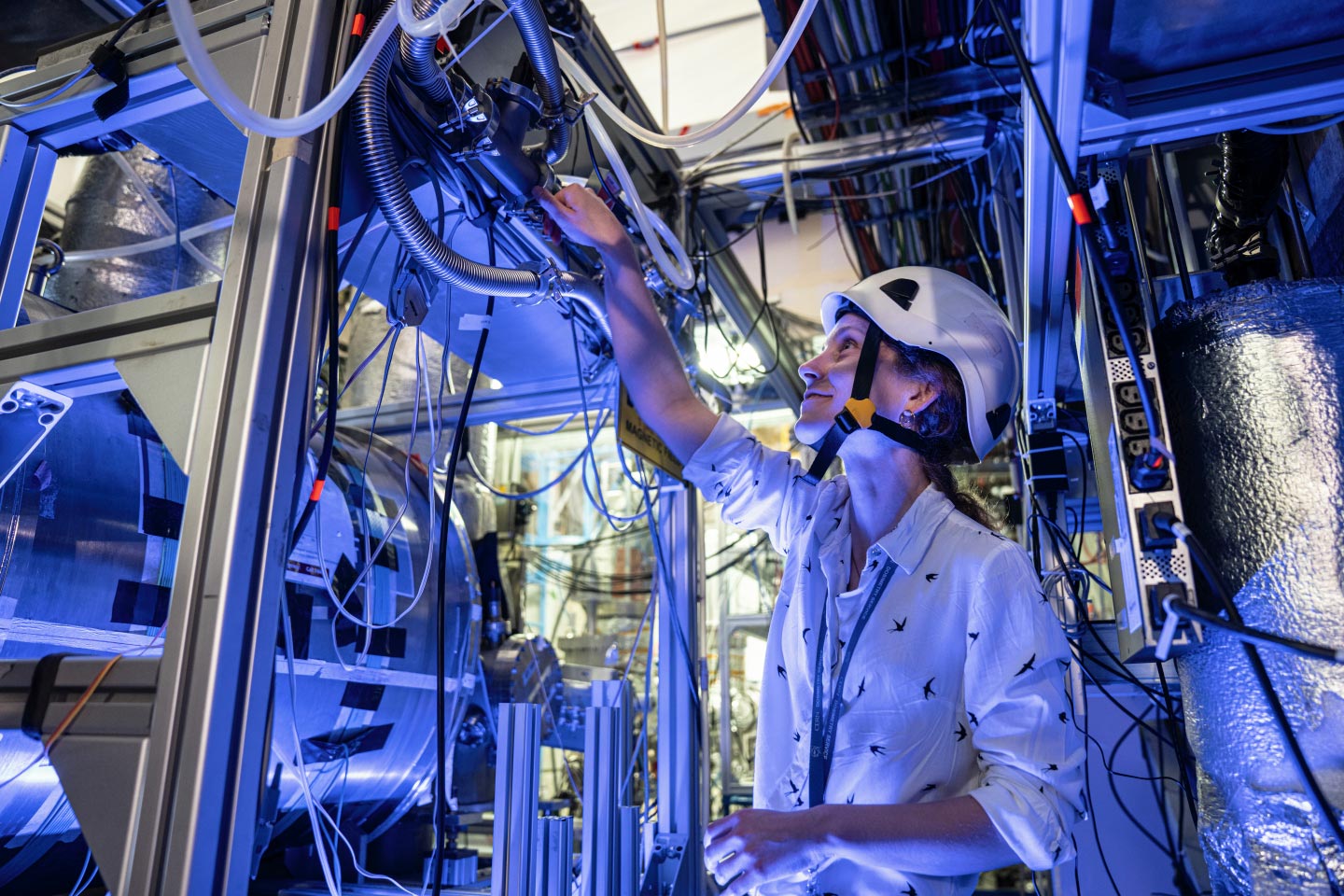
Advances in Antimatter Precision Measurements
Since antiparticles can now be produced in the lab, one way to discover the cause of this imbalance is to measure the properties of antimatter particles at extremely high precisions. Physicists can then test whether there is even the tiniest difference in the properties of matter and antimatter pairs that might have led to the gradual attrition of antimatter over cosmic timescales.
This is the goal of RIKEN researchers and collaborators at the Baryon Antibaryon Symmetry Experiment (BASE), located at the world’s only operating source of cooled antiprotons—the Antiproton Decelerator at CERN on the French–Swiss border. But so far, no such asymmetry between protons and antiprotons has been detected at the resolution limits of the experimental system.
Innovations in Particle Cooling Techniques
Stefan Ulmer, who heads the RIKEN Ulmer Fundamental Symmetries Laboratory, is leading the BASE research collaboration to significantly improve the measurement resolutions of various properties of antiprotons by cooling trapped particles more rapidly.
“The BASE experiment consists of four Penning traps that trap single charged particles using a combination of static magnetic and electric fields,” explains Ulmer. “These traps allow us to observe single particles for years at a time, enabling us to achieve very high accuracy and conduct studies at the highest resolution.”
This measurement resolution is limited by the antiproton’s temperature—the cooler the antiproton, the smaller its oscillation amplitude and the less sensitive it is to external noise sources, enabling researchers to learn more about its fundamental properties.
Enhancing Antiproton Research With New Technology
That is the motivation behind the sophisticated new cooling system developed by Ulmer’s team.
“Our resistive cooling system uses a magnetic bottle to select very cold particles efficiently,” says Ulmer. “It’s a technically complex system, consisting of several ultrasensitive superconducting detectors and other devices, that shuttles antiprotons between the two traps without heating.”
The new cooling system substantially improves the data sampling rate. This, in turn, should considerably improve the accuracy of measured fundamental constants, increasing the likelihood of spotting minuscule differences between protons and antiprotons.
For more on this study, see New CERN Experiment Challenges Conventional Physics.
Reference: “Orders of Magnitude Improved Cyclotron-Mode Cooling for Nondestructive Spin Quantum Transition Spectroscopy with Single Trapped Antiprotons” by BASE Collaboration, B. M. Latacz, M. Fleck, J. I. Jäger, G. Umbrazunas, B. P. Arndt, S. R. Erlewein, E. J. Wursten, J. A. Devlin, P. Micke, F. Abbass, D. Schweitzer, M. Wiesinger, C. Will, H. Yildiz, K. Blaum, Y. Matsuda, A. Mooser, C. Ospelkaus, C. Smorra, A. Soter, W. Quint, J. Walz, Y. Yamazaki and S. Ulmer, 1 August 2024, Physical Review Letters.
DOI: 10.1103/PhysRevLett.133.053201
Never miss a breakthrough: Join the SciTechDaily newsletter.
Follow us on Google and Google News.
3 Comments
It surely unlocks the government purse.
Harnessing antimatter could make some really powerful bombs!
Imagine at the instant of the Big Bang, matter and antimatter were created in equal amounts, but instead of destroying each other, they simply flew off in different time directions or dimensions. Matter dispersed into what we call “the future” (more correctly the present/future) and antimatter into what we call “the past” (more correctly a different, not necessarily opposite, time regime). This suggests the possibility of the so-called multiverse.