
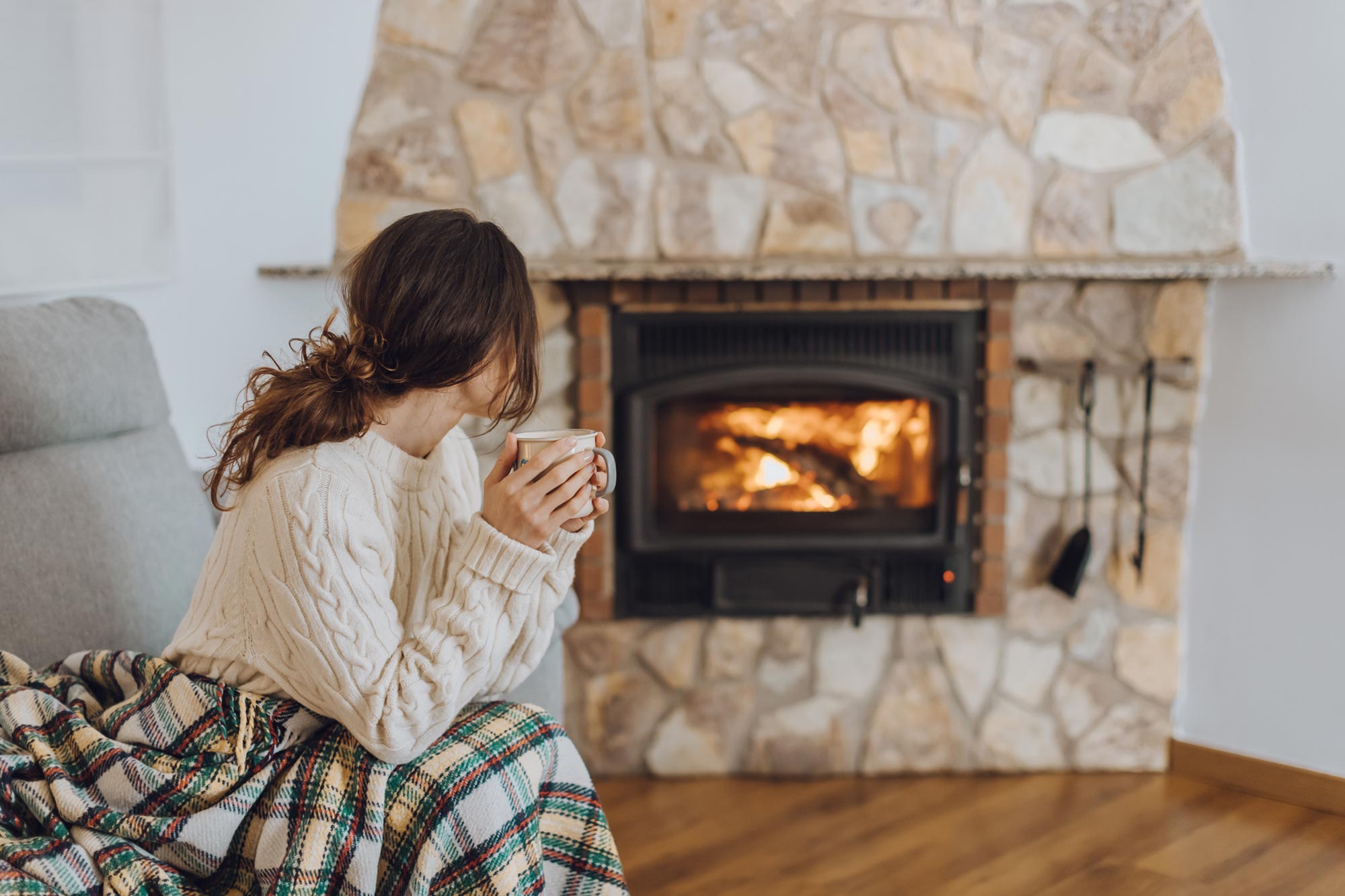
That cozy winter fire could be doing far more harm than good—wood smoke is a hidden killer in America’s winter air.
Adding another log to a glowing fireplace on a cold winter evening often feels comforting and harmless. But new research from Northwestern University shows that burning wood inside homes plays a much larger role in winter air pollution across the United States than most people realize.
Even though just 2% of U.S. households use wood as their main heating source, residential wood burning is responsible for more than one-fifth of Americans’ wintertime exposure to outdoor fine particulate matter (PM2.5), according to the study.
These microscopic particles can travel deep into the lungs and enter the bloodstream. Long-term exposure has been linked to heart disease, lung disease, and a higher risk of early death. The researchers estimate that pollution from residential wood burning is associated with roughly 8,600 premature deaths each year.
A hidden urban health problem
One of the study’s most unexpected findings is who is most affected. The greatest health impacts occur in cities, not rural areas. People of color also face a disproportionate burden, even though they tend to burn less wood than other groups. Higher exposure levels and greater health risks are likely tied to higher baseline mortality rates and the lasting effects of discriminatory policies.
The researchers say reducing wood burning inside homes could significantly cut outdoor air pollution, delivering major public health benefits and saving thousands of lives.
The study will be published today (January 23) in the journal Science Advances.
“Long-term exposure to fine particulate matter is associated with an increased risk of cardiovascular diseases,” said Northwestern’s Kyan Shlipak, who led the study. “Studies have shown consistently that this exposure leads to a higher risk of death. Our study suggests that one way to substantially reduce this pollution is to reduce residential wood burning. Using alternative appliances to heat homes instead of burning wood would have a big impact on fine particulate matter in the air.”
Why wood smoke is often overlooked
Wildfire smoke frequently dominates headlines, but pollution from everyday home heating gets far less attention.
“We frequently hear about the negative health impacts of wildfire smoke, but do not often consider the consequences of burning wood for heat in our homes,” said Northwestern’s Daniel Horton, the study’s senior author. “Since only a small number of homes rely on wood burning for heat, facilitating a home-heating appliance transition to cleaner burning or non-burning heat sources could lead to outsized improvements in air quality.”
Horton is an associate professor of Earth, environmental, and planetary sciences at Northwestern’s Weinberg College of Arts and Sciences, where he directs the Climate Change Research Group (CCRG). Shlipak is an undergraduate in mechanical engineering at Northwestern’s McCormick School of Engineering and a member of the CCRG.
Mapping pollution neighborhood by neighborhood
Most air-quality research and regulation has focused on pollution from vehicles, power plants, agriculture, industry, and wildfires. In this study, the researchers turned their attention to a much less examined source: wood burning in homes, including furnaces, boilers, fireplaces, and stoves.
They began by collecting data from the National Emissions Inventory (NEI), the U.S. Environmental Protection Agency’s detailed database of pollution sources. The NEI estimates wood-burning emissions using household surveys, housing characteristics, climate data, and information about heating appliances.
Next, the team applied a high-resolution atmospheric model to track how pollution moves through the air. The model incorporates weather patterns, wind, temperature, terrain, and atmospheric chemistry to estimate air quality over time.
“Wood burning emissions enter the atmosphere, where they are affected by meteorology,” Horton said. “Some emissions are considered primary pollutants, such as black carbon, and some interact with the atmosphere and other constituents, and can form additional, secondary species of particulate matter pollution.”
To capture fine-scale patterns, the researchers divided the continental United States into 4-kilometer by 4-kilometer squares. For each square, they calculated how much pollution was produced each hour, how it traveled, and where it built up or dispersed. This neighborhood-level approach allowed them to identify pollution hotspots that would be missed by citywide or countywide averages.
They ran the model twice, once including residential wood-burning emissions and once without them. By comparing the two scenarios, the team determined that residential wood burning accounts for about 22% of wintertime PM2.5 pollution, making it one of the largest single sources of fine particle pollution during the coldest months of the year.
Who bears the greatest risk
The analysis showed that wood smoke is especially harmful in urban and suburban areas, where population density, emissions patterns, and atmospheric transport combine to raise exposure levels. In many cases, smoke produced in suburban neighborhoods drifts into nearby city centers, where fewer homes burn wood but far more people live.
Cities that are not typically associated with wood burning can also be affected during cold snaps, recreational burning periods, and when smoke travels long distances through the atmosphere.
“Our results suggest that the impacts of residential wood burning are primarily an urban and suburban phenomenon,” Shlipak said. “This finding underscores the public health relevance of this pollution. We estimate that long-term exposure to emissions from wintertime wood burning is associated with approximately 8,600 deaths per year, and this estimate does not account for particulate matter exposures in other seasons.”
To assess who is most exposed, the researchers combined their pollution estimates with U.S. census data and mortality statistics at the census-tract level. They found that people of color experience higher exposure and greater health harms despite lower wood-burning emissions. In the Chicago metropolitan area, Black communities face more than 30% higher adverse health effects from residential wood burning than the regional average.
“While a lot of emissions from residential wood burning come from the suburbs, pollutants emitted into the air don’t typically stay put,” Horton said. “When this pollution is transported over densely populated cities, more people are exposed. Because people of color tend to be more susceptible to environmental stressors due to the long tail of past discriminatory policies, we estimate larger negative health outcomes for people of color.”
“People of color face both higher baseline mortality rates and higher rates of exposure to pollution from wood burning,” Shlipak said. “However, people of color are correlated with lower emissions rates, indicating that a large fraction of this pollution is transported to these communities, rather than emitted by them.”
The researchers note that their study focuses only on outdoor exposure to wood-burning pollution. Health effects from indoor exposure to particulate matter are also significant but were not included in the analysis.
Reference: “Ambient air quality and health impacts of PM2.5 from US residential wood combustion” by Kyan K. Shlipak, Sara F. Camilleri, Victoria A. Lang, Anastasia Montgomery, Jordan L. Schnell and Daniel E. Horton, 23 January 2026, Science Advances.
DOI: 10.1126/sciadv.adz0189
The study was supported by the National Science Foundation (award number CAS-Climate-2239834).
Never miss a breakthrough: Join the SciTechDaily newsletter.
Follow us on Google and Google News.
3 Comments
The world of jungles and dinosaurs grew robust and healthy with 0.2% carbon. The Dinos and forests slowly deposited the carbon and now we’ve fallen to 0/04% – WHEN – all plant life (and oxygen breathing humans with it) die away at 0.02% – just half our present, precariously low level.
That’s the little part that “Climate Change” enthusiasts leave out – for you not do think too hard about.
So now: do you have a brain? yes or no?
“Because people of color tend to be more susceptible to environmental stressors due to the long tail of past discriminatory policies, …”
Would someone care to translate the above for me? In particular, what is meant by “due to the long tail of past discriminatory policies?” It sounds more like bio-social poetry than science.
These psychos will take everything they can away from you.
You will live like a controlled robot slave.
I pity the fools that fall in line with this tripe.