
An international team proposes replacing Hockett’s feature checklist with a model of language as a dynamic, multimodal, and socially evolving system.
For more than sixty years, Charles Hockett’s ‘design features’ have been widely used as a framework for defining what distinguishes human language from other forms of communication. These features were long treated as a checklist of properties that set language apart.
However, a new study published in Trends in Cognitive Sciences argues that this traditional view is no longer sufficient. The researchers contend that language cannot be captured by a fixed inventory of traits, but is better understood as a flexible system shaped by social interaction, situational context, and human creativity.
Paradigm shift for language science
In a new reassessment of Hockett’s classic “design features” of language—ideas such as arbitrariness, duality of patterning, and displacement—an international team of linguists and cognitive scientists argues that current research requires a fundamental rethink of what language is and how it evolved.
Their central claim is clear: language is not merely a spoken code. Instead, it is a dynamic, multimodal, socially grounded system shaped through interaction, culture, and shared meaning.
Updating Hockett
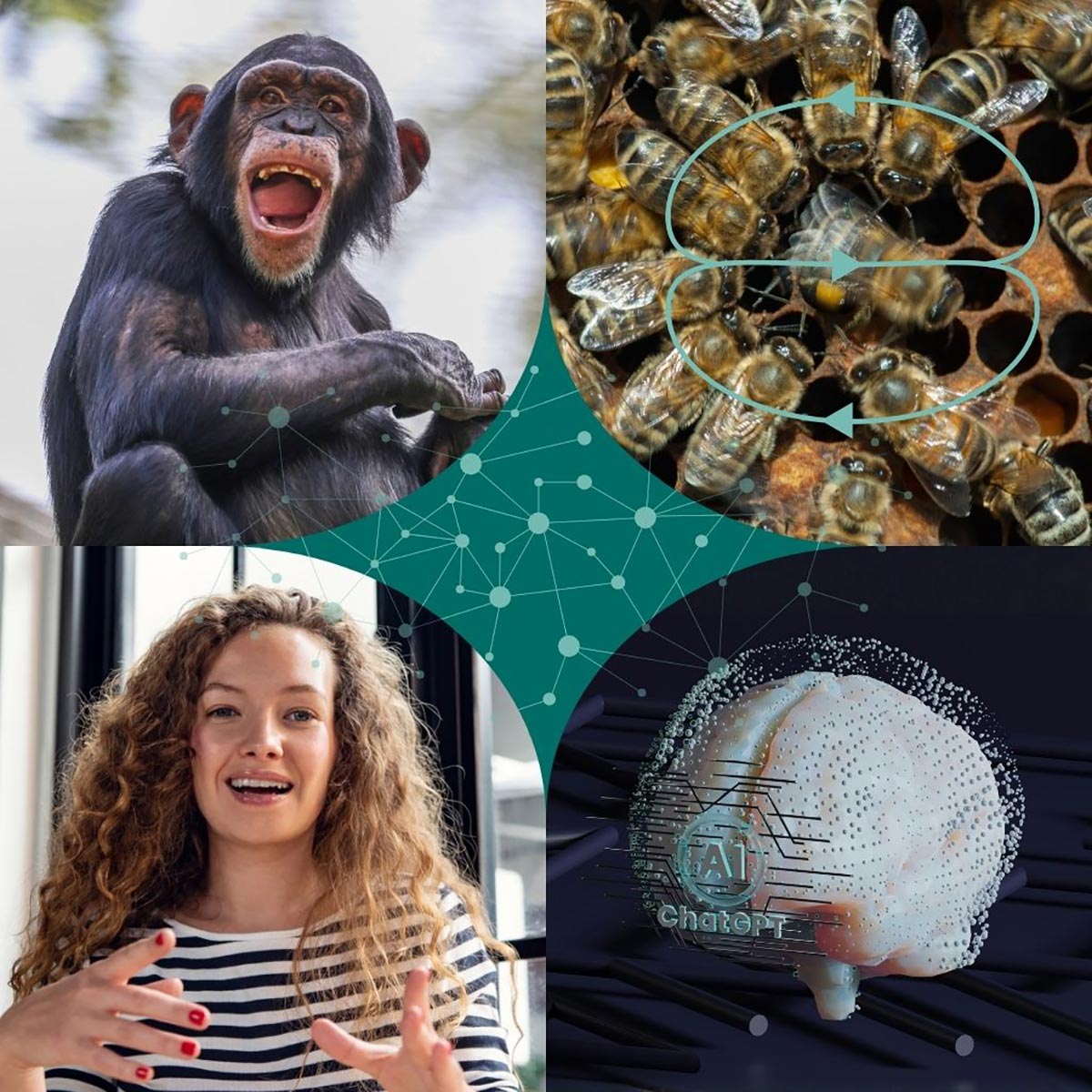
Over the last several decades, scientific discoveries have dramatically expanded our understanding of communication. Language is no longer viewed as something confined to speech. Sign languages used by deaf communities are fully developed linguistic systems, and tactile systems such as Protactile—used by DeafBlind signers in the northwest USA—demonstrate that language can also be conveyed through touch.
Research has also reshaped views of animal communication. Dolphins use distinctive signature whistles, birds produce songs with syntax-like organization, and apes communicate intentionally through context-sensitive gestures. At the same time, the emergence of generative AI has raised new questions about whether language is limited to biological minds at all.
“This isn’t about discarding Hockett,” says Dr. Michael Pleyer, lead author and researcher at Nicolaus Copernicus University in Toruń. “It’s about updating him. His framework was revolutionary in 1960 – but science has moved on. Today, we see that features once thought uniquely human—like productivity (the ability to create an infinite number of sentences), displacement (the ability to talk about things not in the here and now), and even recursive structure (the ability to embed sentences within sentences)—are also found to some extent in animal communication. The real story isn’t about what separates us from other species. It’s about how language, in all its complexity, connects us.”
The interdisciplinary team Pleyer, Perlman, Lupyan, de Reus, and Raviv (2025) proposes a new direction for language science. Rather than treating language as a checklist of defining traits, they describe it as a living, adaptive system shaped by multimodality, social interaction, and cultural evolution.
Beyond the List: A New Vision of Language
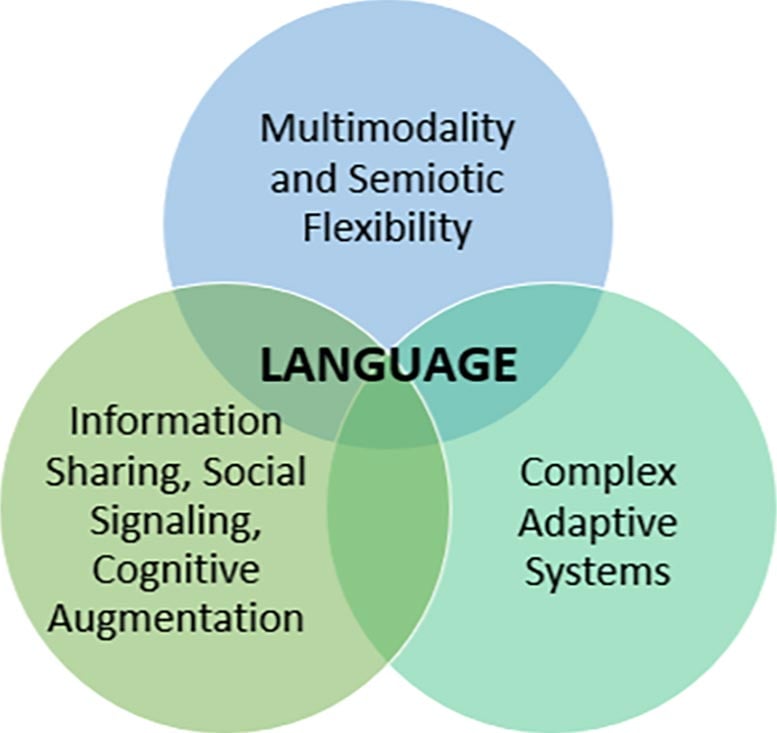
The researchers highlight three major developments that are reshaping linguistic theory and moving it beyond a static feature list.
1. Multimodality and semiotic diversity
Language is not restricted to spoken words. Signed languages function on equal footing with spoken languages, and gestures and facial expressions are integral to everyday communication rather than secondary additions. Furthermore, language is not purely arbitrary.
Iconicity—where form resembles meaning—plays an essential role. Examples include imitative gestures, sound-symbolic words such as ‘buzz’ and ‘crash’, a stretched pronunciation like ‘slooooow’, and even emoji in digital text. This flexibility allows humans to transform almost any behavior into a communicative signal.
2. Language as social and functional
Communication is not simply the transfer of coded information. It involves people building shared meaning within specific contexts. A phrase such as ‘Isn’t that Tom’s bike?’ might signal ‘Let’s meet here’ or ‘Let’s avoid this place,’ depending on shared history and relationships.
Language also conveys identity, sometimes unintentionally, through features such as accent or dialect. It can foster solidarity or create distance. At the same time, language influences cognition; for instance, acquiring a new color term can sharpen a person’s ability to distinguish shades.
3. Language as an adaptive, evolving system
Key properties of language, including productivity and compositional structure, do not simply exist in isolation. They emerge through repeated social interaction and cultural transmission across different timescales, from moment-to-moment exchanges to changes unfolding across generations.
Languages adapt to their social environments, and variations in community structure contribute to the remarkable diversity seen across the world’s languages.
Societal relevance
These insights arrive at a time of major change. Sign languages are increasingly recognized as fully complex languages equal to spoken ones. Animal communication research continues to reveal structured signaling systems involving context, intention, and innovation across birds, dolphins, primates, and even insects. Meanwhile, generative AI systems challenge assumptions about who or what can produce language.
Co-author Dr. Marcus Perlman from the University of Birmingham explains, “The last few decades have been an exciting time for linguistics, especially for those of us interested in the origins of human language. Language scientists today know about lots of stuff that was mostly obscure to scientists back then – for example, huge advances in our understanding of sign languages and now tactile signing systems, and recently, the advent of large language models like ChatGPT. It makes sense that linguistic theory would require a major update.”
The study also carries clear implications for society and education. In particular, it:
- Questions traditional textbook accounts that reduce language to spoken words.
- Recognizes sign languages and non-speech forms of communication as fully legitimate linguistic systems, supporting greater inclusion and equity.
- Provides teachers and educators with an updated framework for discussing language evolution, communication, and cognition in the classroom.
“Language is not a static thing,” adds senior author Dr. Limor Raviv from the Max Planck Institute for Psycholinguistics. “It’s a dynamic, embodied, and deeply social act, which is flexible in form, function, and evolution. When we accept that, we see not just what makes us human—but how we are in fact connected to the wider story of animal communication.”
About the study
The research draws together decades of work from linguistics, cognitive science, animal behavior, and neuroscience. It builds on prior analyses, including a 2022 study showing that Hockett’s design features continue to dominate introductory textbooks, even though growing empirical evidence suggests they no longer provide a complete account of language.
Reference: “The ‘design features’ of language revisited” by Michael Pleyer, Marcus Perlman, Gary Lupyan, Koen de Reus and Limor Raviv, 25 November 2025, Trends in Cognitive Sciences.
DOI: 10.1016/j.tics.2025.10.004
M.Pl. was funded by the National Science Centre, Poland, grant number 2024/53/B/HS2/01366. G.L. was partially funded by NSF-PAC #2020969.
Never miss a breakthrough: Join the SciTechDaily newsletter.
Follow us on Google and Google News.
2 Comments
This is a gross misrepresentation of Hockett. He never claimed all his design features were unique to human language. The majority can be found in other species too. In fact the point of the features was to show the biological continuum of animal and human communication. I agree that what we mean by “language” is more unclear than ever but scientists shouldn’t try to make a name for themselves by setting up strawman fallacies. That has been the logic of linguistic theory for far too long and sadly this appears to be no exception.
I always find it useful to look a little bit at the actual paper in question when I am sceptical of the reporting. For example, the abstract of the paper says that it is the design features “taken together” that “separate language from other communication systems” (which I understand to be Hockett’s position) and later they clarify that “Hockett did not claim that his design features are unique to human language.” and that “Hockett aimed to determine which features are shared with other species and which combination of features
makes human language unique.” So it seems to me the paper itself does not grossly misrepresent Hockett?