

Close Menu
    Facebook X (Twitter) Instagram
    SciTechDaily
    • Biology
    • Chemistry
    • Earth
    • Health
    • Physics
    • Science
    • Space
    • Technology
    Facebook X (Twitter) Pinterest YouTube RSS
    SciTechDaily
    Home»Science»Linguists Tested 191 Universal Grammar Rules. Only One-Third Survived
    Science

    Linguists Tested 191 Universal Grammar Rules. Only One-Third Survived

    By Max Planck SocietyFebruary 23, 20262 Comments4 Mins Read
    Facebook Twitter Pinterest Telegram LinkedIn WhatsApp Email Reddit
    Share
    Facebook Twitter LinkedIn Pinterest Telegram Email Reddit
    Man Speaking Language Letters
    Across thousands of languages spoken worldwide, certain grammatical patterns seem to recur again and again. A new large-scale study applies evolutionary modeling to test whether these similarities reflect deep constraints on language or mere historical coincidence. Credit: Shutterstock

    A new study finds that one-third of proposed grammatical “universals” hold up under rigorous testing.

    Although the world’s languages differ enormously in sound systems, vocabulary, and structure, researchers have long observed that certain grammatical patterns appear repeatedly across cultures. A new study finds that many of these recurring features may be more than a coincidence.

    After applying advanced evolutionary modeling techniques, the researchers report that about one-third of the long-proposed “linguistic universals”—patterns believed to exist across all languages—show clear statistical support.

    The international research team, led by Annemarie Verkerk (Saarland University) and Russell D. Gray (Max Planck Institute for Evolutionary Anthropology), analyzed data from Grambank, the most extensive global database of grammatical features. They tested 191 proposed universals across more than 1,700 languages, making this one of the broadest examinations of cross-linguistic structure to date.

    Moving Beyond Simple Sampling

    In earlier research, linguists often tried to avoid bias by selecting languages from distant regions or unrelated families in order to minimize shared ancestry or regional influence.

    However, simply sampling widely separated languages does not eliminate hidden historical or geographic connections, and it can weaken statistical reliability while offering little insight into how grammatical traits evolved.

    To address these limitations, the team used Bayesian spatio-phylogenetic analyses that explicitly account for both genealogical relationships and geographic proximity among languages. This approach provides a level of statistical rigor rarely achieved in previous work, offering stronger evidence that some grammatical patterns truly recur across human languages rather than arising from shared history alone.
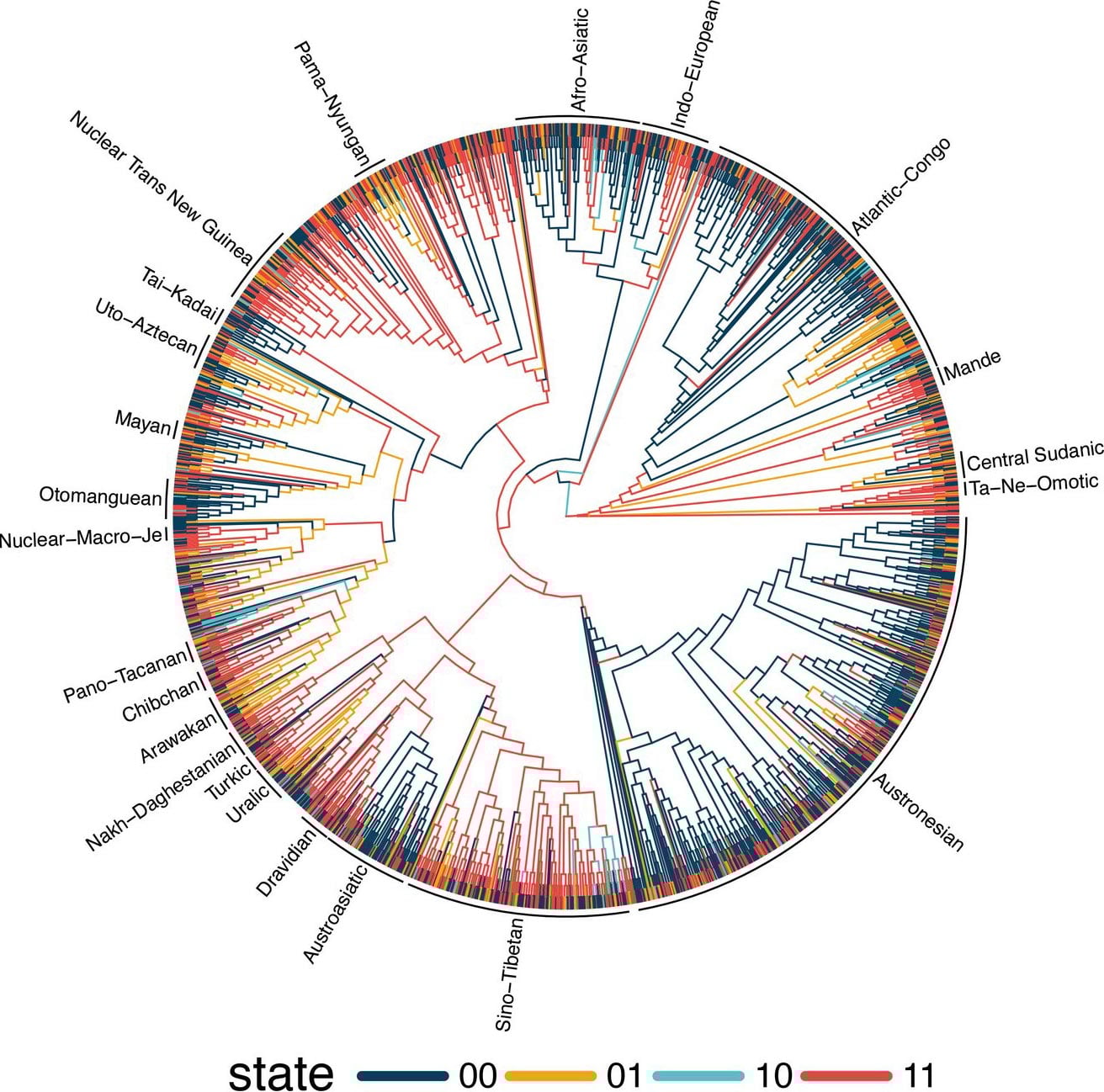
    Global Language Tree Word Order States
    The evolution of a word-order universal on the global language tree. In our analysis of the universal1 “With overwhelmingly greater than chance frequency, languages with normal subject–object–verb order are postpositional”, the absence or presence of the two features defines the ‘state’: state 11 (red) is the prediction made by the universal; in state 00 (black), both features are absent; in states 01 (orange) and 10 (light blue), one feature is absent and the other is present. The ancestral state reconstruction shows that in multiple language families and areas, pathways of language change repeatedly lead to the predicted outcome. Credit: Verkerk et al. (Nature Human Behavior, 2025)

    Languages do not evolve at random

    “In the face of huge linguistic diversity, it is intriguing to find that languages don’t evolve at random,” says Verkerk. “I am delighted that the different types of analyses we did converged on very similar results, suggesting that language change must be a central component in explaining universals.”

    The study found strong evidence for patterns involving word order (such as whether verbs precede or follow objects) and hierarchical universals (such as dependencies in which arguments are marked in grammatical agreement). The patterns predicted by the supported universals have evolved repeatedly across the world’s languages, suggesting deep-rooted constraints in how humans structure communication.

    Senior author Russell Gray reflected, “We discussed whether to write this up as a glass-half-empty paper — ‘look how many proposed universals don’t hold’ — or a glass-half-full paper — ‘there’s robust statistical support for about a third.’ In the end, we chose to highlight the patterns that evolve repeatedly, showing that shared cognitive and communicative pressures push languages toward a limited set of preferred grammatical solutions.”

    By demonstrating which universals truly hold up under evolutionary scrutiny, the study narrows the field for future research into the cognitive and communicative foundations of human language.

    Reference: “Enduring constraints on grammar revealed by Bayesian spatiophylogenetic analyses” by Annemarie Verkerk, Olena Shcherbakova, Hannah J. Haynie, Hedvig Skirgård, Christoph Rzymski, Quentin D. Atkinson, Simon J. Greenhill and Russell D. Gray, 17 November 2025, Nature Human Behaviour.
    DOI: 10.1038/s41562-025-02325-z

    Never miss a breakthrough: Join the SciTechDaily newsletter.
    Follow us on Google and Google News.

    Anthropology Cognitive Science Language Linguistics Max Planck Institute
    Share. Facebook Twitter Pinterest LinkedIn Email Reddit

    Related Articles

    The End of Language As We Know It? Scientists Challenge 60 Years of Linguistic Research

    Writing May Have Begun 40,000 Years Ago

    Have We Been Wrong About Language for 70 Years? New Study Challenges Long-Held Theory

    Why We Don’t Talk Like Computers: Scientists Finally Have an Answer

    Challenging Linguistic Assumptions: Size of Society Doesn’t Dictate Grammar Complexity

    New Hybrid Hypothesis Shakes Up Indo-European Language Origin Theories

    Children with Cochlear Implants Learn Words Faster Than Children With Normal Hearing

    Study Shows Chimps and Infants Want to Punish Antisocial Behavior

    Linguistics Research May Improve Future Internet Search Engines

    2 Comments

    1. Rivegauche on February 25, 2026 11:28 am

      Any average and cursory tour of Reddit proves beyond a shadow of a doubt that people are MORONS. Oops, sorry: “MORON’S”

      Reply
    2. Johan on February 25, 2026 6:26 pm

      Great work! It leaves me wondering if it does not also in a roundabout way provide some support for the Harrisian critique of the “language myth”: these shared patterns are not so much language universals as universal constraining forces on “language” (whatever that is). Grammar is not foundational for languaging but an epiphenomenon arising under epistemically and socially normative constraints.

      Reply
    Leave A Reply Cancel Reply

    • Facebook
    • Twitter
    • Pinterest
    • YouTube

    Don't Miss a Discovery

    Subscribe for the Latest in Science & Tech!

    Trending News

    Scientists Call for a Complete Rethink of Alzheimer’s Treatment

    Scientists Identify Molecular Switch That Lets Exercise Reverse Muscle Aging

    Why Your Most Vivid Dreams Might Be the Key to Deep, Restful Sleep

    A Bright Star Hid a Massive Secret for 50 Years: Mystery of Gamma Cassiopeiae Finally Solved

    Scientists Identify Protein That Slows Key Effects of Aging

    Revolutionary Submarine Mysteriously Disappears Without a Trace – Scientists Are Now Preparing for a Bold Return

    Why Drinking More Water Isn’t Enough To Stop Kidney Stones

    New Study Reveals Surprising Effect of Drinking Coffee at Night

    Follow SciTechDaily
    • Facebook
    • Twitter
    • YouTube
    • Pinterest
    • Newsletter
    • RSS
    SciTech News
    • Biology News
    • Chemistry News
    • Earth News
    • Health News
    • Physics News
    • Science News
    • Space News
    • Technology News
    Recent Posts
    • Your BMI Might Be Wrong: Study Finds Millions Are Misclassified
    • More Than Half of U.S. College Students Are Lonely, Major Study Reveals
    • Scientists Reveal Biological Signal Behind Mysterious Alzheimer’s Drug Side Effect
    • A Simple Blood Test Could Predict Dementia Risk 25 Years Early
    • Scientists Uncover Unexpected Behavior Deep Inside Earth’s Mantle
    Copyright © 1998 - 2026 SciTechDaily. All Rights Reserved.
    • Science News
    • About
    • Contact
    • Editorial Board
    • Privacy Policy
    • Terms of Use

    Type above and press Enter to search. Press Esc to cancel.