
A century-old fossil once thought to be a worm is now rewriting the story of arthropod evolution as the first-known nonmarine lobopodian.
A fossil tucked away in Harvard’s Museum of Comparative Zoology (MCZ) has turned out to be a major find in the story of early animal evolution. First documented in 1865 and mistakenly labeled a caterpillar, the fossil—Palaeocampa anthrax—bounced through several classifications over the years. Scientists variously identified it as a worm, a millipede, and later a type of marine worm called a polychaete. It wasn’t until more than a century later that its true nature came to light: it is the first known lobopodian to have lived outside the ocean, and also the oldest example of its kind.
Lobopodians were soft-bodied, now-extinct animals that represent an evolutionary link between simple worm-like organisms and modern arthropods, which include insects and crustaceans. These ancient creatures are mostly known from marine environments dating back to the Cambrian period. Notable examples like Hallucigenia and Aysheaia pedunculata, both uncovered in 1911 from Canada’s Burgess Shale, reinforced the idea that lobopodians were strictly ocean dwellers. That assumption has now been challenged.
Redefining the Evolutionary Timeline
A new study published in Communications Biology led by Richard Knecht, a former graduate student (PhD ’25) in Harvard’s Department of Organismic and Evolutionary Biology (OEB), redescribes Palaeocampa anthrax as the first nonmarine and youngest lobopodian discovered; predating the famous Burgess Shale lobopodians by nearly fifty years.
“Lobopodians were likely a common sight on Paleozoic sea beds,” said Knecht, “but apart from microscopic tardigrades and terrestrial velvet worms, we thought they were confined to the ocean.”
Knecht, currently a postdoctoral fellow at the University of Michigan and an associate of the MCZ, discovered Palaeocampa while examining fossil millipedes in the MCZ collection. He noted legs on every trunk —ruling out caterpillar or worm—and recognized it as a lobopodian.
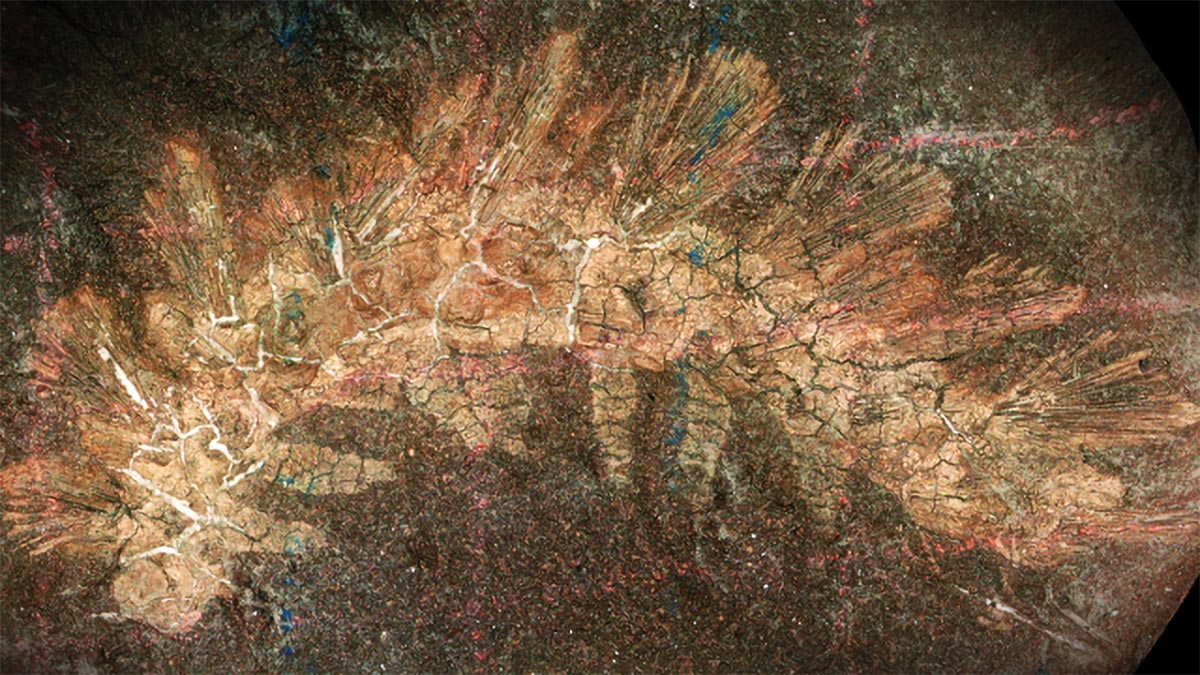
To confirm this, the team analyzed 43 specimens from two Carboniferous Lagerstätten—Mazon Creek (USA) and Montceau-les-Mines (France) —using advanced imaging, including backscatter scanning electron microscopy (SEM) and energy-dispersive spectroscopy. They revealed exquisite anatomical features—most notably, nearly 1,000 bristle-like spines covering the body.
Co-author Nanfang Yu, associate professor of physics at Columbia University, used Fourier-transform infrared spectroscopy (FTIR) to detect chemical residues at the spine tips—suggesting the spines secreted toxins to deter predators in its swampy habitat.
“What amazed me is that fragments of biomacromolecules could be exceptionally preserved or altered to geomacromolecules in fossils,” Yu said. “ I’m thrilled this technique possessed the sensitivity and specificity to differentiate fossilized remains from the rocky substrate.”
A Spiny Survivor From Freshwater Swamps
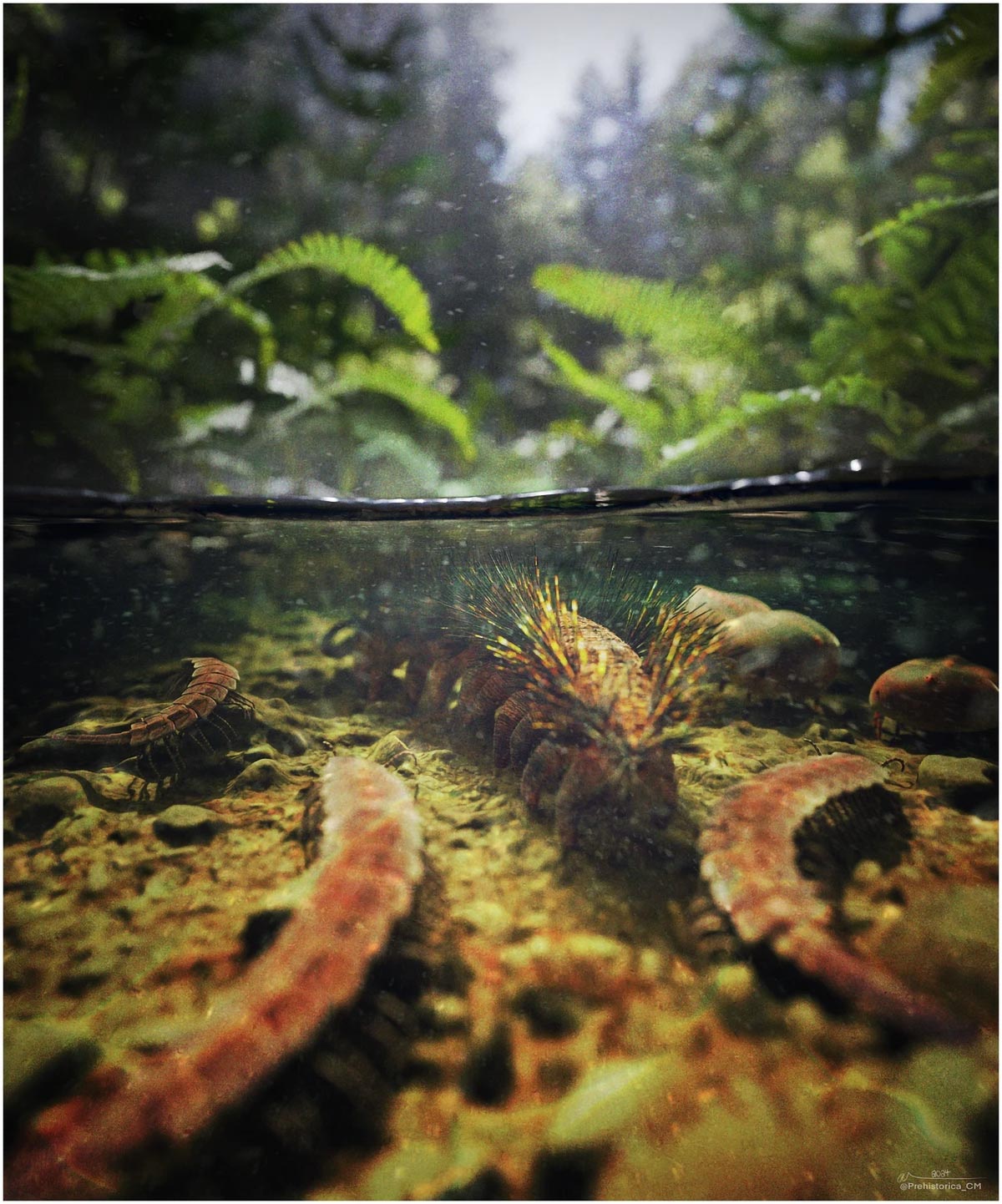
Palaeocampa’s closest relative is Hadranax, a Cambrian lobopodian from Greenland, nearly 200 million years older. Both had ten pairs of legs, no claws, and were blind. But while Hadranax was unarmored and navigated the deep sea using elongated frontal appendages, Palaeocampa, at just four centimeters long, bore a dense coat of spines—arranged above each pair of legs, giving it a fuzzy caterpillar-like appearance—and inhabited freshwater, possibly amphibious, environments.
Palaeocampa’s discovery also resolves the mystery of France’s Montceau-les-Mines fossil site, once considered as marine. “Mazon Creek is a mix of terrestrial, freshwater, and marine animals,” Knecht explained. “But, Montceau-les-Mines, where half of the specimens come from, was hundreds of kilometers inland, with no ocean present.” Its reclassification confirms the site’s nonmarine setting, offering a rare glimpse into ancient freshwater ecosystems.
This discovery broadens our understanding of lobopodian diversity and raises new evolutionary questions: How many others made the leap from marine to freshwater and could more be hiding, misidentified, in museum drawers?
“The conditions required to fossilize soft-bodied creatures like lobopodians are rare,” Knecht noted. “Most of our insights come from Cambrian Lagerstätten, but the Carboniferous period—when Palaeocampa lived—offers far fewer such windows, making every new find incredibly valuable.”
This breakthrough came from reexamining century-old specimens from museums including the MCZ, Yale Peabody Museum, the Smithsonian National Museum of Natural History, France’s Muséum d’histoire naturelle d’Autun, the Chicago Field Museum, and the University of Illinois Urbana-Champaign—highlighting the ongoing scientific value of museum collections.
Ironically, Palaeocampa sat for decades in a drawer just feet from the office of Stephen Jay Gould’s office—MCZ curator and author who popularized the Cambrian oddities in Wonderful Life. “It was literally hiding in plain sight,” Knecht said. “Sometimes, the biggest discoveries are the ones waiting to be looked at again.”
Reference: “Palaeocampa anthrax, an armored freshwater lobopodian with chemical defenses from the Carboniferous” by Richard J. Knecht, Christian R. A. McCall, Cheng-Chia Tsai, Richard A. Rabideau Childers and Nanfang Yu, 23 July 2025, Communications Biology.
DOI: 10.1038/s42003-025-08483-0
Never miss a breakthrough: Join the SciTechDaily newsletter.
Follow us on Google and Google News.