
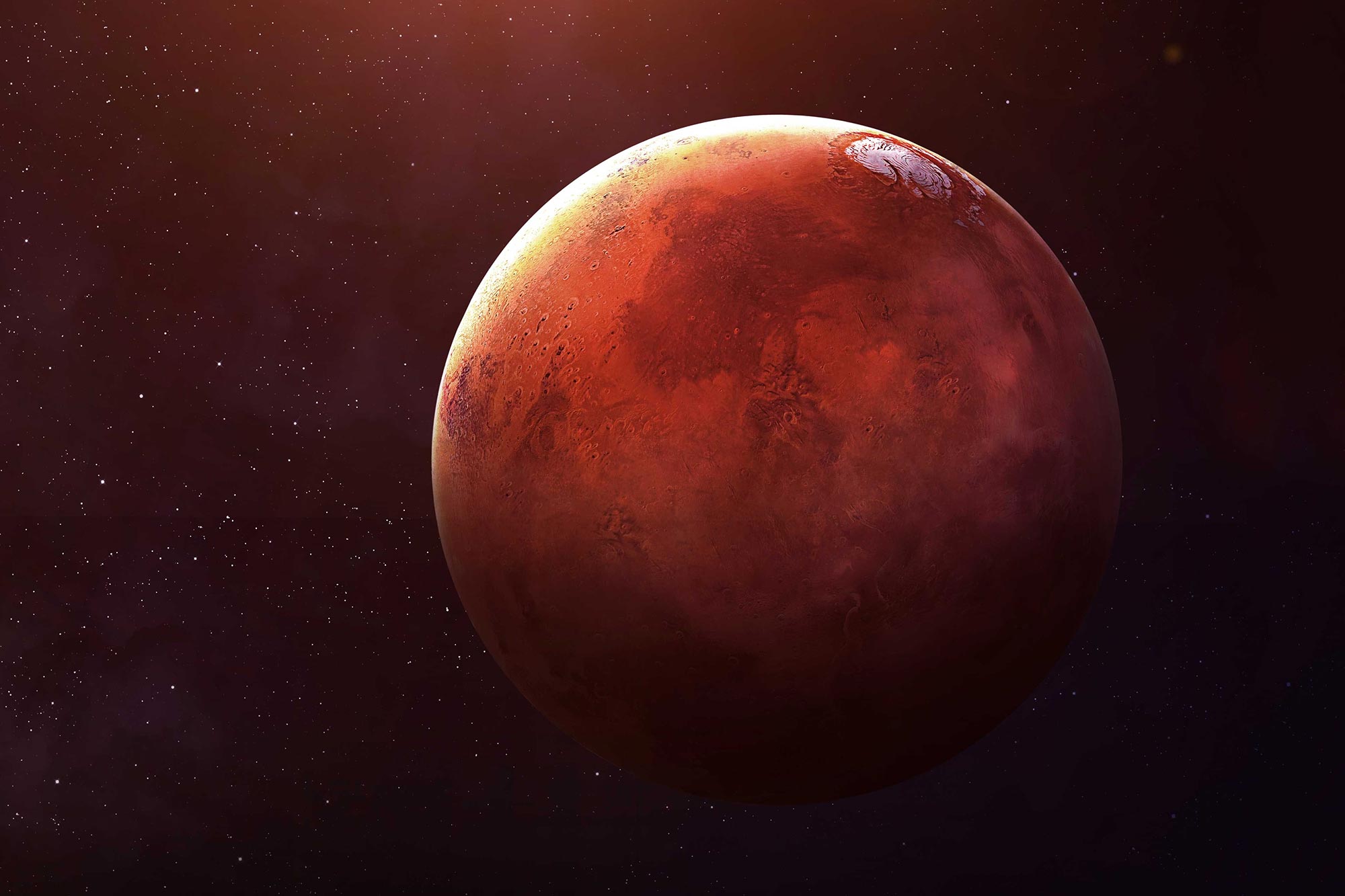
M-MATISSE could be the first mission to deeply probe Martian space weather, potentially revealing hidden threats and mysteries vital to future human exploration.
Preparing to send astronauts to Mars requires a deep understanding of the conditions they will face upon arrival.
A proposed mission known as M-MATISSE could serve as a vital step toward this goal. Highlighted at the Royal Astronomical Society’s National Astronomy Meeting 2025 in Durham, the mission features UK-led instruments and aims to dramatically advance how we study space weather on Mars.
The concept involves launching two robotic orbiters to explore the fourth planet from the Sun. These spacecraft would investigate several layers of Mars’s atmosphere and surrounding environment, including the magnetosphere (the region controlled by the planet’s magnetic field), the ionosphere (a high-altitude layer filled with charged particles), and the thermosphere (where atmospheric gases escape into space). They would also examine conditions in the lower atmosphere and monitor radiation accumulation.
A Safer Pathway to Mars
This, researchers say, could help forecast potentially hazardous situations for spacecraft and astronauts, making it an essential precursor to any future robotic and human exploration.
It will also shed further light on the planet’s habitability.
If the project gets the green light from the European Space Agency (ESA) next year, M-MATISSE would be the first mission solely dedicated to understanding planetary space weather at Mars.
Dr Beatriz Sánchez-Cano, of the University of Leicester, said: “M-MATISSE will provide the first global characterization of the dynamics of the Martian system at all altitudes, to understand how the atmosphere dissipates the incoming energy from the solar wind, including radiation, as well as how different surface processes are affected by space weather activity.
“This is important because understanding the behavior of the Martian system and the chain of processes that control space weather and space climate at Mars is essential for exploration.
“It leads to accurate space weather forecasts (i.e., accurate understanding of solar energy and particles at Mars) and, thus, prevents hazardous situations for spacecraft and humans on the Red Planet, as we well know from Earth space weather monitoring experience.”
Competing for a Launch Slot
M-MATISSE, the ‘Mars Magnetosphere ATmosphere Ionosphere and Space-weather SciencE’, is one of the current three candidates in competition for ESA’s next ‘medium’ mission. It is expected that one candidate mission will be chosen by mid-2026.
Solar Orbiter and Euclid are other examples of flying medium-class ESA missions, while Plato and Ariel are currently being built for launch in the next six years.
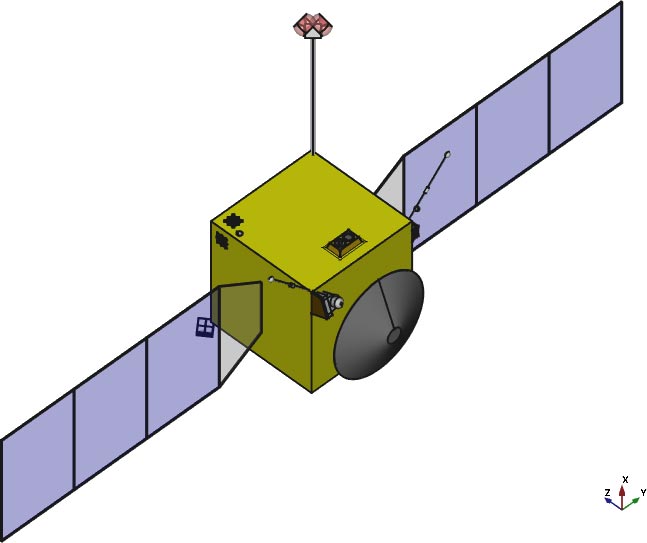
A simulation of the M-MATISSE spacecraft, Henri and Marguerite, exploring the plasma environment around Mars. Credit: M-MATISSE team
If selected, M-MATISSE would study Mars using two identical spacecraft, each carrying an identical set of instruments to observe the Red Planet simultaneously from two different locations in space.
One of the spacecraft, named Henri, would spend most of its time within the Martian plasma system, while the other called Marguerite is intended to mainly be in the solar wind and/or far tail of Mars, a largely unexplored region.
The mission could reveal how the solar wind influences Mars’s atmosphere, ionosphere, and magnetosphere. It also aims to investigate the impact of these interactions on Mars’s lower atmosphere and surface, which is a key aspect to understand the Red Planet’s habitability, as well as the evolution of its atmosphere and climate.
A Leading Role for the UK
Dr Sánchez-Cano, winner of the RAS Fowler Award in 2022, added: “The UK is spearheading this large international effort during the mission selection phase.
“In particular, it is responsible for the particle instrument suite, which will provide the most accurate observations to date of all particles at Mars, including neutrals, ions, and electrons of different energies.
“It is also responsible for the mission Science Centre, where, in coordination with the European Space Agency, the science of the mission will be planned and its data exploitation coordinated.”
Meeting: National Astronomy Meeting 2025
To find out more about the mission concept, visit: https://le.ac.uk/physics/research/space-projects-instrumentation/projects/m-matisse
Never miss a breakthrough: Join the SciTechDaily newsletter.
Follow us on Google and Google News.
1 Comment
When we install enough self-supporting biological life-forms into that Permafrost – there will be an explosion, something tells me none of these people have bothered to even consider.
Think: out of control moldy bread that eats your house. Then your town, then your boots and space suit. Welcome to Mars the uninhabitable planet…