
Close Menu
    Facebook X (Twitter) Instagram
    SciTechDaily
    • Biology
    • Chemistry
    • Earth
    • Health
    • Physics
    • Science
    • Space
    • Technology
    Facebook X (Twitter) Pinterest YouTube RSS
    SciTechDaily
    Home»Space»The Rotation of Venus – Accuracy Critical for Future Lander Missions
    Space

    The Rotation of Venus – Accuracy Critical for Future Lander Missions

    By Harvard-Smithsonian Center for AstrophysicsOctober 22, 2019No Comments3 Mins Read
    Facebook Twitter Pinterest Telegram LinkedIn WhatsApp Email Reddit
    Share
    Facebook Twitter LinkedIn Pinterest Telegram Email Reddit
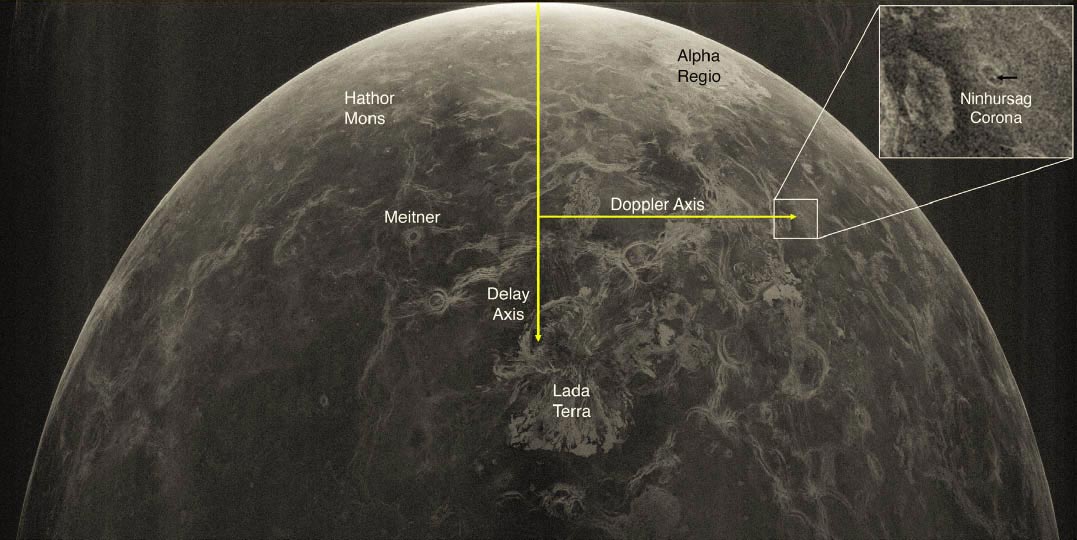
    Venus Surface Radar Image
    A radar image of the surface of Venus showing one of the surface features used to measure a revised value for the length of the Venusian day. Credit: Campbell et al., 2019

    Venus is covered in a thick layer of clouds, which is one reason why it appears so bright in the sky. Ancient astronomers had a good idea of what (since Copernicus) we know as its orbital period — the modern measurement is that Venus takes 224.65 days to complete one revolution around the Sun, a Venusian year. Because of the clouds, however, it has been difficult to measure the length of the Venusian day since the nominal method of watching a visible surface feature rotate around 360 degrees is not possible.

    In 1963, Earth-based radar observations penetrated the cloud cover and were able to measure a rotation rate of 243 days; more surprising is that Venus rotates on its axis in the opposite direction from that of most planets, so-called retrograde rotation. Subsequent ground-based radar studies came up with inconsistent values for the length, differing by about 6 minutes. The Magellan spacecraft completed its 487-day orbital mapping program in 1991 and concluded the correct number was slightly different still: 243.0185 days with an uncertainty of about 9 seconds. But subsequent missions and ground-based observations found that the rate of rotation was actually not constant but seemed to vary, with models arguing that solar tidal torques and atmosphere drag on the surface could account for at least some of the variation.

    Knowing the rotation rate of Venus is critically important for future lander missions to Venus, like ones being considered for the next decade. The current rotation uncertainties correspond to a distance on the surface of about thirteen miles, more than enough to miss a landing site. To try to reduce the uncertainties, CfA astronomer John Chandler and the team of scientists to which he belonged undertook a new analysis of twenty-nine years of Earth-based radar observation taken between 1988 to 2017. They conclude that the mean Venusian day length is 243.0212 +- .00006 days. In particular, their formal uncertainty is the smallest yet obtained, although they note that their result is an average since it does not reflect short-term oscillations. In the next decade, the authors anticipate that further improvements will ensure that a Venus lander mission in the late 2020s will be able to succeed.

    Reference: “The Mean Rotation Rate of Venus from 29 years of Earth-based Radar Observations” by Bruce A. Campbell, Donald B. Campbell, Lynn M. Carter, John F. Chandler, Jon D. Giorgini, Jean-Luc Margot, Gareth A. Morgan, Michael C. Nolan, Phillip J. Perillath and Jennifer L. Whitteni, 19 June 2019, Icarus.
    DOI: 10.1016/j.icarus.2019.06.019

    Never miss a breakthrough: Join the SciTechDaily newsletter.
    Follow us on Google and Google News.

    Astrophysics Harvard-Smithsonian Center for Astrophysics Venus
    Share. Facebook Twitter Pinterest LinkedIn Email Reddit

    Related Articles

    Gamma-Ray Beams Suggest Milky Way’s Central Black Hole Had Active Past

    Calculations Show the Ideal Time to Study the Cosmos

    Using Infrared Images from Hubble & Spitzer, Scientists Discover 25 Distant Galaxies

    Supernova Shock Wave Breaks Through a Cocoon of Gas

    Astronomers Observed Evolved Star Being Devoured

    Rogue Planets Captured by Stars

    Runaway Planets at 30 Million MPH

    Origins of Type Ia Supernovae

    Hubble Reveals GJ1214b is a Waterworld Enshrouded by a Steamy Atmosphere

    Leave A Reply Cancel Reply

    • Facebook
    • Twitter
    • Pinterest
    • YouTube

    Don't Miss a Discovery

    Subscribe for the Latest in Science & Tech!

    Trending News

    Artificial Sweeteners May Harm Future Generations, Study Suggests

    Splashdown! NASA Artemis II Returns From Record-Breaking Moon Mission

    What If Consciousness Exists Beyond Your Brain

    Scientists Finally Crack the 100-Million-Year Evolutionary Mystery of Squid and Cuttlefish

    Beyond “Safe Levels”: Study Challenges What We Know About Pesticides and Cancer

    Researchers Have Found a Dietary Compound That Increases Longevity

    Scientists Baffled by Bizarre “Living Fossil” From 275 Million Years Ago

    Your IQ at 23 Could Predict Your Wealth at 27, Study Finds

    Follow SciTechDaily
    • Facebook
    • Twitter
    • YouTube
    • Pinterest
    • Newsletter
    • RSS
    SciTech News
    • Biology News
    • Chemistry News
    • Earth News
    • Health News
    • Physics News
    • Science News
    • Space News
    • Technology News
    Recent Posts
    • What if Dark Matter Has Two Forms? Bold New Hypothesis Could Explain a Cosmic Mystery
    • Researchers Expose Hidden Chemistry of “Ore-Forming” Elements in Biology
    • Geologists Reveal the Americas Collided Earlier Than We Thought
    • 20x Difference: Study Reveals True Source of Airborne Microplastics
    • Scientists Uncover Hidden Force Powering Yellowstone’s Supervolcano
    Copyright © 1998 - 2026 SciTechDaily. All Rights Reserved.
    • Science News
    • About
    • Contact
    • Editorial Board
    • Privacy Policy
    • Terms of Use

    Type above and press Enter to search. Press Esc to cancel.