
Revolutionizing Lunar Exploration with a Dust Solution
Researchers at Washington State University have developed a liquid nitrogen spray that can effectively eliminate almost all of the simulated moon dust from a space suit, potentially solving a significant challenge for astronauts on future moon missions.
According to the researchers’ report in the journal Acta Astronautica, the sprayer was able to eliminate over 98% of the moon dust simulant in a vacuum environment with little to no harm to the spacesuits, outperforming any previously studied techniques.
The Challenge of Moon Dust
While people have managed to put men on the moon, they haven’t figured out how to keep them clean there. Similar to the clingiest packaging peanuts, moon dust sticks to everything that it touches. Worse than the packing peanuts, the dust is composed of very fine particles that are the consistency of ground fiberglass.
“Moon dust is electrostatically charged, abrasive and gets everywhere, making it a very difficult substance to deal with,” said Ian Wells, first author on the paper and a senior in WSU’s School of Mechanical and Materials Engineering. “You end up with a fine layer of dust as a minimum just covering everything.”
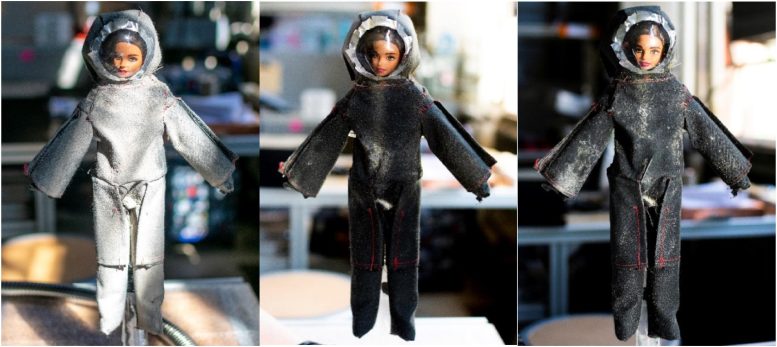
During the six crewed Apollo missions to the moon in the 1960s and early 1970s, astronauts used a brush to try to remove the dust from their spacesuits, but it didn’t work very well. The abrasive and tiny dust particles can get into engines and electronics. They also got into the spacesuits, destroying their seals and making some of the expensive suits unusable. Astronauts also suffered from “lunar hay fever,” and researchers think that a longer exposure to the dust could cause lung damage similar to that of Black Lung Disease.
“It posed a lot of problems that affected the missions as well as the astronauts once they returned home,” said Wells.
The NASA Artemis mission aims to land the first woman and first person of color on the moon in 2025 with the hope of eventually setting up a base camp there for further planetary exploration, so they are interested in finding a solution to the moon dust problem.
The Liquid Nitrogen Solution
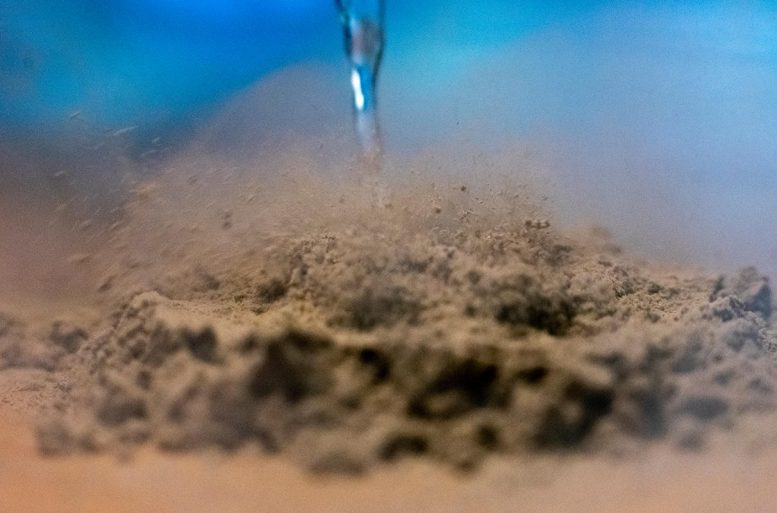
In their work, the research team demonstrated their technology that uses the Leidenfrost Effect to clean the space suits. The effect can be seen when one pours cold water on a hot frying pan, where it beads up and moves across the pan. Spray the very cold liquid nitrogen at a warmer dust-covered material, and the dust particles bead up and float away on the nitrogen vapor.
The team tested their cleaning method under normal atmospheric conditions and in a vacuum that is more similar to outer space with the sprayer performing better in the vacuum atmosphere.
The liquid nitrogen spray was also much gentler on spacesuit materials than other cleaning methods. While a brush caused damage to the spacesuit material after just one brushing, the liquid nitrogen spray took 75 cycles before damage occurred.
A liquid nitrogen spray developed by Washington State University researchers can remove almost all of simulated moon dust from a space suit, potentially solving what is a significant challenge for future moon-landing astronauts. The sprayer removed more than 98% of moon dust simulant in a vacuum environment with minimal damage to spacesuits, performing better than any techniques that have been investigated previously. Credit: WSU
Supported by a NASA grant, the researchers’ innovative cleaning idea took a top prize last year at the agency’s Breakthrough, Innovative and Game-changing (BIG) Idea Challenge. In addition to Wells, undergraduate researchers on the paper included John Bussey and Nathaniel Swets. Jacob Leachman, associate professor in the School of Mechanical and Materials Engineering, led the project.
The researchers are now working to fully understand and model the complex interactions between the dust particles and liquid nitrogen that allows the cleaning process to work. They are also applying for another grant to further test the technology in conditions that more closely approximate outer space, such as in lunar gravity.
Reference: “Lunar dust removal and material degradation from liquid nitrogen sprays” by I. Wells, J. Bussey, N. Swets and J. Leachman, 10 February 2023, Acta Astronautica.
DOI: 10.1016/j.actaastro.2023.02.016
Never miss a breakthrough: Join the SciTechDaily newsletter.
Follow us on Google and Google News.