
A Hidden Pattern of Electrons Could Provide Clues to Exotic Quantum Behavior
Hidden stripes in a crystal could help scientists understand the mysterious behavior of electrons in certain quantum systems, including high-temperature superconductors, an unexpected discovery by RIKEN physicists suggests.
The electrons in most materials interact with each other very weakly. But physicists often observe interesting properties in materials in which electrons strongly interact with each other. In these materials, the electrons often collectively behave as particles, giving rise to ‘quasiparticles’.
“A crystal can be thought of like an alternative universe with different laws of physics that allow different fundamental particles to live there,” says Christopher Butler of the RIKEN Center for Emergent Matter Science.
Quasiparticles in a Nickel Atom Lattice
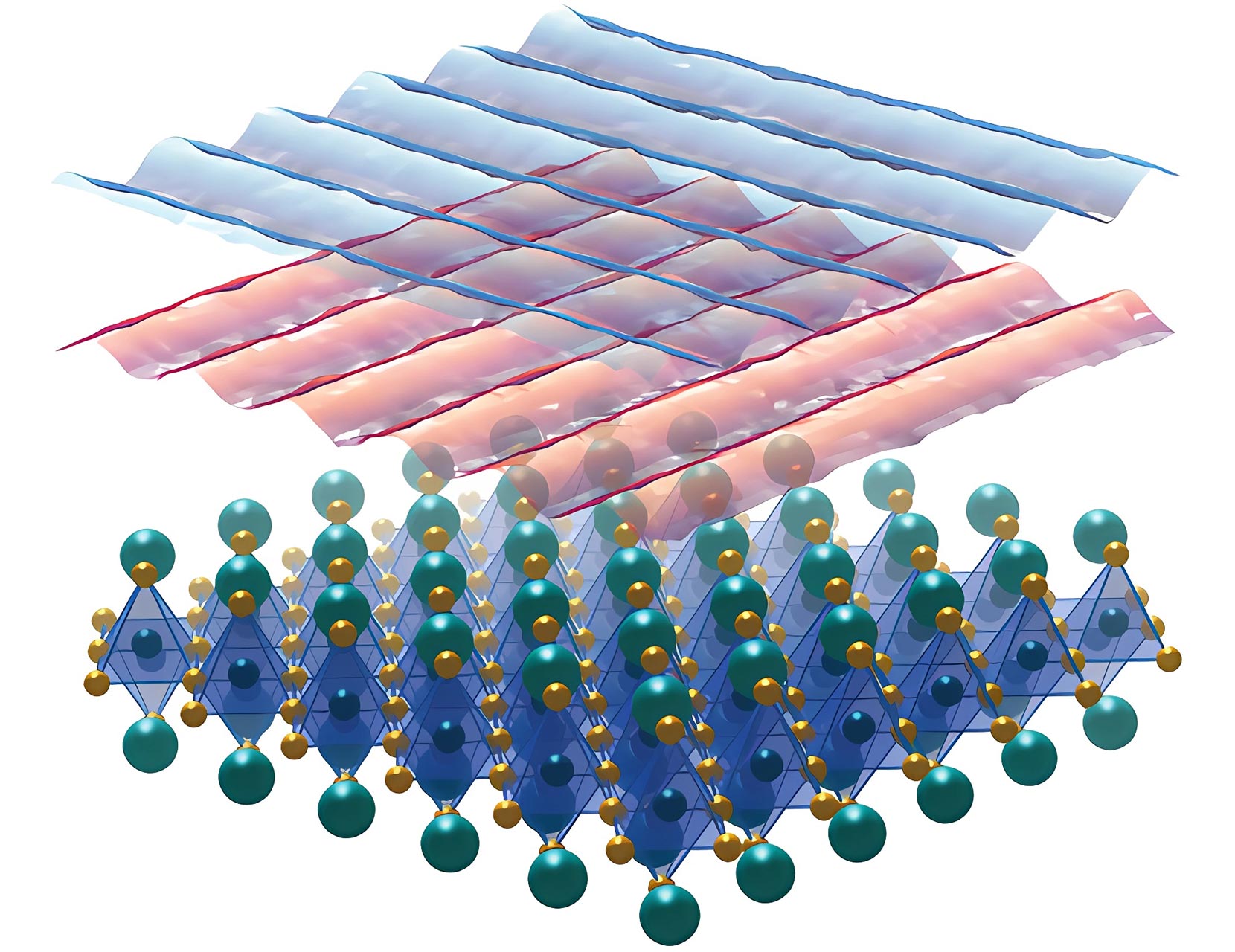
Butler and colleagues examined a crystal in which a layer of nickel atoms was arranged in a square lattice, like a chessboard. Individual electrons have a small mass, but within this crystal, they appeared as massless quasiparticles.
The team set out to examine this odd effect using a scanning tunneling microscope, but this proved challenging. The walnut-sized microscope is housed inside a vacuum chamber, surrounded by a roomful of equipment that creates low temperatures and ultralow pressures comparable to that at the surface of the Moon.
“To examine the pristine surface of these crystals, we try to cleave off a small flake, much as geologists do,” says Butler. “But we have to do this inside the vacuum, and these crystals are so brittle they are prone to explode into dust.”
After numerous attempts, they succeeded and used the microscope to scan the flake with a small needle—like a record player—with a voltage across it. Varying the voltage allowed them to probe different features.
Nematicity in Electrons
The team confirmed the nickel atoms were arranged in a chessboard-like arrangement. But to their surprise, the electrons had broken this pattern and were instead aligned in stripes (Fig. 1). This is called nematicity—where interactions in the system make the electrons display less symmetry than the underlying material.
Butler likens the discovery to standing by a pond and throwing in a pebble. “You’d expect to see circular ripples, so if you saw ripples appearing in parallel lines, you would know something weird is going on,” he says. “It demands an explanation.”
Such experiments will help physicists test different proposed theories for the behavior of quantum systems with many particle interactions, such as high-temperature superconductors. These new results, for instance, fit with predictions made using a ‘density-wave’ framework proposed by the study’s co-authors at Nagoya University in Japan.
The behavior of many interacting electrons is hard to predict even with supercomputers,” says Butler. “But at least we can observe what they are doing under a microscope.”
Reference: “Correlation-driven electronic nematicity in the Dirac semimetal BaNiS2” by Christopher John Butler, Yuhki Kohsaka, Youichi Yamakawa, Mohammad Saeed Bahramy, Seiichiro Onari, Hiroshi Kontani, Tetsuo Hanaguri and Shinichi Shamoto, 2 December 2022, Proceedings of the National Academy of Sciences.
DOI: 10.1073/pnas.2212730119
Never miss a breakthrough: Join the SciTechDaily newsletter.
Follow us on Google and Google News.
2 Comments
According to the gravitational field theory of topological vortex, it is not impossible to speculate the past and build the future.
Certainty and uncertainty are the inherent unity of opposites of matter. Without certainty, there would be no material existence. Without uncertainty, there will be no material movement, and there will be no development, progress and replacement of things. Certainty and uncertainty are inseparable, then material existence and movement are inseparable.