

Scientists have finally uncovered the ancient secret behind the potato’s origin—and it involves an unexpected genetic romance.
About 9 million years ago, a wild interbreeding event occurred between a tomato-like plant and a potato-relative in the Andes. This rare hybridization gave rise to the first tuber-forming plants.
Ancient Hybrid Sparked the Potato’s Origins
An international team of scientists has discovered that the modern potato originated from a natural crossbreeding event between tomato plants and potato-like wild species in South America around 9 million years ago.
Their research, published in the journal Cell, points to this ancient genetic mixing as the trigger for the development of the tuber. Tubers are underground plant structures that store nutrients and are found in crops such as potatoes, yams, and taros.
“Our findings show how a hybridization event between species can spark the evolution of new traits, allowing even more species to emerge,” says corresponding author Sanwen Huang of the Chinese Academy of Agricultural Sciences, China. “We’ve finally solved the mystery of where potatoes came from.”
A Crop with Mysterious Roots
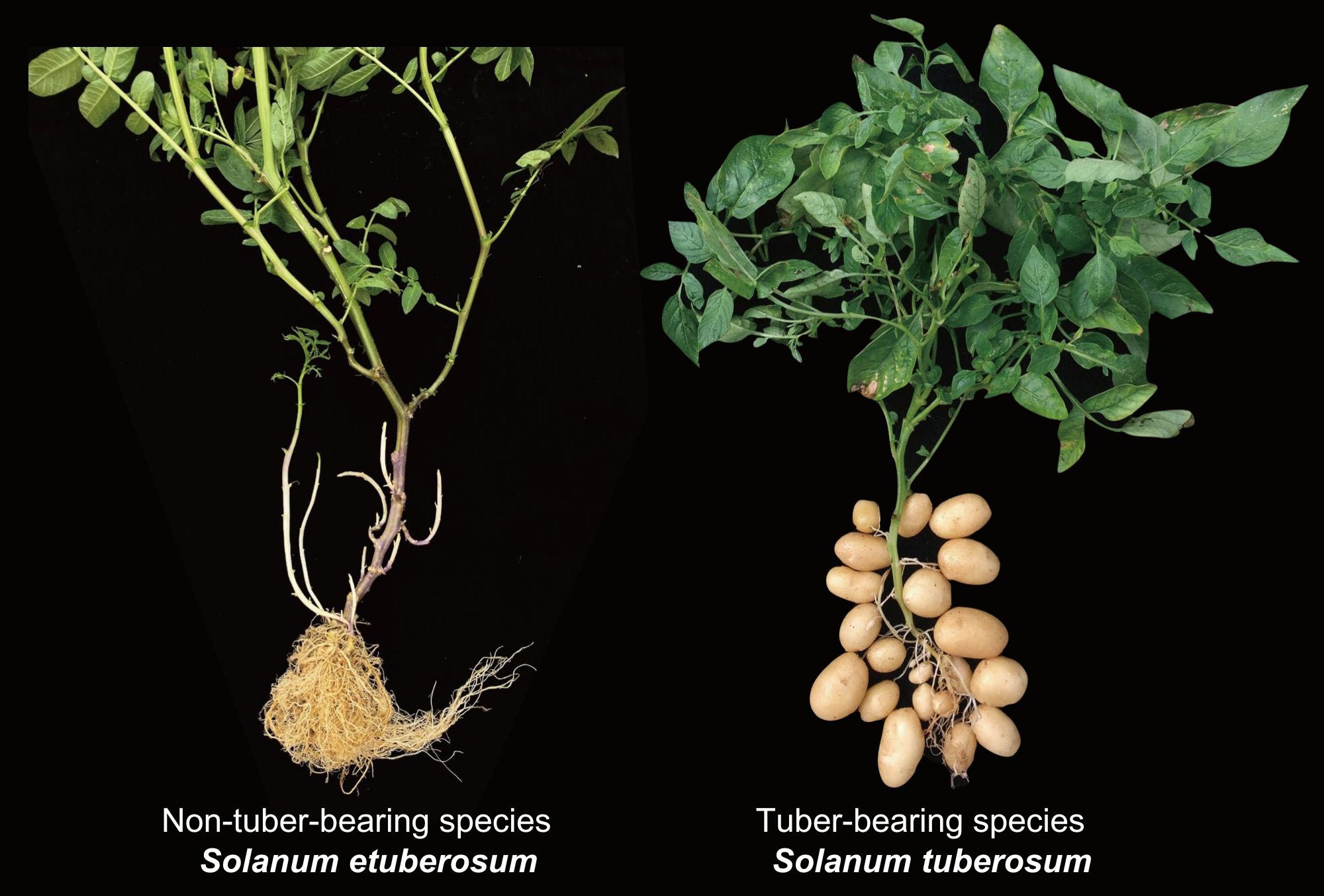
Although potatoes are one of the world’s most essential food crops, their evolutionary origin had remained unclear. Interestingly, modern potato plants closely resemble three Chilean species known as Etuberosum, yet those species do not produce tubers. On the other hand, genetic studies show that potatoes are more closely related to tomatoes.
To resolve this puzzle, the researchers examined genetic data from 450 cultivated potato varieties and 56 wild species.
“Wild potatoes are very difficult to sample, so this dataset represents the most comprehensive collection of wild potato genomic data ever analyzed,” says the paper’s first author, Zhiyang Zhang of the Agricultural Genomics Institute at Shenzhen, Chinese Academy of Agricultural Sciences.
A Genetic Fusion Confirmed
They found that every potato species contained a stable, balanced mix of genetic material from both Etuberosum and tomato plants, suggesting that potatoes originated from an ancient hybridization between the two.
While Etuberosum and tomatoes are distinct species, they share a common ancestor that dates back about 14 million years. Even after diverging for about 5 million years, they were able to interbreed and gave rise to the earliest potato plants with tubers around 9 million years ago.
Key Genes From Both Parents
The team also traced the origins of the potato’s key tuber-forming genes, which are a combination of genetic material from each parent. They found the SP6A gene, which acts like a master switch that tells the plant when to start making tubers, came from the tomato side of the family. Another important gene called IT1, which helps control the growth of the underground stems that form tubers, came from the Etuberosum side. Without either piece, the hybrid offspring would be unable to produce tubers.
This evolutionary innovation coincided with the rapid uplift of the Andes Mountains, a period during which new ecological environments were emerging. With a tuber to store nutrients underground, early potatoes were able to quickly adapt to the changing environment, surviving harsh weather in the mountains.
Tubers also enable potato plants to reproduce without the need for seeds or pollination. They grow new plants by simply sprouting from buds on the tuber. This trait helped them to rapidly expand and fill diverse ecological niches, ranging from mild grasslands to high and cold alpine meadows in Central and South America.
A Rapid Expansion and Global Impact
“Evolving a tuber gave potatoes a huge advantage in harsh environments, fueling an explosion of new species and contributing to the rich diversity of potatoes we see and rely on today,” Huang said.
Reference: “Ancient hybridization underlies tuberization and radiation of the potato lineage” by Zhiyang Zhang, Pingxian Zhang, Yiyuan Ding, Zefu Wang, Zhaoxu Ma, Edeline Gagnon, Yuxin Jia, Lin Cheng, Zhigui Bao, Zinan Liu, Yaoyao Wu, Yong Hu, Qun Lian, Weichao Lin, Nan Wang, Keyi Ye, Hongru Wang, Jinzhe Zhang, Yongfeng Zhou, Liang Liu, Suhua Li, William J. Lucas, Tiina Särkinen, Sandra Knapp, Loren H. Rieseberg, Jianquan Liu and Sanwen Huang, 31 July 2025, Cell.
DOI: 10.1016/j.cell.2025.06.034
Never miss a breakthrough: Join the SciTechDaily newsletter.
Follow us on Google and Google News.