
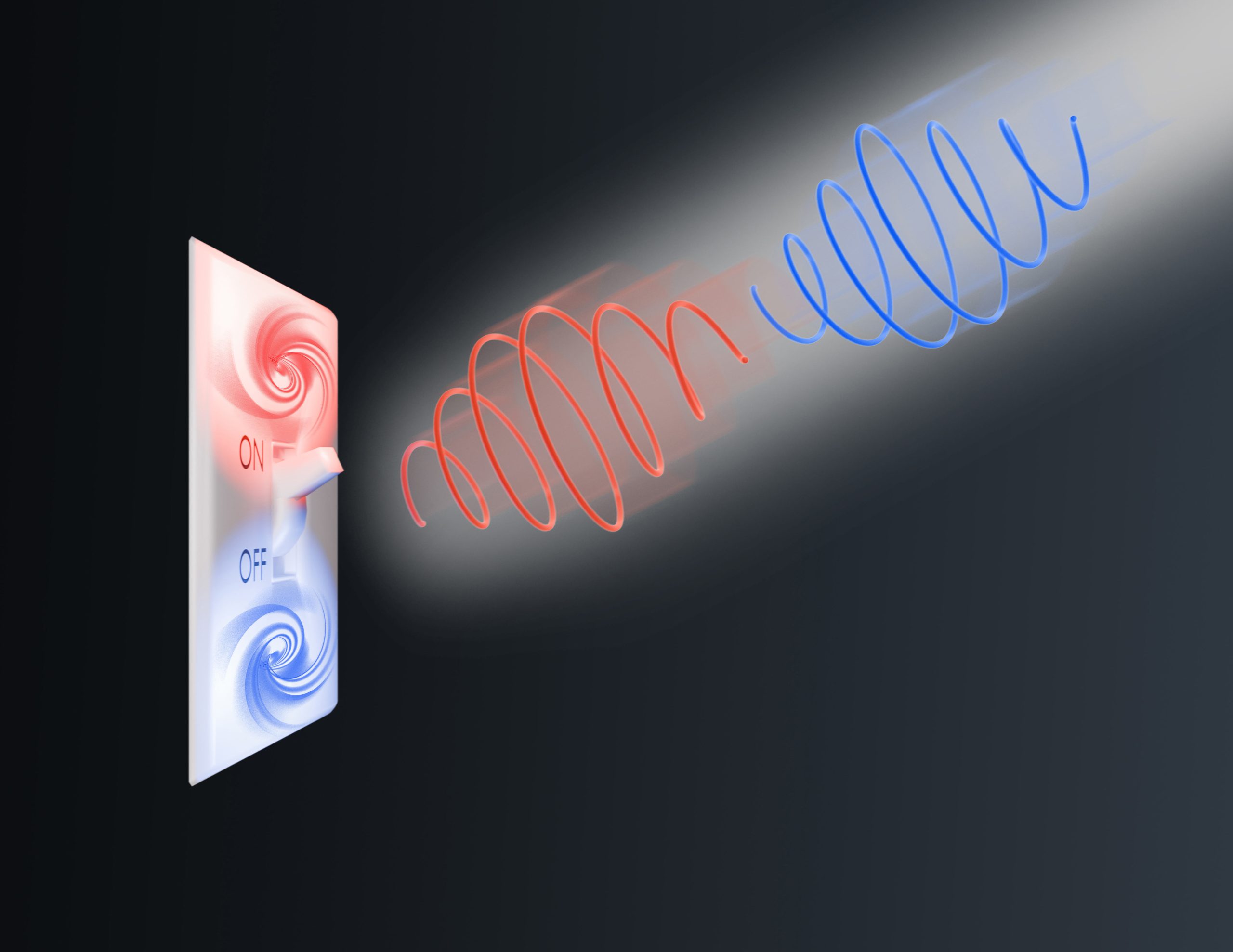
Scientists have discovered a method to switch ultra-stable ferroaxial materials using circular terahertz light, paving the way for next-generation, non-volatile data storage technologies.
Modern life depends on digital technology, where every piece of information is stored using a simple binary code made up of 0s and 1s. This means that any physical system capable of consistently toggling between two stable conditions could, in theory, be used to store digital data.
Ferroic materials are a class of solids that naturally exhibit this property. The best-known examples are ferromagnets, which can align their magnetization in opposite directions, and ferroelectrics, which can maintain opposite electric polarizations. Because these states can be easily changed with magnetic or electric fields, ferroic materials play a central role in current data storage devices and electronic systems.
Despite their usefulness, these materials have notable weaknesses. They can be disturbed by external forces, such as strong magnetic fields near a hard drive, and their performance often declines over time. These limitations have motivated scientists to explore new materials that could lead to more stable and durable data storage solutions.
A New Class of Stability
Ferroaxial materials are a recent addition to the ferroic family. Instead of magnetic or electric states, these solids host vortices of electric dipoles that can be oriented in two opposite directions without creating a net magnetization or electric polarization. These are very stable and are unaffected by external fields, but for the same reason, very difficult to control, which has limited their exploration until now.
The research team, led by Andrea Cavalleri, used circularly polarized terahertz light pulses to switch between clockwise and anti-clockwise ferroaxial domains in a material termed rubidium iron dimolybdate (RbFe(MoO₄)₂).
“We take advantage of a synthetic effective field that arises when a terahertz pulse drives ions in the crystal lattice in circles,” says Zhiyang Zeng, lead author of this work.
“This effective field is able to couple to the ferroaxial state, just like a magnetic field would switch a ferromagnet or an electric field would reverse a ferroelectric state,” he added.
Unlocking Non-Volatile, Ultrafast Data Storage
“By adjusting the helicity, or twist, of the circularly polarized light pulses, we can selectively stabilize a clockwise or anti-clockwise rotational arrangement of the electric dipoles,” continues fellow author Michael Först, “in this way enabling information storage in the two ferroic states. Because ferroaxials are free from depolarizing electric or stray magnetic fields, they are extremely promising candidates for stable, non-volatile data storage.”
“This is an exciting discovery that opens up new possibilities for the development of a robust platform for ultrafast information storage,” says Andrea Cavalleri. “It also shows how circular phonon fields, first achieved in our group in 2017, are emerging as a new resource for the control of exotic materials phases.”
Reference: “Photo-induced nonvolatile rewritable ferroaxial switching” by Z. Zeng, M. Först, M. Fechner, D. Prabhakaran, P. G. Radaelli and A. Cavalleri, 9 October 2025, Science.
DOI: 10.1126/science.adz5230
This work was primarily supported by the Max Planck Society and by the Max-Planck Graduate center for Quantum Materials, supporting collaborations with the University of Oxford. The MPSD is also associated with and receives funding from the Deutsche Forschungsgemeinschaft via the Cluster of Excellence ‘CUI: Advanced Imaging of Matter’. The MPSD is a partner of the Center for Free-Electron Laser Science (CFEL) with DESY and the University of Hamburg.
Never miss a breakthrough: Join the SciTechDaily newsletter.
Follow us on Google and Google News.
3 Comments
By adjusting the helicity, or twist, of the circularly polarized light pulses, that can selectively stabilize a clockwise or anti-clockwise rotational arrangement of the electric dipoles.
VERY GOOD!
Based on the Topological Vortex Theory (TVT), human cognition of nature’s essence is undergoing a profound shift from “universal gravitation” to “universal spin.” This transition not only addresses old theory limitations but philosophically reshapes our cosmic view. Adjusting the circularly polarized light can selectively stabilize a clockwise or anti-clockwise rotational arrangement of the electric dipoles, that show spin phenomena span quantum to classical scales, supporting TVT’s universality.
Topological vortices represent a fascinating intersection of mathematics and physics, providing insights into the behavior of complex systems. Their study not only enhances our understanding of fundamental physical principles but also opens avenues for practical applications in technology and materials science. As research continues, the implications of topological vortices are likely to expand, further enriching the scientific landscape.
The study of topological vortices is deeply rooted in topological invariants and mathematical principles. The Topological Vortex Theory (TVT) integrates concepts from topology and nonlinear dynamics to describe the behavior of vortices across different scales. This theory posits that quantum and classical systems with topological defects can be universally described through a geometric framework, highlighting the role of vortex polarization and topological invariants.
Topological Vortex Theory (TVT) represents a significant paradigm shift in understanding the universe’s fundamental nature, offering new insights into particle physics, quantum mechanics, and materials science. Its mathematical rigor and interdisciplinary applications make it a compelling area of study in modern physics.