
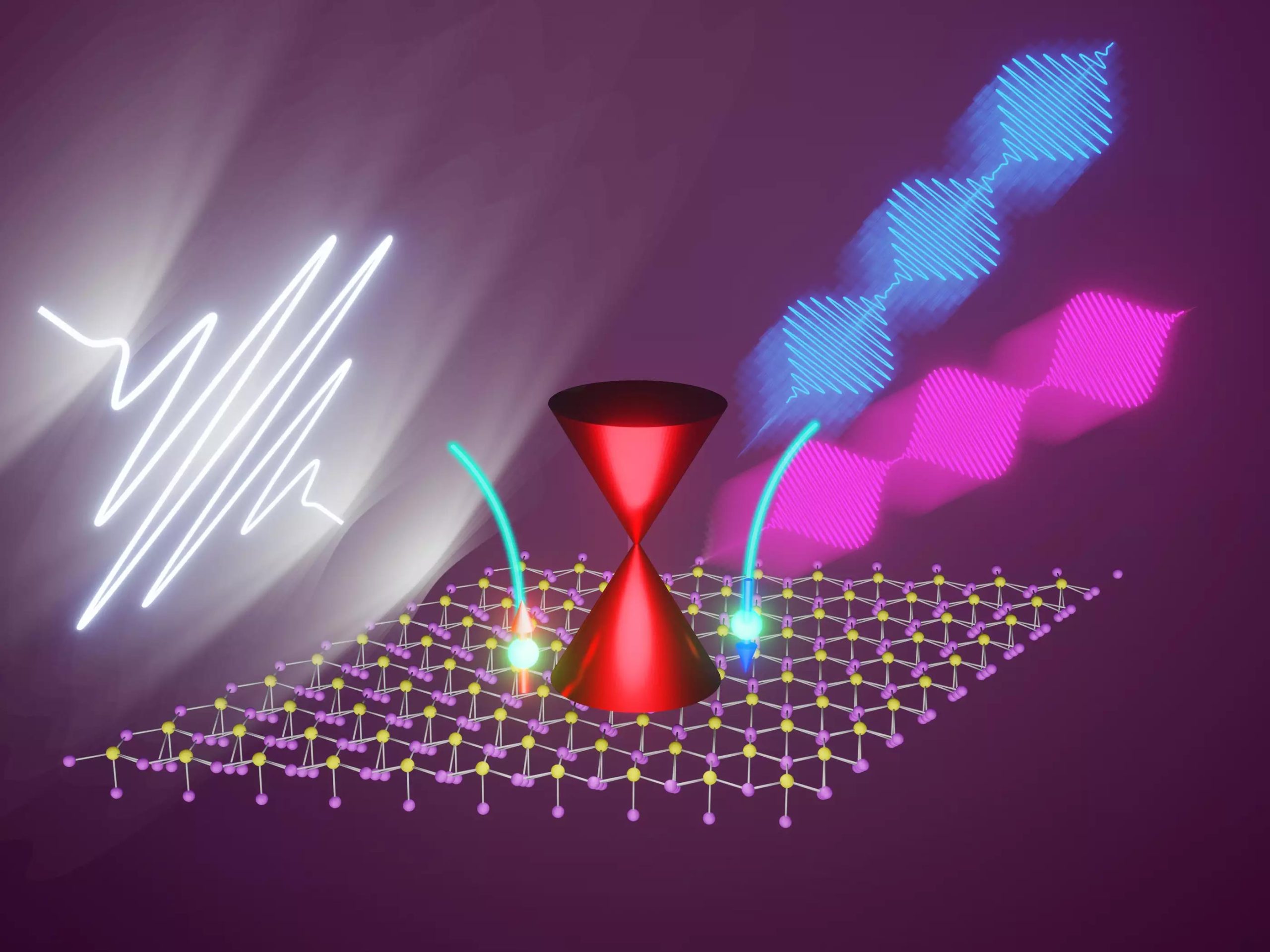
Theoretical physicists at the Max Planck Institute for the Structure and Dynamics of Matter (MPSD) have demonstrated how the coupling between intense lasers, the motion of electrons, and their spin influences the emission of light on the ultrafast timescale.
Electrons, which are present in all kinds of matter, are charged particles and therefore react to the application of light. When an intense light field hits a solid, electrons experience a force, called the Lorentz force, that drives them and induces some exquisite dynamics reflecting the properties of the material. This, in turn, results in the emission of light by the electrons at various wavelengths, a well-known phenomenon called high-harmonic generation.
Exactly how the electrons move under the influence of the light field depends on a complex mixture of properties of the solid, including its symmetries, topology, and band structure, as well as the nature of the light pulse. Additionally, electrons are like spinning tops. They have a propensity to rotate either clockwise or counter-clockwise, a property called the “spin” of the electrons in quantum mechanics.
The Role of Spin and Spin-Orbit Coupling
In a recent study, a team from the MPSD undertook the challenging task of understanding how the light and the spin of the electron can interact in Na3Bi, a topological material known as a Dirac semimetal (the three-dimensional analog of graphene), via an effect known as spin-orbit coupling. This relativistic effect couples the particle’s spin to its motion inside a potential, a potential that intense light can modify on the ultrafast timescale.
A better understanding of how spin-orbit coupling influences the electron dynamics on these timescales is an important step towards understanding the electron dynamics in complex quantum materials, where this effect is often present. Indeed, it is the spin-orbit coupling that often makes quantum materials interesting for future technological applications. It is expected to lead to the next generation of electronic devices, namely topological electronic systems.
The authors show how spin-orbit coupling affects the velocity of the electrons within the electron bands of solids, effectively acting like a magnetic field that depends on the electrons’ spin.
They demonstrate how changes in the electron velocity can affect the electron dynamics in Na3Bi and that this effect can sometimes be detrimental to the generation of high-order harmonics. While this material is non-magnetic, the team has shown that the spin of the electrons is important for the dynamics, as it couples to the potential felt by the electrons, which is modified by the intense applied light-field.
High Harmonic Generation and Spin Dynamics
A further important finding is that the spin-orbit coupling can modify the properties of the emitted high harmonics, for example, their timing. These changes contain crucial information of the internal electron dynamics. In particular, the authors show that the ultrafast spin dynamics, given by the spin current, get encoded in the property emitted light. Given that it is presently challenging to measure spin currents, the present work opens up interesting perspectives towards using intense light to perform high-harmonic spectroscopy of spin currents, as well as magnetization dynamics, or unusual spin textures that can be present in quantum materials.
This work serves as a platform for a better understanding of the link between spin-orbit coupling, spin current, topology, and electron dynamics in solids driven by strong fields – a crucial step towards the development of petahertz electronics based on quantum materials.
Reference: “Effect of spin-orbit coupling on the high harmonics from the topological Dirac semimetal Na3Bi” by Nicolas Tancogne-Dejean, Florian G. Eich and Angel Rubio, 6 July 2022, npj Computational Materials.
DOI: 10.1038/s41524-022-00831-6
Never miss a breakthrough: Join the SciTechDaily newsletter.
Follow us on Google and Google News.