
Cause, Scope Determined for Deadly Winter Debris Flow in Uttarakhand, India
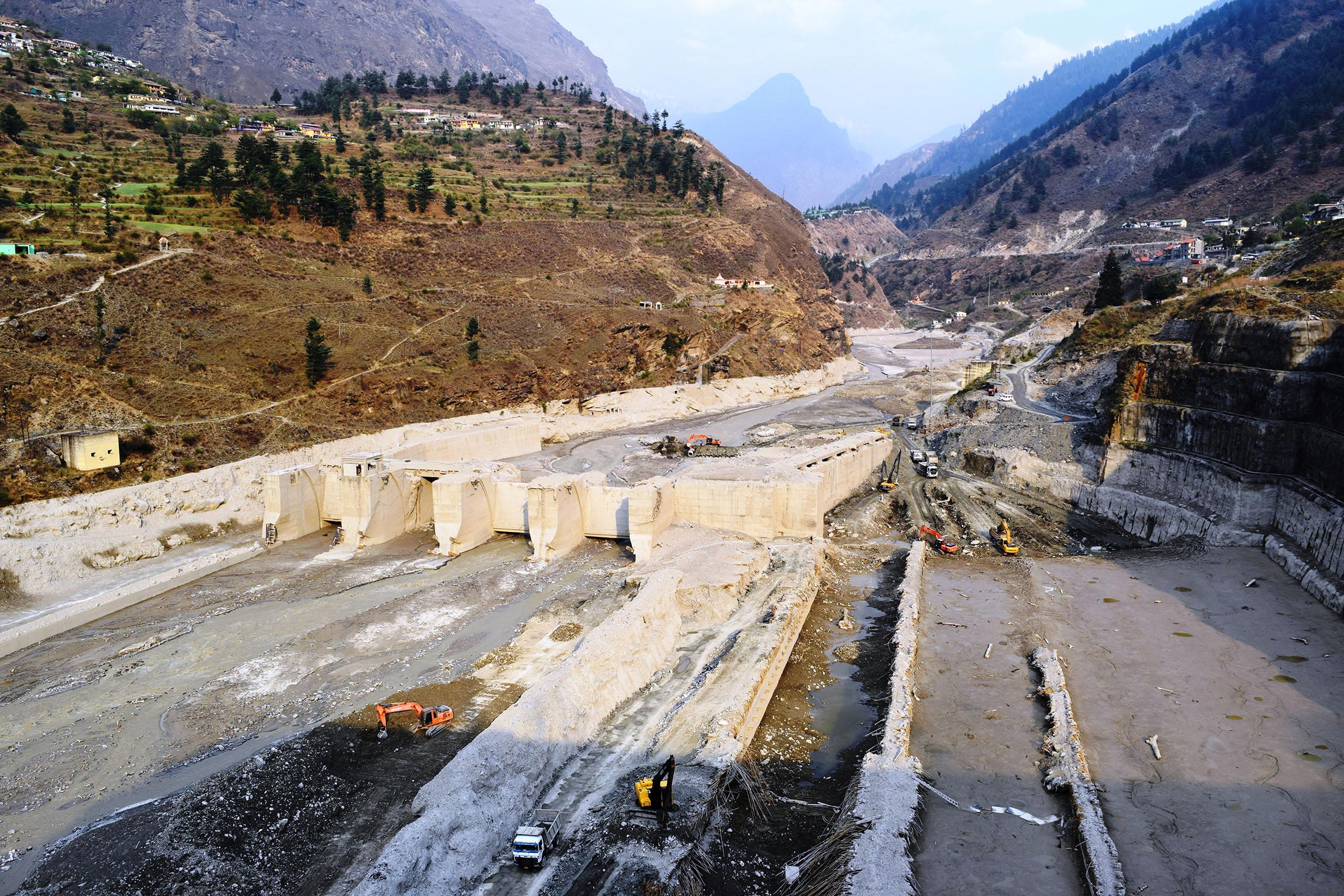
The Uttarakhand region of India experienced a humanitarian tragedy on February 7, 2021, when a wall of debris and water barreled down the Ronti Gad, Rishiganga and Dhauliganga river valleys.
The event began when a wedge of rock carrying a glacier broke off of a steep ridge in the Himalayan mountain range. The resulting debris flow destroyed two hydropower facilities and left more than 200 people dead or missing.
A self-organized coalition of 53 scientists came together in the days following the disaster to investigate the cause, scope, and impacts. The team determined that the flood was caused by falling rock and glacier ice that melted on its descent — not by a lake or diverted river — which will help researchers and policymakers better identify emerging hazards in the region.
The study, which used satellite imagery, seismic records, and eyewitness videos to produce computer models of the flow, will be published today (June 10, 2021) in Science.
“On the morning of the event, I was reading the news over coffee, and saw a headline about a disaster in the Himalayas,” said co-author David Shean, a University of Washington assistant professor of civil and environmental engineering. “I sat down at the computer and pulled up the satellite images that had been acquired that morning. When I saw the dust cloud moving down the valley, I started writing emails to other scientists asking if they were working on this. One email thread quickly became five, then 10, and the response effort consumed most of our waking hours for the next two weeks.”
Initial hypotheses for the cause of the event suggested a glacial lake outburst flood. But there are no glacial lakes large enough to produce a flood anywhere near the site, the team determined.
High-Tech Tools Enable Swift Mapping of the Disaster
“Our access to high-resolution satellite imagery and research software, and our expertise in satellite remote sensing were crucial to get a bird’s-eye view of how the event unfolded,” said co-author Shashank Bhushan, a UW doctoral student in civil and environmental engineering. “We worked with our French collaborators to coordinate satellite collections within days of the event and rapidly process the images to derive detailed topographic maps of the site.”
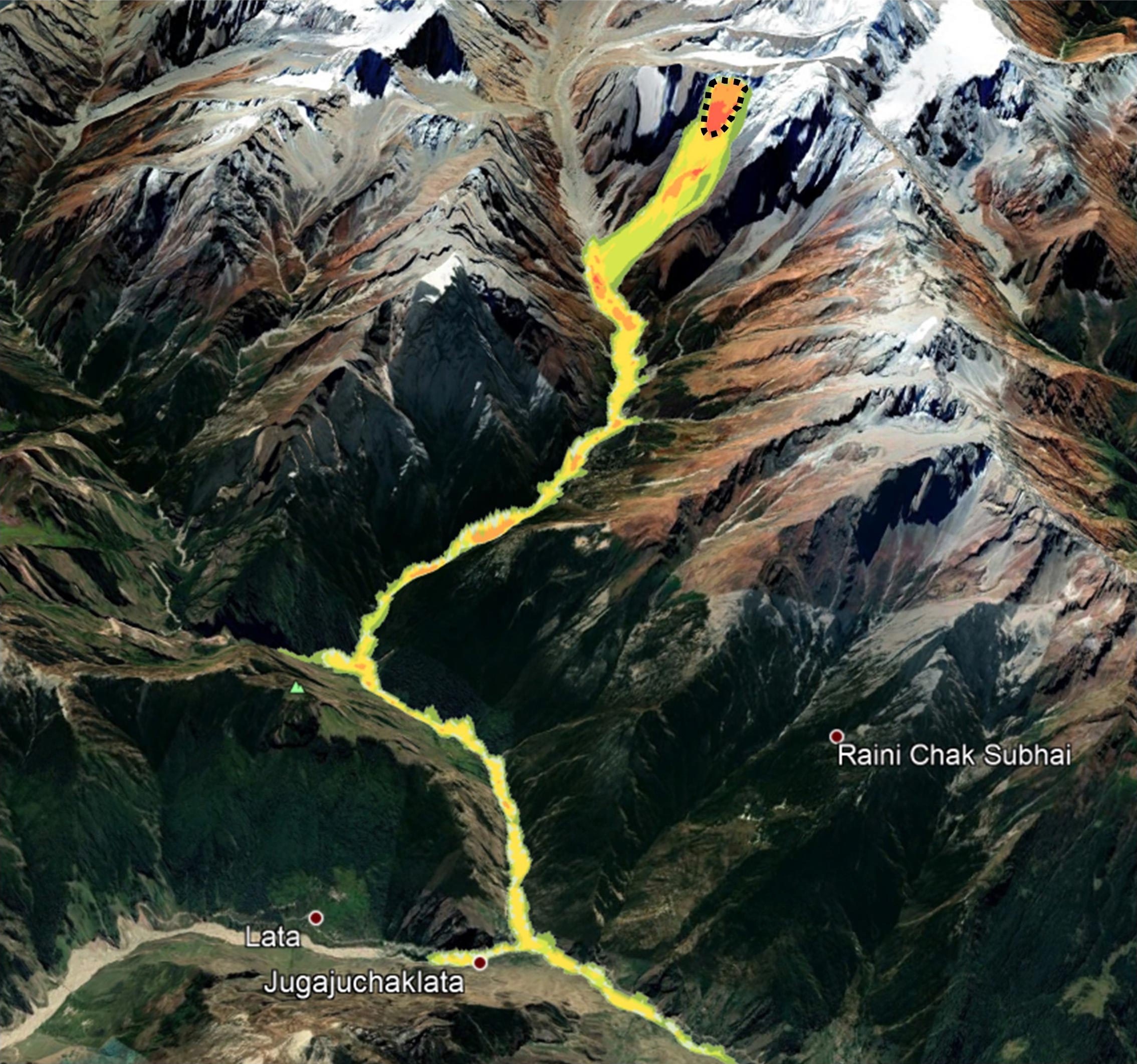
The researchers compared the images and topographic maps from before and after the event to document all of the changes and reconstruct the sequence of events.
“We tracked a plume of dust and water to a conspicuous dark patch high on a steep slope,” said lead author Dan Shugar, associate professor at the University of Calgary.
The dark patch turned out to be the scar left by the 35 million cubic yards of missing rock and glacier ice — enough material to cover Washington, D.C., with a 3-foot-deep layer.
“This was the source of a giant landslide that triggered the cascade of events, and caused immense death and destruction,” said Shugar, who was previously an assistant professor at UW Tacoma.
The researchers also used the maps to determine how far the block of ice and rock fell.
“The failed block fell over a mile before impacting the valley floor. To put this height in context, imagine vertically stacking up 11 Space Needles or six Eiffel Towers,” Bhushan said.
Then the larger team was able to quantify how the pulverized rock and ice were redistributed over the downstream areas.
Instant Ice Melt Fueled the Massive Flood
“As the block fell, most of the glacier ice melted within minutes. This resulted in a huge volume of water associated with the flooding,” Bhushan said. “This is highly unusual — a normal rock landslide or snow/ice avalanche could not have produced such huge volumes of water.”
For Bhushan, the work was personal.
“In general, doctoral research projects are very niche. I sometimes have a hard time explaining to my parents why measuring glacier dynamics is important,” Bhushan said. “But due to the scale of this disaster, my family and friends back in India were very curious to know how this event unfolded, and they were expecting me to come up with an answer. These interactions provided me with a sense of belonging and motivation that some of my research can be of such immediate use to society.”
The team also used satellite image archives to show that previous large ice masses had been dislodged from the same ridge and struck the same valley in recent years. The researchers suggest that climate change is likely increasing the frequency of such events, and that the greater magnitude of the latest disaster should be considered before further infrastructure development in the area.
“These high-mountain rivers are appealing for hydropower projects, and we need a better understanding of the full spectrum of potential high-mountain hazards,” Shean said. “We hope that lessons learned from this effort will improve our ability to respond to future disasters and guide policy decisions that will save lives.”
Reference: “A massive rock and ice avalanche caused the 2021 disaster at Chamoli, Indian Himalaya” by D. H. Shugar, M. Jacquemart, D. Shean, S. Bhushan, K. Upadhyay, A. Sattar, W. Schwanghart, S. McBride, M. Van Wyk de Vries, M. Mergili, A. Emmer, C. Deschamps-Berger, M. McDonnell, R. Bhambri, S. Allen, E. Berthier, J. L. Carrivick, J. J. Clague, M. Dokukin, S. A. Dunning, H. Frey, S. Gascoin, U. K. Haritashya, C. Huggel, A. Kääb, J. S. Kargel, J. L. Kavanaugh, P. Lacroix, D. Petley, S. Rupper, M. F. Azam, S. J. Cook, A. P. Dimri, M. Eriksson, D. Farinotti, J. Fiddes, K. R. Gnyawali, S. Harrison, M. Jha, M. Koppes, A. Kumar, S. Leinss, U. Majeed, S. Mal, A. Muhuri, J. Noetzli, F. Paul, I. Rashid, K. Sain, J. Steiner, F. Ugalde, C. S. Watson and M. J. Westoby, 10 June 2021, Science.
DOI: 10.1126/science.abh4455
Shean, Bhushan and Shugar are joined by 50 additional co-authors from 14 countries. In addition to geoscientists, the co-authors list includes water policy experts and a social scientist. Shean and Bhushan were funded by the NASA High Mountain Asia Team and the Future Investigators in NASA Earth and Space Science Technology fellowship. Other co-authors received funding from a variety of government agencies including those in India, Canada, France, Germany and Switzerland. The satellite imagery the UW team used was provided by MAXAR, Planet, ISRO and CNES, the French government space agency.
Never miss a breakthrough: Join the SciTechDaily newsletter.
Follow us on Google and Google News.