
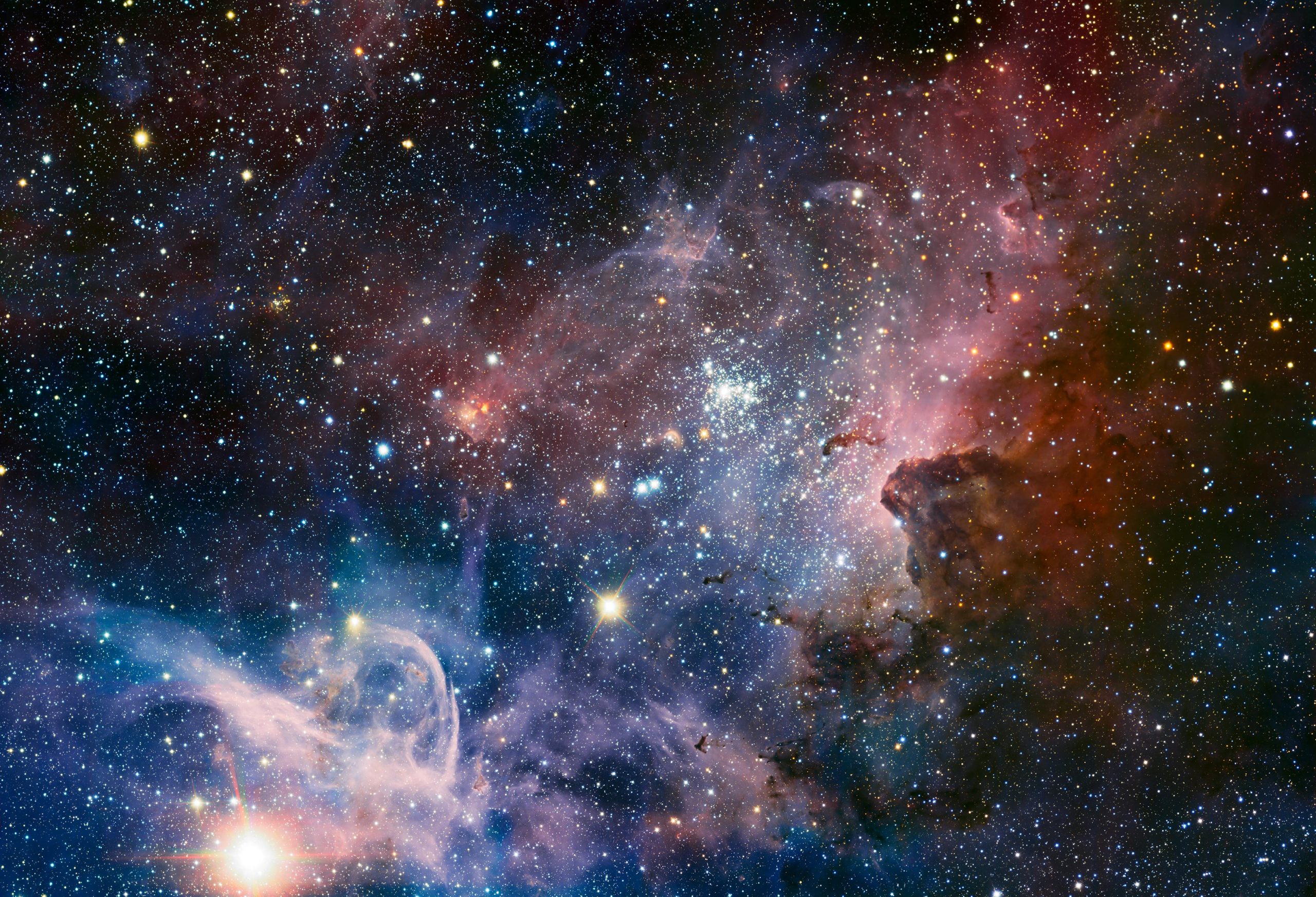
Results from physicists in Bochum have challenged the Standard Model of Cosmology. Infrared data, which have recently been included in the analysis, could be decisive.
Ruhr University Bochum cosmologists headed by Professor Hendrik Hildebrandt have gained new insights into the density and structure of matter in the Universe. Several years ago, Hildebrandt had already been involved in a research consortium that had pointed out discrepancies in the data between different groups. The values determined for matter density and structure differed depending on the measurement method. A new analysis, which included additional infrared data, made the differences stand out even more. They could indicate that this is the flaw in the Standard Model of Cosmology.
Rubin, the science magazine of Ruhr-Universität Bochum, has published a report on Hendrik Hildebrandt’s research. The latest analysis of the research consortium, called Kilo-Degree Survey, was published in the journal Astronomy and Astrophysics in January 2020.

Two methods for determining the structure of matter
Research teams can calculate the density and structure of matter based on the cosmic microwave background, a radiation that was emitted shortly after the Big Bang and can still be measured today. This is the method used by the Planck Research Consortium.
The Kilo-Degree Survey team, as well as several other groups, determined the density and structure of matter using the gravitational lensing effect: as high-mass objects deflect light from galaxies, these galaxies appear in a distorted form in a different location than they actually are when viewed from Earth. Based on these distortions, cosmologists can deduce the mass of the deflecting objects and thus the total mass of the Universe. In order to do so, however, they need to know the distances between the light source, the deflecting object and the observer, among other things. The researchers determine these distances with the help of redshift, which means that the light of distant galaxies arrives on Earth shifted into the red range.
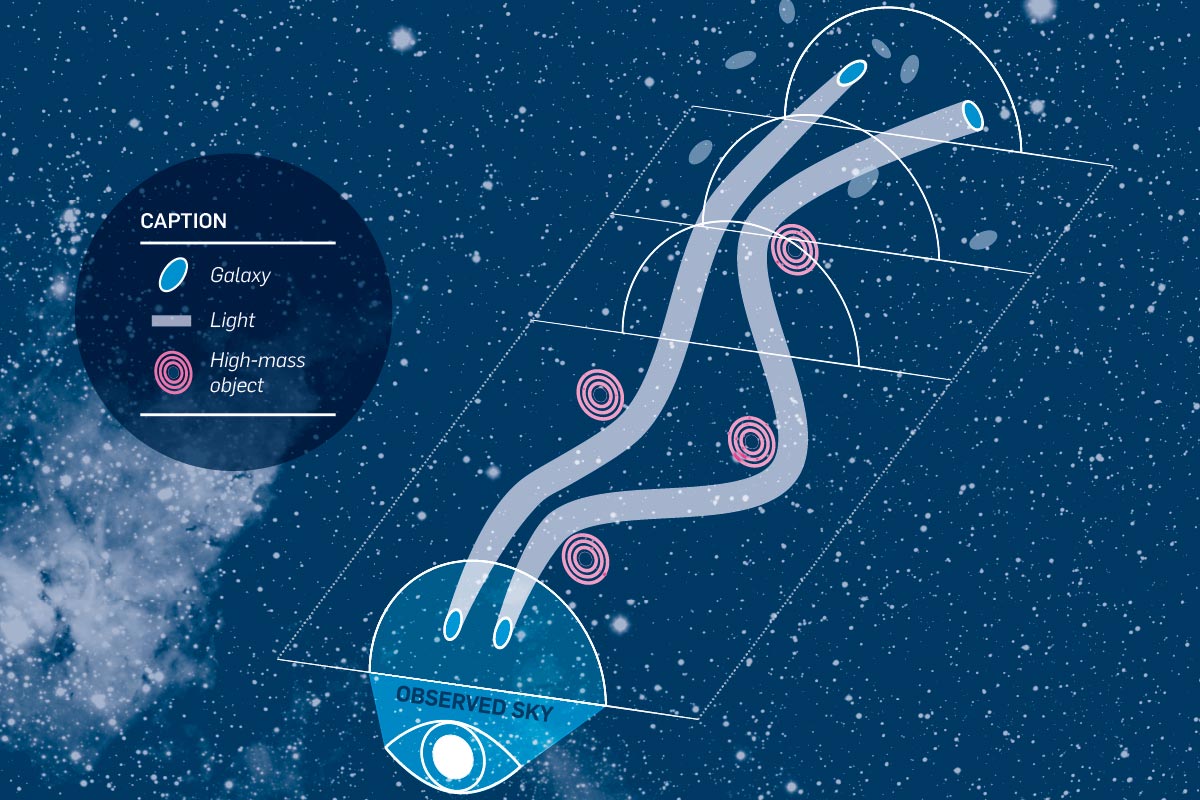
On its way to Earth, the light from the galaxies passes high-mass objects, such as clusters of galaxies that contain large quantities of invisible dark matter. As a result light is deflected, and the galaxies appear distorted when viewed from Earth.
Since the light travels a long way, it is repeatedly deflected by high-mass objects. Light from galaxies that are close to each other mostly passes the same objects and is thus deflected in a similar way.
Neighboring galaxies therefore tend to be distorted in a similar way and point in the same direction, although the effect is exaggerated here. Researchers explore this tendency in order to deduce the mass of the deflecting objects.
Credit: © Agentur der RUB
New calibration using infrared data
To determine distances, cosmologists therefore take images of galaxies at different wavelengths, for example one in the blue, one in the green and one in the red range; they then determine the brightness of the galaxies in the individual images. Hendrik Hildebrandt and his team also include several images from the infrared range in order to determine the distance more precisely.
Previous analyses had already shown that the microwave background data from the Planck Consortium systematically deviate from the gravitational lensing effect data. Depending on the data set, the deviation was more or less pronounced; it was most pronounced in the Kilo-Degree Survey. “Our data set is the only one based on the gravitational lensing effect and calibrated with additional infrared data,” says Hendrik Hildebrandt, Heisenberg professor and head of the RUB research group Observational Cosmology in Bochum. “This could be the reason for the greater deviation from the Planck data.”
To verify this discrepancy, the group evaluated the data set of another research consortium, the Dark Energy Survey, using a similar calibration. As a result, these values also deviated even more strongly from the Planck values.

Debate in expert circles
Scientists are currently debating whether the discrepancy between the data sets is actually an indication that the Standard Model of Cosmology is wrong or not. The Kilo-Degree Survey team is already working on a new analysis of a more comprehensive data set that could provide further insights. It is expected to provide even more precise data on matter density and structure in spring 2020.
Reference: “KiDS+VIKING-450: Cosmic shear tomography with optical and infrared data” by H. Hildebrandt, F. Köhlinger, J. L. van den Busch, B. Joachimi, C. Heymans, A. Kannawadi, A. H. Wright, M. Asgari, C. Blake, H. Hoekstra, S. Joudaki, K. Kuijken, L. Miller, C. B. Morrison, T. Tröster, A. Amon, M. Archidiacono, S. Brieden, A. Choi, J. T. A. de Jong, T. Erben, B. Giblin, A. Mead, J. A. Peacock, M. Radovich, P. Schneider, C. Sifón and M. Tewes, 13 January 2020, Astronomy & Astrophysics.
DOI: 10.1051/0004-6361/201834878
Never miss a breakthrough: Join the SciTechDaily newsletter.
Follow us on Google and Google News.
13 Comments
What Yahoo wrote the title of the article? The reference should be to the mass of the universe, not the weight.
I think it is a jest. The structure parameter s_8 is telling how local gravity condense the cosmic filaments of gas and galaxy clusters later in the universe life, so telling “weight” force analogous to weight force on Earth surface due to gravity acting on mass. But it has nothing to do with the mass of the universe to do as such.
It’s mass of universe not weight unless one is propagating the idea of some thing else.
It is an unfortunate jest (I think), see my response to Robert Jansen.
Weight, mass, who cares? Creationists must make stuff up and the only thing they really care about is their religious beliefs.
Briefly: The red shifts of galaxies and supernovas, and the CMB, are isotropic, and “space itself” or “the spacetime continuum” cannot expand because the Michelson-Morley experiment proved there is no aether.
How do you figure superstitious beliefs in after an article and thread that is devoted entirely to what scientists can observe!?
It is precisely because the Michelson-Morley experiment rejected “an aether” (not “proved” within science, to touch on creationism and their figures of speech again) that helped with discovering relativity.
“The incompatibility of Newtonian mechanics with Maxwell’s equations of electromagnetism and, experimentally, the Michelson-Morley null result (and subsequent similar experiments) demonstrated that the historically hypothesized luminiferous aether did not exist. This led to Einstein’s development of special relativity, which corrects mechanics to handle situations involving all motions and especially those at a speed close to that of light (known as relativistic velocities).” [ https://en.wikipedia.org/wiki/Special_relativity ]
Famously, you immediately get that mass is a form of energy.
By realizing that a complete Lorentzian (relativistic) description is needed for all observers to have the same law, that leads to general relativity.
“Einstein recognized that the general principle of relativity should also apply to accelerated relative motions, and he used the newly developed tool of tensor calculus to extend the special theory’s global Lorentz covariance (applying only to inertial frames) to the more general local Lorentz covariance (which applies to all frames), eventually producing his general theory of relativity.”
[ https://en.wikipedia.org/wiki/General_covariance ]
Famously, you immediately get that kinetic and gravitic mass is the same energy.
So now we have Einstein’s general relativistic equations where space-time curvature balances mass-energy and stress. When these are applied to a universe on large scales (i.e. approximating the particulate matter with a uniform liquid) we get a FLRW universe that describe the most obvious property of the universe – it can expand. In fact, such universes must either collapse or expand since a scale balance is unstable, which Einstein himself discovered.
“The Friedmann–Lemaître–Robertson–Walker (FLRW) metric is an exact solution of Einstein’s field equations of general relativity; it describes a homogeneous, isotropic, expanding (or otherwise, contracting) universe …”
“This model is sometimes called the Standard Model of modern cosmology,[4] although such a description is also associated with the further developed Lambda-CDM model.”
[ https://en.wikipedia.org/wiki/Friedmann%E2%80%93Lema%C3%AEtre%E2%80%93Robertson%E2%80%93Walker_metric ]
So this non-quantified, unreferenced made up claim of yours do not pass the smell test when looking up these things in a well referenced encyclopedia – it is wrong.
Having said that, I,m not sure if you recognize that your claim is wrong. Are you interested in nature and so science, i.e. can you tell us what would convince you that you are wrong? If you can’t, your’s is not a science position, and you should perhaps comment elsewhere.
The result is not statistically significant.
We dont seam to know the mass of the Universe, cause it is always changeing.?!
The Weight of our Universe is changeing to! But an agreed on guess is 13.85 Billion
Years , Give or take! Thats a long wait, the other weight depends on the gravity of what world, or what Black Hole you pick to use.
The s_8 local “weight” parameter is changing over time, but the matter content – roughly, the number of protons – is roughly constant.
I would like to hear some news about time. It seems to me that particles and space are the focus of most studies. Although Einstein’s work relative to time dilation associated with the speed of light, there seems to be little further scientific interest relative to time. It seens clear from his work that evert point in space also a point in time, Further every body of matter is located in a unique point in time. consequently every body of matter is in the past relative to a given body of matter.
So what’s the mass of space itself not the mass in it. Galaxies move not away from each other or towards but simply move this way that way. Now the matter that’s in space that’s a different question? The weight of galaxies differ depending on their age how much they eat so to try and come up with a number is a Noble attempt but futile. Space I think has great mass and we no this by watching how things move out in the space. And I believe that space has an over all structure that changes with the magnetic fields as they would increase or decrease with mergers. What I mean is space is all around everything yet when magnetism is introduced it pushes space like the blackspheres in the middle of galaxies keeps the space at bay so we can exist as a star on its own merits cannot. We live in a magnetic bubble and everything that’s alive out in the space live in one. So when a blacksphere stops eating the space starts to push back. And then you get a collapse and the galaxie is no more . If we know anything we know the space keeps repeating itself as it breaks down all the matter in it. Till the universe flatlines does it start again or does it just keep humming? Or does it start to break down the remaining (what)?
So what I’m wondering is this when the space starts to push back does the blacksphere in the center of galaxies start the star making process intentionally to intensify its magnetic field. Does it happen only when it needs it or is it spontaneous I’m starting to think it’s done only when it’s needed to stabilize the fields as to not use it’s gas until it’s needed hence the great ages of galaxies. Can blacksphere’s feel the space trying to consume them and when it gets to the tipping point star formation is once again activated kinda like a safety valve of sorts? Is that’s why some galaxies slow that process and some speed up star formation is it a matter of survival?
I’m also wondering if the magnetic fields from a blacksphere are attractive in nature. As they pull the matter they created back onto them selves. What I mean is does it change depending on the distance from it. So when your up tight to one it makes an event horizon to keep you out but when your at distance it holds you in a circular pattern. Is it possible that blacksphere’s have a negative force and it’s the event horizon that’s pulling on matter and that’s why there’s a sweet spot between the sphere and the horizon that seems calm. So the sphere is actually pushing matter away while the horizon is pulling. And that’s why you get the pole jets cause the sphere doesn’t want it so it sends it away through the poles? And it’s actually the negative charge from the sphere that makes the horizon heat up as it tries to force matter on to the sphere. What if the spheres are cold?