
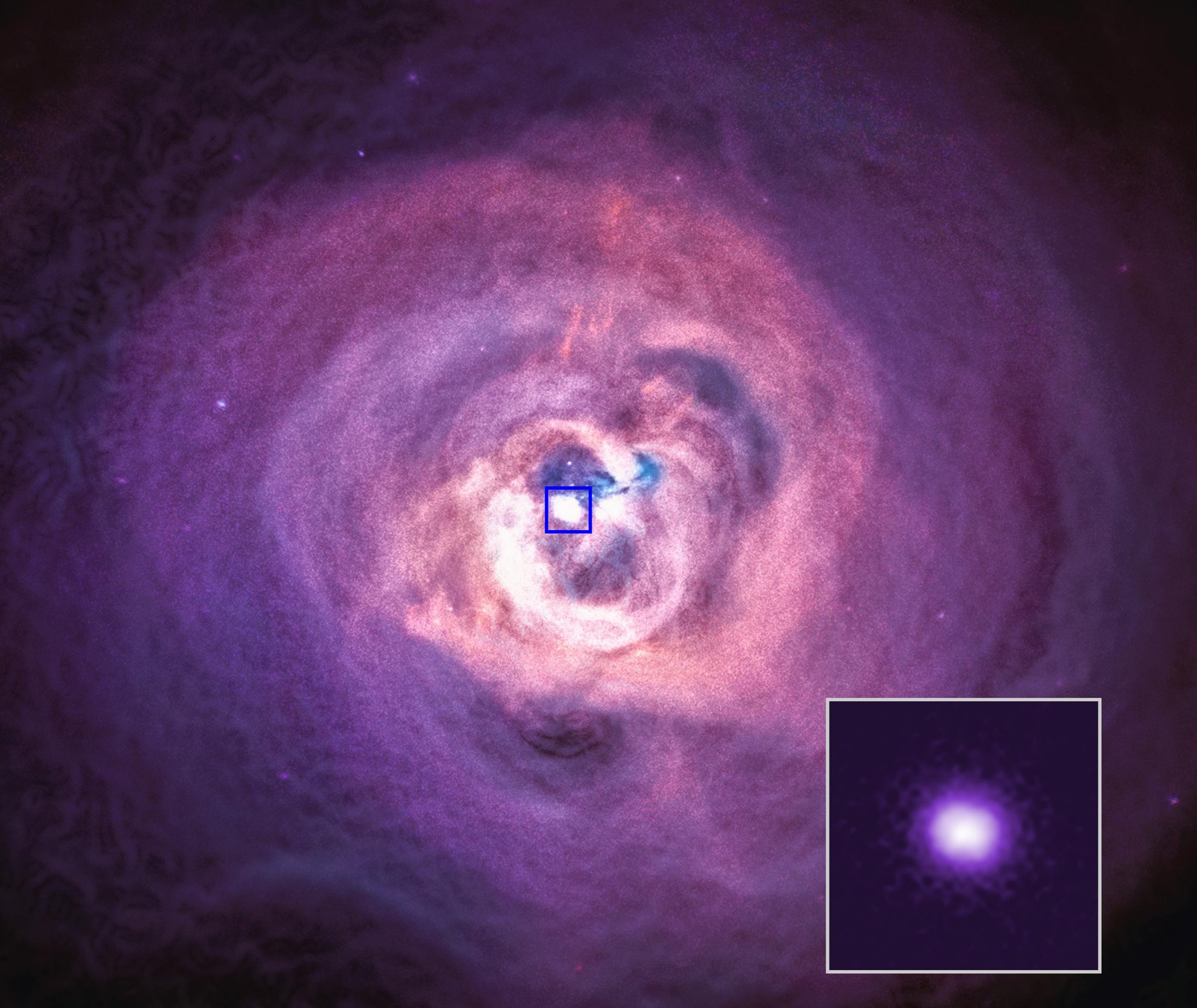
Astronomers used Chandra to perform a test of string theory, a possible “theory of everything” that would tie all of known physics together.
One of the biggest ideas in physics is the possibility that all known forces, particles, and interactions can be connected in one framework. String theory is arguably the best-known proposal for a “theory of everything” that would tie together our understanding of the physical universe.
Despite having many different versions of string theory circulating throughout the physics community for decades, there have been very few experimental tests. Astronomers using NASA’s Chandra X-ray Observatory, however, have now made a significant step forward in this area.
By searching through galaxy clusters, the largest structures in the universe held together by gravity, researchers were able to hunt for a specific particle that many models of string theory predict should exist. While the resulting non-detection does not rule out string theory altogether, it does deliver a blow to certain models within that family of ideas.
“Until recently I had no idea just how much X-ray astronomers bring to the table when it comes to string theory, but we could play a major role,” said Christopher Reynolds of the University of Cambridge in the United Kingdom, who led the study. “If these particles are eventually detected it would change physics forever.”
The particle that Reynolds and his colleagues were searching for is called an “axion.” These as-yet-undetected particles should have extraordinarily low masses. Scientists do not know the precise mass range, but many theories feature axion masses ranging from about a millionth of the mass of an electron down to zero mass. Some scientists think that axions could explain the mystery of dark matter, which accounts for the vast majority of matter in the universe.
One unusual property of these ultra-low-mass particles would be that they might sometimes convert into photons (that is, packets of light) as they pass through magnetic fields. The opposite may also hold true: photons may also be converted into axions under certain conditions. How often this switch occurs depends on how easily they make this conversion, in other words on their “convertibility.”
Some scientists have proposed the existence of a broader class of ultra-low-mass particles with similar properties to axions. Axions would have a single convertibility value at each mass, but “axion-like particles” would have a range of convertibility at the same mass.
“While it may sound like a long shot to look for tiny particles like axions in gigantic structures like galaxy clusters, they are actually great places to look,” said co-author David Marsh of Stockholm University in Sweden. “Galaxy clusters contain magnetic fields over giant distances, and they also often contain bright X-ray sources. Together these properties enhance the chances that conversion of axion-like particles would be detectable.”
To look for signs of conversion by axion-like particles, the team of astronomers examined over five days of Chandra observations of X-rays from material falling towards the supermassive black hole in the center of the Perseus galaxy cluster. They studied the Chandra spectrum, or the amount of X-ray emission observed at different energies, of this source. The long observation and the bright X-ray source gave a spectrum with enough sensitivity to have shown distortions that scientists expected if axion-like particles were present.
The lack of detection of such distortions allowed the researchers to rule out the presence of most types of axion-like particles in the mass range their observations were sensitive to, below about a millionth of a billionth of an electron’s mass.
“Our research doesn’t rule out the existence of these particles, but it definitely doesn’t help their case,” said co-author Helen Russell of the University of Nottingham in the UK. “These constraints dig into the range of properties suggested by string theory, and may help string theorists weed their theories.”
The latest result was about three to four times more sensitive than the previous best search for axion-like particles, which came from Chandra observations of the supermassive black hole in M87. This Perseus study is also about a hundred times more powerful than current measurements that can be performed in laboratories here on Earth for the range of masses that they have considered.
Clearly, one possible interpretation of this work is that axion-like particles do not exist. Another explanation is that the particles have even lower convertibility values than this observation’s detection limit, and lower than some particle physicists have expected. They also could have higher masses than probed with the Chandra data.
A paper describing these results appeared in the February 10th, 2020 issue of The Astrophysical Journal. In addition to Reynolds, Marsh, and Russell, the authors of this paper are Andrew C. Fabian, also from the University of Cambridge, Robyn Smith from the University of Maryland in College Park, Maryland, Francesco Tombesi from the University of Rome in Italy, and Sylvain Veilleux, also from the University of Maryland.
Reference: “Astrophysical Limits on Very Light Axion-like Particles from Chandra Grating Spectroscopy of NGC 1275″ by Christopher S. Reynolds, M. C. David Marsh, Helen R. Russell, Andrew C. Fabian, Robyn Smith, Francesco Tombesi and Sylvain Veilleux, 12 February 2020, The Astrophysical Journal.
DOI: 10.3847/1538-4357/ab6a0c
arXiv: 1907.05475
NASA’s Marshall Space Flight Center manages the Chandra program. The Smithsonian Astrophysical Observatory’s Chandra X-ray Center controls science and flight operations from Cambridge and Burlington, Massachusetts.
Never miss a breakthrough: Join the SciTechDaily newsletter.
Follow us on Google and Google News.