
For a brief moment, it looked like asteroid 2024 YR4 had a real shot at hitting Earth in 2032.
With its impact probability climbing to a record-breaking 3%, astronomers scrambled to refine its trajectory using some of the most powerful telescopes on the planet. But just as concern was reaching its peak, new observations flipped the script—dropping the risk to nearly zero.
Asteroid 2024 YR4’s Impact Risk Plummets
New observations from the European Southern Observatory’s Very Large Telescope (ESO’s VLT) and other facilities worldwide have nearly ruled out the possibility of asteroid 2024 YR4 colliding with Earth. Over the past few months, scientists closely tracked the asteroid as its projected impact probability for 2032 climbed to 3% — the highest ever recorded for a sizable asteroid. However, new data has now reduced that risk to almost zero.
Estimated to be between 40 and 90 meters in diameter, 2024 YR4 was discovered in late December. Initial calculations showed a potential collision course with Earth on December 22, 2032. Due to its size and initial risk level, the asteroid quickly became the top concern on the European Space Agency’s (ESA) risk list, which tracks space objects with any possibility of impacting Earth.
Evolution of the risk corridor for asteroid 2024 YR4, using data from observations made up to February 20, 2025. Each red dot represents the asteroid’s possible location on December 22, 2032. The yellow dot represents the location that best fits the available observations. Click here for a sequence of events and more details about this video. Credit: ESA/Planetary Defence Office
Precision Tracking with ESO’s VLT
ESO’s VLT was used to observe 2024 YR4 in mid-January, giving astronomers the crucial data they needed to more precisely calculate its orbit. Combined with data from other observatories, the very precise measurements from the VLT improved our knowledge of the asteroid’s orbit, leading to an impact probability exceeding 1% — a key threshold to trigger disaster mitigation. More observations were triggered and the International Asteroid Warning Network issued a potential asteroid impact notification, alerting planetary defense groups, including the Space Mission Planning Advisory Group, about the possible impact.
With multiple telescopes around the world observing the asteroid, and astronomers modeling its orbit, the impact probability rose to around 3% on 18 February, the highest impact probability ever recorded for an asteroid larger than 30 meters. However, just the next day, new observations made with ESO’s VLT cut the impact risk in half.

How Asteroid Risk Predictions Evolve
This rise and fall of the asteroid’s impact probability follows an expected and understood pattern. To know where the asteroid will be in 2032, astronomers extrapolate from the small bit of the orbit measured thus far. ESO Astronomer Olivier Hainaut makes an analogy: “Because of the uncertainties, the orbit of the asteroid is like the beam of a flashlight: getting broader and broader and fuzzier in the distance. As we observe more, the beam becomes sharper and narrower. Earth was getting more illuminated by this beam: the probability of impact increased.”
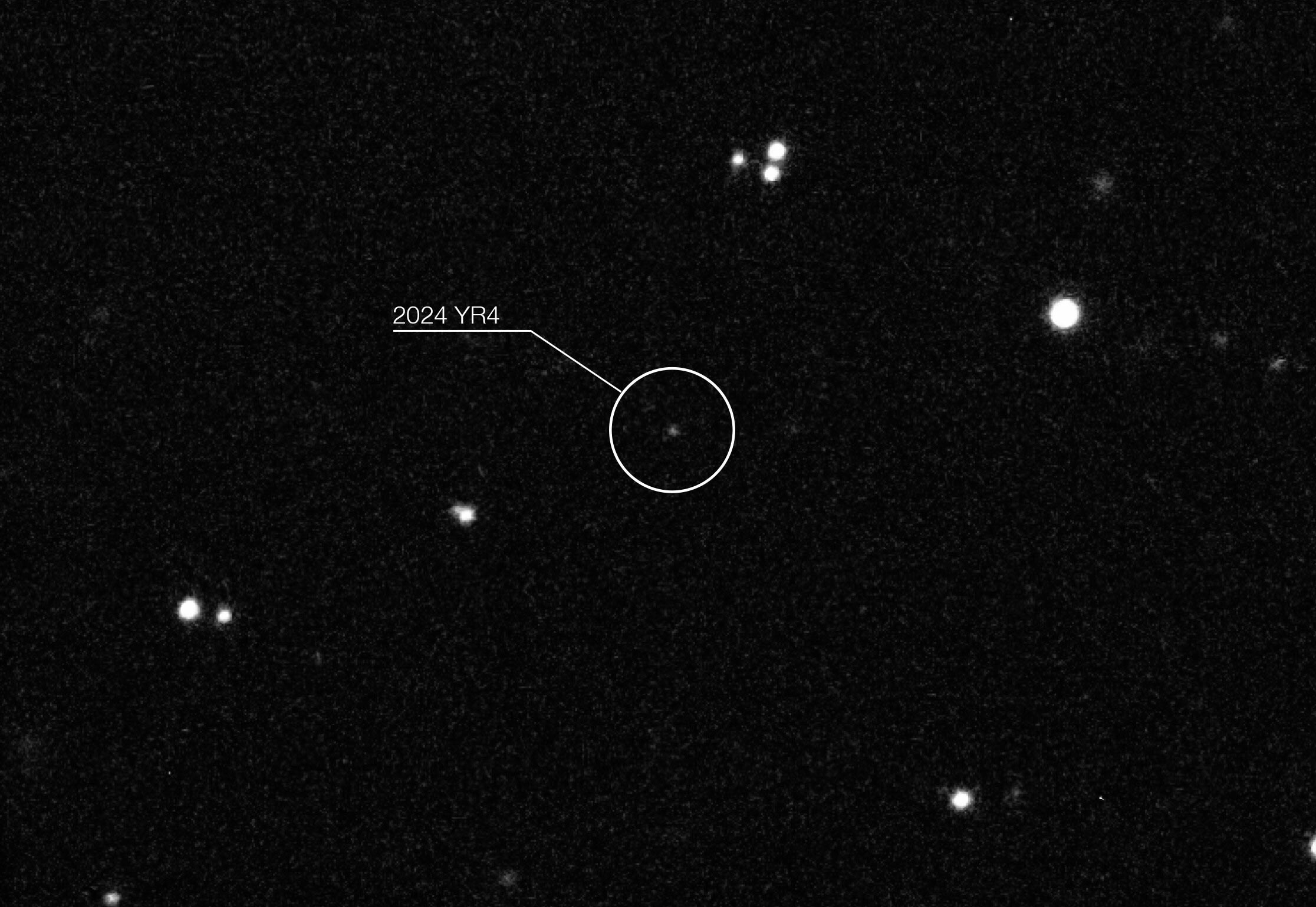
This is a sequence of observations of the Near Earth Asteroid 2024 YR4 carried out with ESO’s Very Large Telescope in January 2025, shortly after it was discovered in December 2024. The images have been aligned so that the asteroid remains fixed at the center of the frame, while the stars appear to move in the background.
Final Observations Confirm Earth Is Safe
The new VLT observations, together with data from other observatories, have allowed astronomers to constrain the orbit enough to all but rule out an impact with Earth in 2032. “The narrower beam is now moving away from Earth,” Hainaut says. At the time of writing, the impact probability reported by ESA’s Near-Earth Objects Coordination Centre is around 0.001% and the asteroid no longer tops ESA’s risk list.
As 2024 YR4 is moving away from Earth, it has become increasingly faint and difficult to observe it with all but the largest telescopes. ESO’s VLT has been instrumental in observations of this asteroid because of its mirror size and superb sensitivity, as well as the excellent dark skies at ESO’s Paranal Observatory in Chile, where the telescope is located. This makes it ideal to track faint objects such as 2024 YR4 and other potentially dangerous asteroids.
This is a sequence of observations of the Near Earth Asteroid 2024 YR4 carried out with ESO’s Very Large Telescope in January 2025, shortly after it was discovered in December 2024. The asteroid is the faint source moving diagonally against the background of fixed stars.
A Threat to the Future of Astronomy
Unfortunately, the same Paranal’s pristine dark skies that made these crucial measurements possible are currently under threat by the industrial megaproject INNA by AES Andes, a subsidiary of the US power company AES Corporation. The project is planned to cover an area similar in size to that of a small city and be located, at the closest point, about 11 km from the VLT. Due to its size and proximity, INNA would have devastating effects on the quality of the skies at Paranal, especially due to light pollution from its industrial facilities. With a brighter sky, telescopes like the VLT will lose their ability to detect some of the faintest cosmic targets.
Hainaut warns: “With that brighter sky, the VLT would lose the faint 2024 YR4 about one month earlier, which would make a huge difference in our capability to predict an impact, and prepare mitigation measures to protect Earth.”
Explore Further: NASA Drops Impact Risk to Near Zero, But There’s One Small Catch
More Information
The observations were obtained in the context of the collaboration between ESA and ESO in contribution to the International Asteroid Warning Network. The team is composed of Olivier R. Hainaut (ESO), Marco Micheli (ESA NEO Coordination Centre), Bruno Leibundgut (ESO), Andrew Williams (formerly ESO, now ESA), Detlef Koschny (Technical University Munich, Germany), Luca Conversi (ESA). For the 2024 YR4 observations, they were joined by Maxime Devogele (ESA), Julia de Leon (Instituto de Astrofisica de Canarias, Spain) and Nicholas Moskovitz (Lowell Observatory, United States). FORS2 and HAWK-I were the VLT instruments used.
Never miss a breakthrough: Join the SciTechDaily newsletter.
Follow us on Google and Google News.