
Close Menu
    Facebook X (Twitter) Instagram
    SciTechDaily
    • Biology
    • Chemistry
    • Earth
    • Health
    • Physics
    • Science
    • Space
    • Technology
    Facebook X (Twitter) Pinterest YouTube RSS
    SciTechDaily
    Home»Space»Large Near-Earth Asteroid Florence to Pass Earth on September 1
    Space

    Large Near-Earth Asteroid Florence to Pass Earth on September 1

    By DC Agle, Jet Propulsion LaboratoryAugust 18, 20171 Comment3 Mins Read
    Facebook Twitter Pinterest Telegram LinkedIn WhatsApp Email Reddit
    Share
    Facebook Twitter LinkedIn Pinterest Telegram Email Reddit

    Asteroid Florence to Safely Pass Earth on September 1

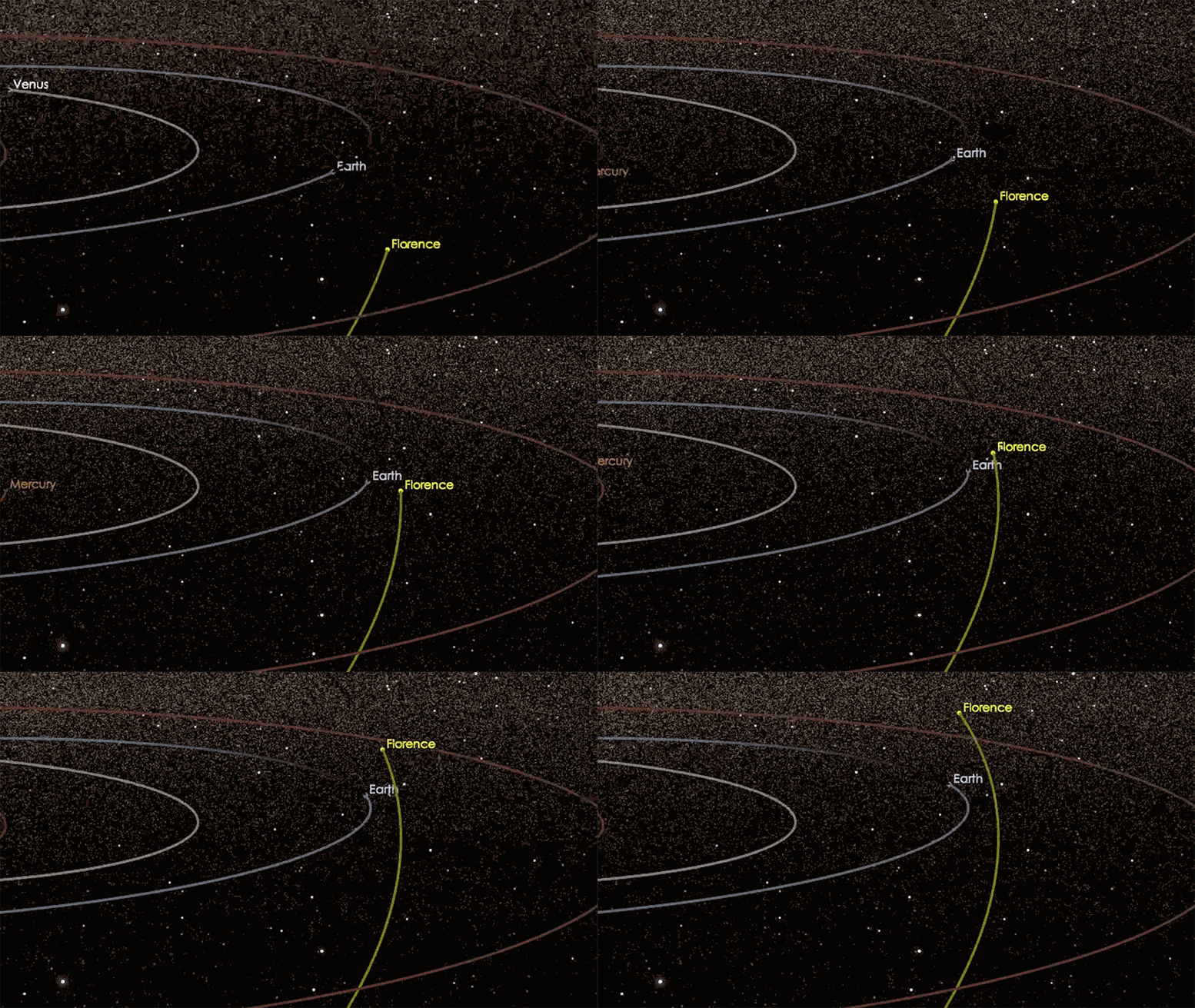
    Asteroid Florence, a large near-Earth asteroid, will pass safely by Earth on September 1, 2017, at a distance of about 4.4 million miles.

    The large near-Earth asteroid named Florence will safely pass by Earth on September 1, 2017, at a distance of about 4.4 million miles (7.0 million kilometers, or about 18 Earth-Moon distances). Florence is among the largest near-Earth asteroids that are several miles in size; measurements from NASA’s Spitzer Space Telescope and NEOWISE mission indicate it’s about 2.7 miles (4.4 kilometers) in size.

    “While many known asteroids have passed by closer to Earth than Florence will on September 1, all of those were estimated to be smaller,” said Paul Chodas, manager of NASA’s Center for Near-Earth Object Studies (CNEOS) at the agency’s Jet Propulsion Laboratory in Pasadena, California. “Florence is the largest asteroid to pass by our planet this close since the NASA program to detect and track near-Earth asteroids began.”
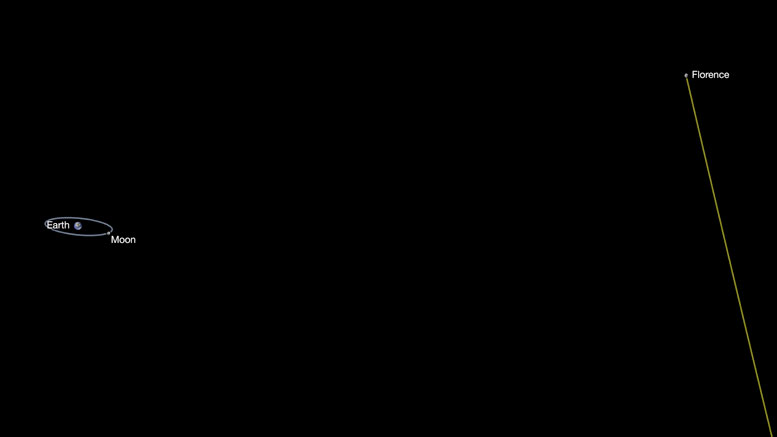
    Asteroid Florence to Pass Near Earth
    Asteroid Florence, a large near-Earth asteroid, will pass safely by Earth on September 1, 2017, at a distance of about 4.4 million miles. Credit: NASA/JPL-Caltech

    This relatively close encounter provides an opportunity for scientists to study this asteroid up close. Florence is expected to be an excellent target for ground-based radar observations. Radar imaging is planned at NASA’s Goldstone Solar System Radar in California and at the National Science Foundation’s Arecibo Observatory in Puerto Rico. The resulting radar images will show the real size of Florence and also could reveal surface details as small as about 30 feet (10 meters).

    Asteroid Florence was discovered by Schelte “Bobby” Bus at Siding Spring Observatory in Australia in March 1981. It is named in honor of Florence Nightingale (1820-1910), the founder of modern nursing. The 2017 encounter is the closest by this asteroid since 1890 and the closest it will ever be until after 2500. Florence will brighten to ninth magnitude in late August and early September, when it will be visible in small telescopes for several nights as it moves through the constellations Piscis Austrinus, Capricornus, Aquarius, and Delphinus. 

    Radar has been used to observe hundreds of asteroids. When these small, natural remnants of the formation of the solar system pass relatively close to Earth, deep space radar is a powerful technique for studying their sizes, shapes, rotation, surface features, and roughness, and for more precise determination of their orbital path.

    JPL manages and operates NASA’s Deep Space Network, including the Goldstone Solar System Radar, and hosts the Center for Near-Earth Object Studies for NASA’s Near-Earth Object Observations Program, an element of the Planetary Defense Coordination Office within the agency’s Science Mission Directorate.

    More information about asteroids and near-Earth objects can be found at:

    https://cneos.jpl.nasa.gov

    https://www.jpl.nasa.gov/asteroidwatch

    For more information about NASA’s Planetary Defense Coordination Office, visit:

    https://www.nasa.gov/planetarydefense

    For asteroid and comet news and updates, follow AsteroidWatch on Twitter:

    twitter.com/AsteroidWatch

    Never miss a breakthrough: Join the SciTechDaily newsletter.
    Follow us on Google and Google News.

    Asteroid Astronomy NEO NEOWISE Planetary Defense Planetary Science Spitzer Space Telescope
    Share. Facebook Twitter Pinterest LinkedIn Email Reddit

    Related Articles

    NEOWISE Asteroid-Hunting Spacecraft Releases Fourth Year of Data

    Astronomers Prepare for Asteroid 2002 AJ129 Flyby of Earth

    Mars “Shakes Up” Asteroid Surfaces

    Astronomers Create First Cloud Map of a Planet Beyond Our Solar System

    Astronomers Discover ‘Trojan’ Asteroid Sharing the Orbit of Uranus

    Spitzer Discovers a Young Stellar System That “Blinks” Every 93 Days

    Researchers Confirm Three Asteroids Are Co-Orbital With Uranus

    New Study Revives Doubted Exoplanet Fomalhaut b

    Near Miss Asteroid – An Opportunity To Test a Rapid Response Program

    1 Comment

    1. Robin Gist on August 19, 2017 8:03 am

      We are living in last days God gives us warnings and signs do we pay attention most of us no

      Reply
    Leave A Reply Cancel Reply

    • Facebook
    • Twitter
    • Pinterest
    • YouTube

    Don't Miss a Discovery

    Subscribe for the Latest in Science & Tech!

    Trending News

    Bone-Strengthening Discovery Could Reverse Osteoporosis

    Scientists Uncover Hidden Trigger Behind Stem Cell Aging

    Scientists Find Way to Reverse Fatty Liver Disease Without Changing Diet

    Could Humans Regrow Limbs? New Study Reveals Promising Genetic Pathway

    Scientists Reveal Eating Fruits and Vegetables May Increase Your Risk of Lung Cancer

    Scientists Reverse Brain Aging With Simple Nasal Spray

    Scientists Uncover Potential Brain Risks of Popular Fish Oil Supplements

    Scientists Discover a Surprising Way To Make Bread Healthier and More Nutritious

    Follow SciTechDaily
    • Facebook
    • Twitter
    • YouTube
    • Pinterest
    • Newsletter
    • RSS
    SciTech News
    • Biology News
    • Chemistry News
    • Earth News
    • Health News
    • Physics News
    • Science News
    • Space News
    • Technology News
    Recent Posts
    • AI Meets Quantum Computing and the Predictions Get Scary Accurate
    • Wind Farms Are Disrupting Ocean Currents, Moving Millions of Tons of Mud Each Year
    • Scientists Discover Massive Magma Reservoir Beneath Tuscany
    • Scientists Create “Neurobots” – Living Machines With Their Own Nervous Systems
    • Europe’s Most Active Volcano Just Got Stranger – Here’s Why Scientists Are Rethinking It
    Copyright © 1998 - 2026 SciTechDaily. All Rights Reserved.
    • Science News
    • About
    • Contact
    • Editorial Board
    • Privacy Policy
    • Terms of Use

    Type above and press Enter to search. Press Esc to cancel.