
Close Menu
    Facebook X (Twitter) Instagram
    SciTechDaily
    • Biology
    • Chemistry
    • Earth
    • Health
    • Physics
    • Science
    • Space
    • Technology
    Facebook X (Twitter) Pinterest YouTube RSS
    SciTechDaily
    Home»Space»Hubble Space Telescope Views Dwarf Galaxy NGC 178
    Space

    Hubble Space Telescope Views Dwarf Galaxy NGC 178

    By ESA/HubbleAugust 21, 20173 Comments2 Mins Read
    Facebook Twitter Pinterest Telegram LinkedIn WhatsApp Email Reddit
    Share
    Facebook Twitter LinkedIn Pinterest Telegram Email Reddit
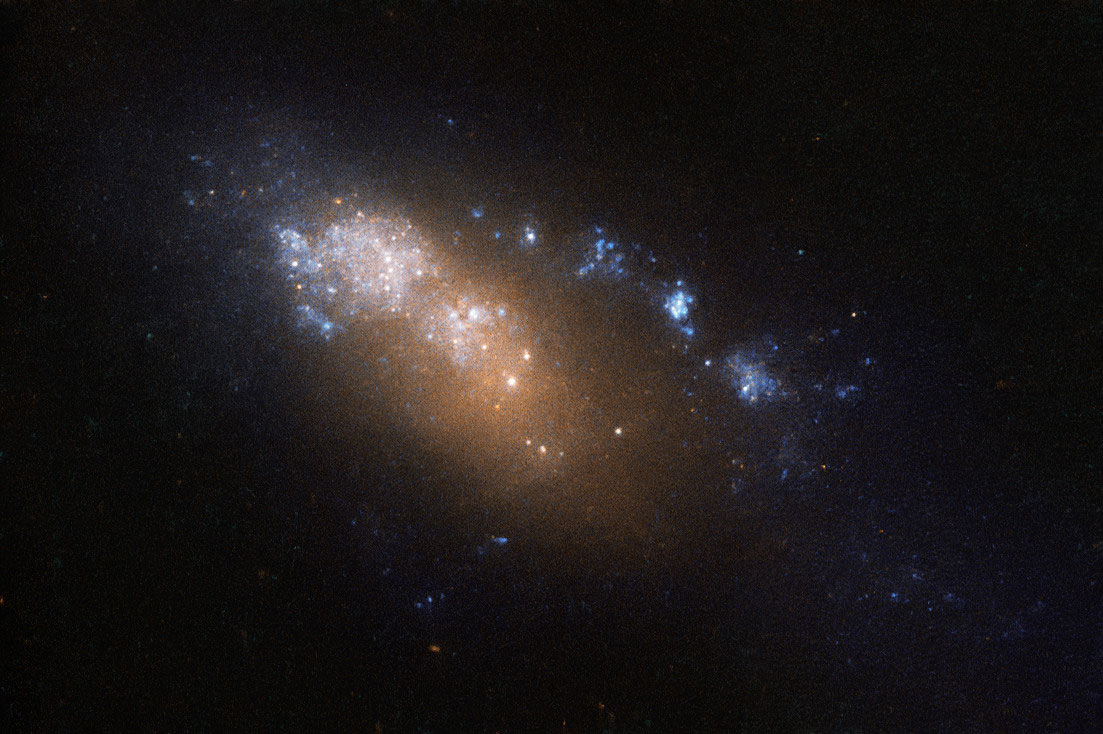
    Hubble Views NGC 178
    Hubble Space Telescope image of the dwarf galaxy NGC 178, which is located approximately 65 million light-years away. Credit: ESA/Hubble & NASA

    This Hubble Space Telescope image of the week shows dwarf galaxy NGC 178, which is located roughly 65 million light-years away.

    NGC 178 may be small, but it packs quite a punch. Measuring around 40,000 light-years across, its diameter is less than half that of the Milky Way, and it is accordingly classified as a dwarf galaxy. Despite its diminutive size, NGC 178 is busy forming new stars. On average, the galaxy forms stars totaling around half the mass of the Sun per year — enough to label it a starburst galaxy.

    The galaxy’s discovery is an interesting, and somewhat confusing, story. It was originally discovered by American astronomer Ormond Stone in 1885 and dubbed NGC 178, but its position in the sky was recorded incorrectly — by accident the value for the galaxy’s right ascension (which can be thought of as the celestial equivalent of terrestrial longitude) was off by a considerable amount.

    In the years that followed NGC 178 was spotted again, this time by French astronomer Stéphane Javelle. As no cataloged object occupied that position in the sky, Javelle believed he had discovered a new galaxy and entered it into the expanded Index Catalogue under the name IC 39. Later, American astronomer Herbert Howe also observed the object and corrected Stone’s initial mistake. Many years later, astronomers finally noticed that NGC 178 and IC 39 were actually the same object!

    This image comprises data gathered by the Wide Field Planetary Camera 2 aboard the NASA/ESA Hubble Space Telescope.

    Never miss a breakthrough: Join the SciTechDaily newsletter.
    Follow us on Google and Google News.

    Astronomy Hubble Space Telescope
    Share. Facebook Twitter Pinterest LinkedIn Email Reddit

    Related Articles

    A Morphing Spiral Galaxy Amongst Friends

    Hubble Views Magnificent Lopsided Galaxy NGC 2276

    Hubble Captures Fantastic Detail of Eponymous Spiral Galaxy NGC 691

    Spectacular Image Captured by Hubble Shows a Strangely Contorted Spiral Galaxy

    A Distant Spiral in Virgo: Extraordinary Detail Seen in a Galaxy 150 Million Light-Years Away From Earth

    Magnetic Monsters: Hubble Tracks Down Location of Mysterious Radio Signals From Intergalactic Space

    A Menagerie of Galaxies: Hubble Captures a Cluster With Galaxies of All Shapes and Sizes

    How Habitable Are Planets That Orbit Red Dwarfs – The Most Common Type of Stars in the Galaxy?

    Cosmic Silver Lining: Hubble Spots V565 Surrounded by Four Prominent Diffraction Spikes

    3 Comments

    1. Derrick Kaonga on August 22, 2017 12:27 am

      I enjoy much about these galaxy news.But do you people believe that there is God.Where is heaven that the Bible say?

      Reply
    2. Derrick Kaonga on August 22, 2017 12:43 am

      I started reading much about the position of the sun on milky way and discovery of other galaxy. And read much about exo plants discovered later l started to believe there is no God and telling my friends. Who now rebuke me .What can you advice me?

      Reply
    3. Valeriy on August 22, 2017 5:00 pm

      There are some very complicated issues of galaxy formation. Unfortunately, here is the same problem as with the stars. The origin of galaxies remains unclear, in spite of huge activity in the field. What the “formation” means? It means that we have the material that is assembling into galaxies.

      Reply
    Leave A Reply Cancel Reply

    • Facebook
    • Twitter
    • Pinterest
    • YouTube

    Don't Miss a Discovery

    Subscribe for the Latest in Science & Tech!

    Trending News

    Enormous Prehistoric Insects Puzzle Scientists

    Scientists Develop Bioengineered Chewing Gum That Could Help Fight Oral Cancer

    After 37 Years, the World’s Longest-Running Soil Warming Experiment Uncovers a Startling Climate Secret

    NASA Satellite Captures First-Ever High-Res View of Massive Pacific Tsunami

    ADHD Isn’t Just a Deficit: Study Reveals Powerful Hidden Strengths

    Scientists Discover Stem Cells That Could Regrow Teeth and Bone

    Early Cannabis Use May Stall Key Brain Skills in Teens

    Popular Vitamin D Supplement Has “Previously Unknown” Negative Effect, Study Finds

    Follow SciTechDaily
    • Facebook
    • Twitter
    • YouTube
    • Pinterest
    • Newsletter
    • RSS
    SciTech News
    • Biology News
    • Chemistry News
    • Earth News
    • Health News
    • Physics News
    • Science News
    • Space News
    • Technology News
    Recent Posts
    • Beyond Inflammation: Scientists Uncover New Cause of Persistent Rheumatoid Arthritis
    • Cancer-Like Mutations Found in the Brain May Be Driving Alzheimer’s Disease
    • A Simple Molecule Could Unlock Safer, Easier Weight Loss
    • Stretching Diamonds Unlocks Powerful New Quantum Sensing Abilities
    • This Robot Could Explore Mars 3x Faster Than Today’s Rovers
    Copyright © 1998 - 2026 SciTechDaily. All Rights Reserved.
    • Science News
    • About
    • Contact
    • Editorial Board
    • Privacy Policy
    • Terms of Use

    Type above and press Enter to search. Press Esc to cancel.