

Lianas are spreading in tropical forests, harming trees and cutting carbon storage. They thrive on rising CO2 and show up in satellite images. Scientists call for climate action, not removal.
A pandemic of lianas is rapidly spreading through tropical forests, reducing their capacity to store carbon and weakening their ability to slow climate change. Two recent studies from Leiden University shed light on the growing problem. “We now understand why lianas are visible in satellite imagery,” researchers said.
Tropical forests absorb about as much CO2 each year as the entire continent of Europe emits. They also support around half of the world’s biodiversity. But their ability to regulate climate and protect biodiversity is increasingly threatened, not only by deforestation, but also by a sharp rise in lianas.
According to ecologist Marco Visser from Leiden’s Centre for Environmental Sciences (CML), “Lianas can smother and kill trees. When they take over, the forest becomes choked, and mostly lianas are left growing over fallen trees.”
A liana pandemic for over thirty years
During his doctoral research in 2016, Visser was the first to model lianas as if they were infectious diseases. “Lianas, such as passionflowers and many other species, can be compared to tapeworms. They intercept trees’ resources and can more than double tree mortality.” At CML, Visser now supervises PhD candidate Manuela Rueda-Trujillo, who has reviewed hundreds of studies on lianas.
Their paper, published last summer, shows that the rise in lianas is not limited to South and Latin America, as once believed, but is occurring across all tropical forests. “A liana pandemic has been raging for over thirty years, with their prevalence rising by 10 to 24 percent every decade,” Visser says.
Lianas benefit more from increased CO2
Lianas are quickly spreading through tropical forests and, in some places, are completely preventing tree growth. In these areas, forest regeneration stops, and carbon storage can drop by up to 95 percent.
“That’s almost equivalent to deforestation,” Visser says. He links this trend to rising atmospheric CO2 levels.
“All plants grow faster with more CO2, but lianas benefit even more. They cheat. They don’t invest in structural support, borrowing it from trees instead, and their leaves require less energy and nutrients to produce.” A liana can rapidly reach the canopy, cover tree crowns with dense foliage, and absorb nearly all the sunlight for itself.
Lianas can be seen in satellite images
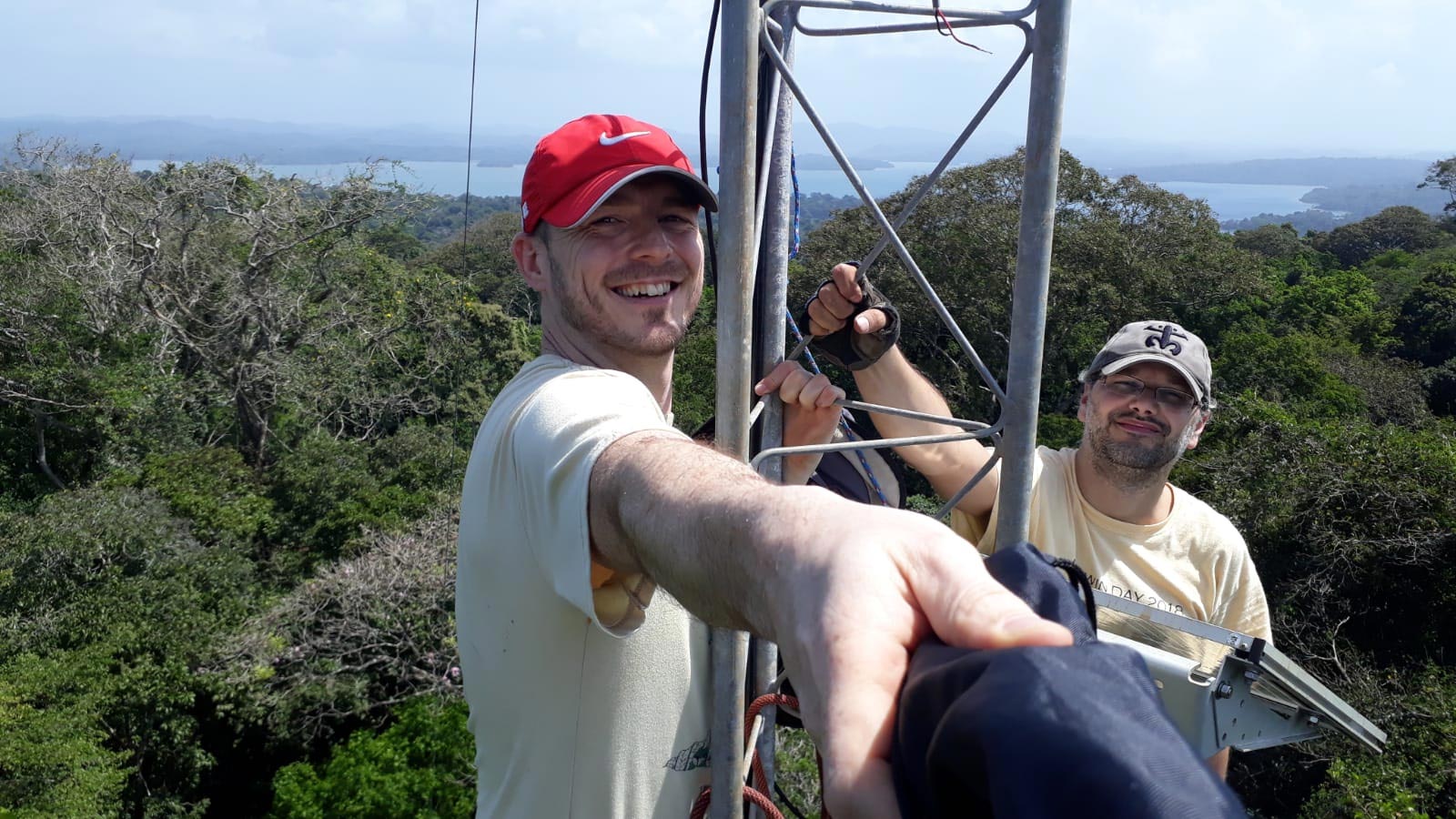
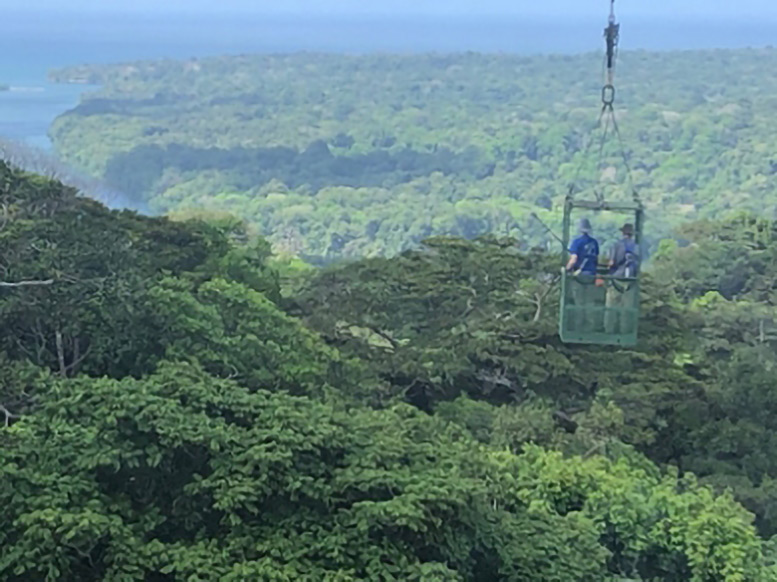
On 28 April, Visser published research demonstrating that lianas are visible from space. Collaborating with American and British colleagues, he has now shown why this is the case. Visser developed mathematical models predicting how light interactions occur. “Then, we used cranes to access treetops in Panama to measure leaf properties. Our findings confirmed the models were correct.”
Why lianas stand out in satellite imagery
The leaves that make lianas ultra-efficient reflect more light and infrared radiation than tree foliage. They also lie much flatter than tree leaves.
“Lianas are true egoists,” Visser explains. “Tree leaves tilt, allowing light to reach lower neighbors—even the forest floor gets some sunlight. But lianas leave almost nothing for others.”
These properties make them visible in satellite images. “Now that we understand why lianas are detectable from space, we can develop targeted techniques to map their spread and impact worldwide.”
Solution: Stop climate change
Can anything be done about the liana problem? Should we start cutting them down? Definitely not, says Visser. “We shouldn’t intervene until we fully understand their ecological role. They bear fruit year-round and are vital for rare monkey and bird species.” The only necessary action, he insists, is halting climate change, which will also slow the expansion of lianas.
References: “Global increase of lianas in tropical forests” by Manuela A. Rueda-Trujillo, Michiel P. Veldhuis, Peter M. van Bodegom, Hannes P. T. de Deurwaerder and Marco Visser, 26 August 2024, Global Change Biology.
DOI: 10.1111/gcb.17485
“When can we detect lianas from space? Toward a mechanistic understanding of liana-infested forest optics” by Marco D. Visser, Matteo Detto, Félicien Meunier, Jin Wu, Jane R. Foster, David C. Marvin, Peter M. van Bodegom, Boris Bongalov, Matheus Henrique Nunes, David Coomes, Hans Verbeeck, J. Antonio Guzmán Q, Arturo Sanchez-Azofeifa, Chris J. Chandler, Geertje M. F. van der Heijden, Doreen S. Boyd, Giles M. Foody, Mark E. J. Cutler, Eben N. Broadbent, Shawn P. Serbin, Stefan Schnitzer, M. Elizabeth Rodríguez-Ronderos, Frank Sterck, José A. Medina-Vega and Stephen W. Pacala, 27 April 2025, Ecology.
DOI: 10.1002/ecy.70082
Never miss a breakthrough: Join the SciTechDaily newsletter.
Follow us on Google and Google News.
2 Comments
“Should we start cutting them down? Definitely not, says Visser. “We shouldn’t intervene until we fully understand their ecological role. … The only necessary action, he insists, is halting climate change, which will also slow the expansion of lianas.”
Aren’t the third and last sentences contradictory? I can find nothing explicit in the peer-reviewed publication to support his remarks.
Contradictory or not, invading remote forests with chain saws and leaving behind a heap of dead liana doesn’t sound beneficial.
That said, halting climate change isn’t likely to happen soon.