
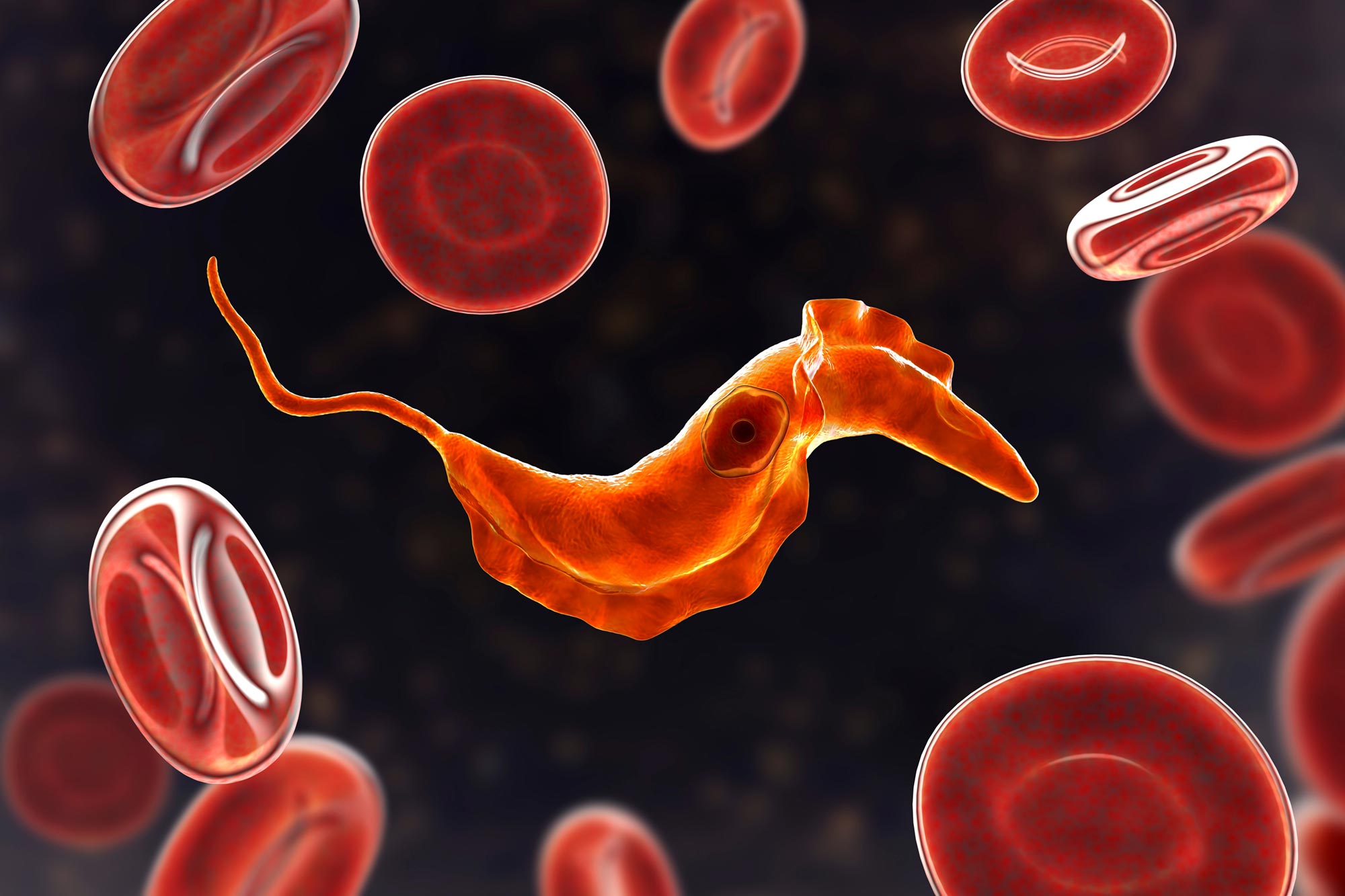
A deadly parasite stays hidden by shredding its own genetic instructions—now scientists finally know how.
To survive inside the human bloodstream, the African trypanosome parasite disguises itself with a protective “cloak” made of proteins called variant surface glycoproteins (VSG). New research published in Nature Microbiology has identified a key protein that helps the parasite carefully control this disguise.
Scientists discovered a protein called ESB2 that acts as a “molecular shredder.” It allows the parasite to stay undetected by cutting up specific pieces of its genetic instructions with remarkable precision as they are being created.
By uncovering how this process works, researchers have revealed potential weak points in the parasite’s life cycle. This insight could help guide the development of new treatments for Sleeping Sickness, a disease that still severely affects communities across sub-Saharan Africa.
Sleeping Sickness is spread through the bite of the tsetse fly. If not treated, the parasite can invade the central nervous system, leading to serious neurological symptoms such as disrupted sleep, confusion, and eventually coma.
A “Molecular Shredder” That Edits Genes in Real Time
Dr. Joana Faria, senior author of the study and head of the research group at the University of York, explained: “We’ve discovered that the parasite’s secret to staying invisible isn’t just what it prints, but what it chooses to redact. By placing a ‘molecular shredder’ directly inside its ‘protein factory’, the parasite can edit its genetic manual in real-time.
“This suggests a fundamental shift in how we view infection: survival for many organisms may depend less on how they issue genetic instructions and more on how they destroy them at the source.”
Solving a 40-Year Mystery in Parasite Biology
The findings also resolve a long-standing puzzle that has confused scientists for decades. The genetic instructions that produce the parasite’s protective “cloak” also include several “helper genes” that are important for survival and immune evasion. Based on this setup, researchers expected the parasite to produce similar amounts of each protein.
Instead, the parasite generates large quantities of cloak proteins while producing only small amounts of helper proteins. The new study shows that this imbalance is not accidental.
By identifying ESB2, the research team demonstrated that the parasite controls its genetic output by destroying certain messages rather than simply regulating how much is produced.
Precision Gene Control Inside the Parasite’s “Factory”
ESB2 operates within the parasite’s protein-making center, known as the Expression Site Body. As genetic instructions are being read, ESB2 acts like a “molecular blade,” immediately cutting up the helper gene messages while leaving the cloak-related instructions untouched.
This precise editing process ensures the parasite produces exactly what it needs to remain hidden from the host’s immune defenses.
Breakthrough Discovery and Global Collaboration
This breakthrough represents the first major achievement from Dr. Faria’s new laboratory at the University of York and adds to the city’s growing reputation as a center for life sciences research.
The work was supported by a Sir Henry Dale Fellowship – a partnership between the Wellcome Trust and the Royal Society – and involved scientists from the United Kingdom, Portugal, the Netherlands, Germany, Singapore, and Brazil.
Lianne Lansink, the study’s first author, said: “When we first saw the molecular shredder localized in the microscope, we knew we had found something special.”
Dr. Faria added: “This discovery is a real full-circle moment for me. The mystery of how this parasite manages the asymmetric expression of its genetic manual has been a cold case in the back of my mind since my days as a postdoc. To finally solve it now, as the first major output of my own lab here at York, is incredibly rewarding. It’s a testament to what a fresh lab and a diverse group of scientists can achieve when they look at an old problem from a completely new angle.”
Reference: “Specialized RNA decay fine-tunes monogenic antigen expression in Trypanosoma brucei” by Lianne I. M. Lansink, Htay Mon Aye, Leon Walther, Sophie Longmore, Madeleine Jones, Adam Dowle, João L. Reis-Cunha and Joana R. C. Faria, 30 March 2026, Nature Microbiology.
DOI: 10.1038/s41564-026-02289-4
Never miss a breakthrough: Join the SciTechDaily newsletter.
Follow us on Google and Google News.
2 Comments
Princess peach
If you can figure that out amazing ( congrats!). Need something to do next? I wish you could look at my daughter. She is reaļ sick with bad blood numbers this week then different numbers bad next week. Bad Immune. Gets recurring Meningitis, heart up and down 23 to 212 bpm. Has had spinal taps. Always feels real bad, migraines every day, bad pain to extreme. Not TB. Neck pain. Tingling , now loosing weight fast, list goes on and on. Suffering for years now. Can you help? It is getting worse!
Docs can’t seem to come up with anything although still kinda trying.
CDC what…..? Idea’s?
Lianne Lansink,
Dr. Joana Faria
Thank you for your time.
Kindness and Love.