

Zebrafish possess a natural superpower that humans lack: the ability to regrow the tiny inner ear cells that are essential for hearing and balance.
Scientists have now identified two specific genes responsible for this remarkable regeneration. These genes each control a different type of support cell, helping maintain a steady supply of stem cells while triggering the growth of new hair cells. By decoding this dual mechanism, researchers hope to uncover why humans can’t do the same—and whether we might someday flip the biological switch that restores lost hearing.
Why Humans Can’t Regrow Sensory Cells
Although the human body can routinely replace some types of cells, such as those found in our blood and digestive system, it lacks the ability to naturally regenerate many other kinds of tissue. One example is the sensory hair cells inside the inner ear. When these delicate cells are damaged, the consequences often include permanent hearing loss, deafness, or problems with balance. But in a surprising contrast, animals like fish, frogs, and chicks are able to regenerate these cells with ease.
Scientists at the Stowers Institute for Medical Research have now discovered how two specific genes play a role in this regenerative ability in zebrafish. Their research sheds new light on the biological mechanisms behind zebrafish regeneration and could provide valuable direction for future efforts to treat hearing loss or stimulate similar repair processes in humans.
“Mammals such as ourselves cannot regenerate hair cells in the inner ear,” said Stowers Investigator Tatjana Piotrowski, Ph.D., the study’s co-author. “As we age or are subjected to prolonged noise exposure, we lose our hearing and balance.”
Cracking the Code of Cell Division
In a study published on July 14, 2025, in Nature Communications, researchers from the Piotrowski Lab explored how zebrafish manage to regulate cell division in ways that promote the regeneration of hair cells while also maintaining a stable pool of stem cells. The research, led by former Stowers scientist Mark Lush, Ph.D., revealed that two distinct genes, each involved in controlling cell division, are responsible for the growth of two different types of sensory support cells in zebrafish. This insight may help scientists investigate whether similar regenerative pathways could one day be activated in human cells.
“During normal tissue maintenance and regeneration, cells need to proliferate to replace the cells that are dying or being shed — however, this only works if there are existing cells that can divide to replace them,” said Piotrowski. “To understand how proliferation is regulated, we need to understand how stem cells and their offspring know when to divide and at what point to differentiate.”
Tatjana Piotrowski, Ph.D., discusses how her team identified specific genes involved in zebrafish sensory hair cell regrowth. The findings reveal new insights that could inform future research into hearing loss treatments. Credit: Stowers Institute for Medical Research
Zebrafish Neuromasts: A Natural Laboratory
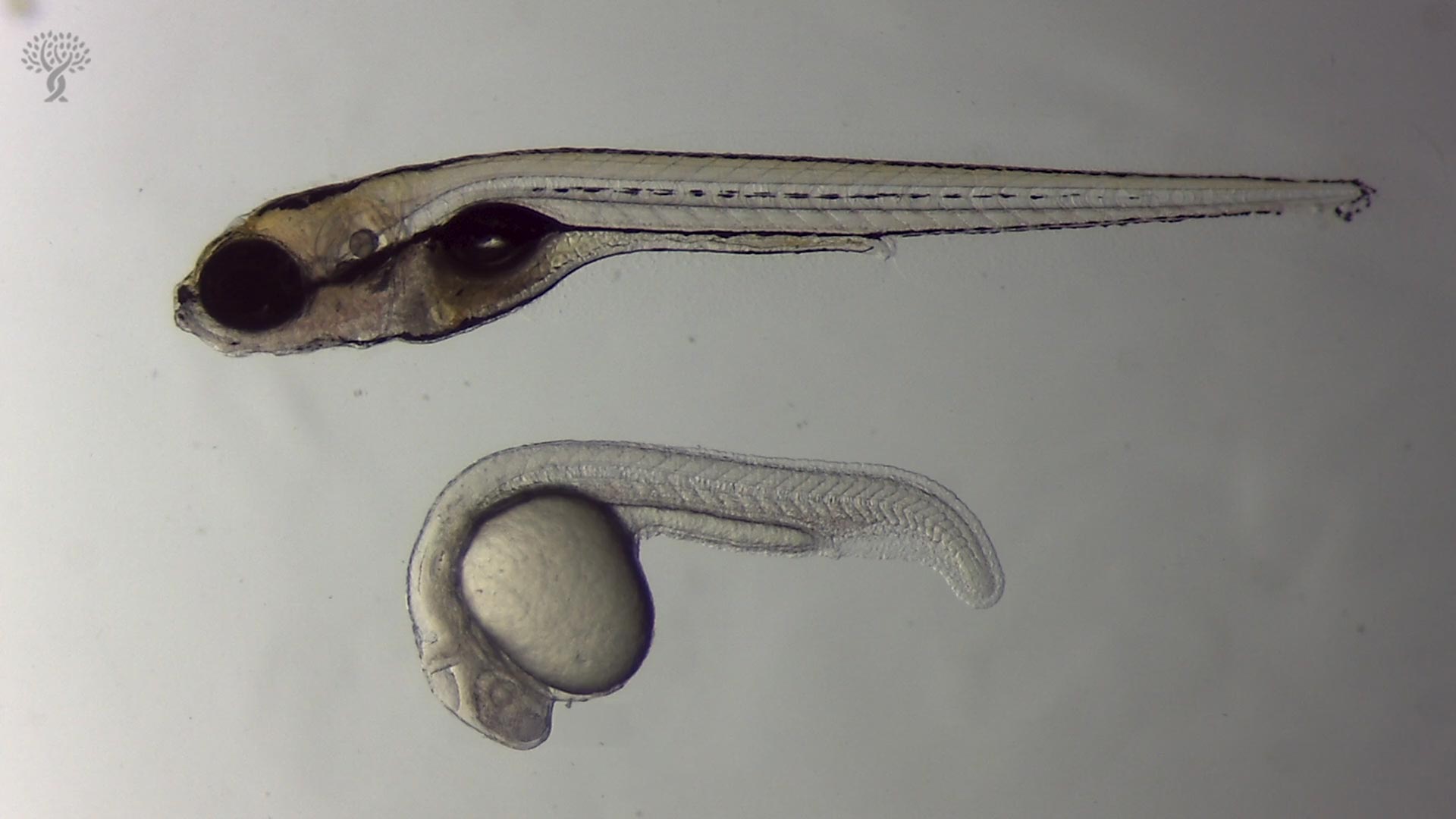
Zebrafish are an excellent system for studying regeneration. Dotted in a straight line from their head to tailfin are sensory organs called neuromasts. Each neuromast resembles a garlic bulb with “hair cells” sprouting from its top. A variety of supporting cells encompass the neuromast to give rise to new hair cells. These sensory cells, which help zebrafish detect water motion, closely resemble those in the human inner ear.
Because zebrafish are transparent during development and have accessible sensory organ systems, scientists can visualize, as well as genetically sequence and modify, each neuromast cell. This allows them to investigate the mechanisms of stem cell renewal, the proliferation of progenitor cells — direct precursors to hair cells — and hair cell regeneration.
Gene Manipulation Reveals Regeneration Secrets
“We can manipulate genes and test which ones are important for regeneration,” said Piotrowski. “By understanding how these cells regenerate in zebrafish, we hope to identify why similar regeneration does not occur in mammals and whether it might be possible to encourage this process in the future.”
Two key populations of support cells contribute to regeneration within neuromasts: active stem cells at the neuromast’s edge and progenitor cells near the center. These cells divide symmetrically, which allows the neuromast to continuously make new hair cells while not depleting its stem cells. The team used a sequencing technique to determine which genes were active in each type and found two distinct cyclinD genes present in only one or the other population.
CyclinD Genes: Independent Controllers
The researchers then genetically altered each gene in the stem and progenitor populations. They discovered that the different cyclinD genes were independently regulating cell division of the two types of cells.
“When we rendered one of these genes non-functional, only one population stopped dividing,” said Piotrowski. “This finding shows that different groups of cells within an organ can be controlled separately, which may help scientists understand cell growth in other tissues, such as the intestine or blood.”
Progenitor cells lacking their cell type-specific cyclinD gene did not proliferate; however, they did form a hair cell, uncoupling cell division with differentiation. Notably, when the stem cell-specific cyclinD gene was engineered to work in progenitor cells, progenitor cell division was restored.
Broader Implications for Human Healing
David Raible, Ph.D., a professor at the University of Washington who studies the zebrafish lateral line sensory system, commented on the significance of the new study. “This work illuminates an elegant mechanism for maintaining neuromast stem cells while promoting hair cell regeneration. It may help us investigate whether similar processes exist or could be activated in mammals.”
Because cyclinD genes also regulate proliferation in many human cells, like those in the gut and blood, the team’s findings may have implications beyond hair cell regeneration.
“Insights from zebrafish hair cell regeneration could eventually inform research on other organs and tissues, both those that naturally regenerate and those that do not,” said Piotrowski.
Reference: “Stem and progenitor cell proliferation are independently regulated by cell type-specific cyclinD genes” by Mark E. Lush, Ya-Yin Tsai, Shiyuan Chen, Daniela Münch, Julia Peloggia, Jeremy E. Sandler and Tatjana Piotrowski, 14 July 2025, Nature Communications.
DOI: 10.1038/s41467-025-60251-0
Additional authors include Ya-Yin Tsai, Shiyuan Chen, Daniela Münch, Julia Peloggia, Ph.D., and Jeremy Sandler, Ph.D.
This work was funded by the National Institute on Deafness and Other Communication Disorders of the National Institutes of Health (NIH) (award: 1R01DC015488-01A1), the Hearing Health Foundation, and with institutional support from the Stowers Institute for Medical Research. The content is solely the responsibility of the authors and does not necessarily represent the official views of the NIH.
Never miss a breakthrough: Join the SciTechDaily newsletter.
Follow us on Google and Google News.