

Auburn University scientists have developed a new class of materials that allow precise control over free electrons, potentially transforming computing and chemical manufacturing.
Imagine a future where factories produce new materials and chemical compounds more quickly, more efficiently, and at lower cost. Picture laptops that handle complex computations in seconds or supercomputers that can learn and adapt almost like the human brain. These kinds of breakthroughs all depend on one thing: how electrons behave inside matter.
Researchers at Auburn University have developed an entirely new class of materials that gives scientists precise control over these tiny particles. Their work, published in ACS Materials Letters, introduces a way to adjust interactions between isolated-metal molecular complexes known as solvated electron precursors, where electrons move freely through open spaces instead of remaining attached to atoms.
The Central Role of Electrons in Technology and Chemistry
Electrons are essential to both chemical and technological systems. They power energy transfer, chemical bonding, and electrical conductivity, forming the foundation of modern industry and innovation.
In chemistry, electrons drive redox reactions, make bonding possible, and are central to catalysis. In technology, the ability to guide and control the flow of electrons defines how electronic devices, artificial intelligence, solar panels, and quantum computers function.
In most conventional materials, electrons are tightly bound to atoms, limiting their flexibility. In a special class of materials called electrides, however, electrons can move freely, creating opportunities for new forms of science and technology.
Breaking the Rules of Nature With Controlled Electrons
“By learning how to control these free electrons, we can design materials that do things nature never intended,” says Dr. Evangelos Miliordos, Associate Professor of Chemistry at Auburn and senior author of the study based on state-of-the-art computational descriptions.
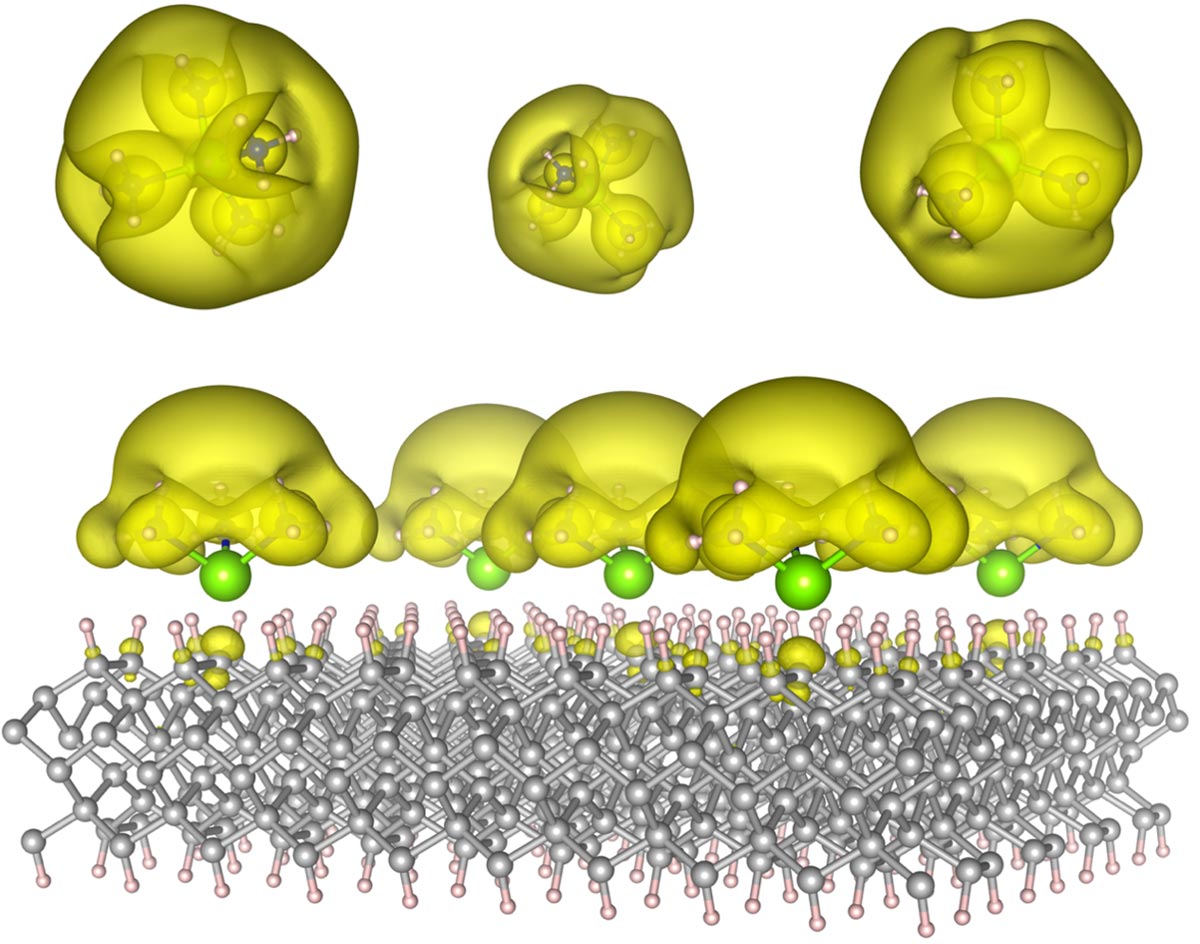
The Auburn research team designed innovative materials called Surface Immobilized Electrides by attaching solvated electron precursors to stable surfaces such as diamond and silicon carbide. This configuration allows the electronic properties of these materials to be both durable and adjustable. By changing how the molecules are arranged, electrons can either cluster into isolated “islands” that behave like quantum bits for advanced computing or spread into wide metallic “seas” that drive complex chemical reactions.
Quantum Computing and Catalytic Possibilities
This adaptability gives the discovery remarkable potential. One arrangement could help create powerful quantum computers capable of solving problems far beyond the reach of today’s machines. Another could lead to a new generation of catalysts that accelerate chemical reactions, transforming how fuels, medicines, and industrial materials are produced.
“As our society pushes the limits of current technology, the demand for new kinds of materials is exploding,” says Dr. Marcelo Kuroda, Associate Professor of Physics at Auburn. “Our work shows a new path to materials that offer both opportunities for fundamental investigations on interactions in matter as well as practical applications.”
Toward Scalable, Real-World Applications
Earlier types of electrides were unstable and difficult to reproduce on a large scale. The Auburn researchers overcame these challenges by depositing their electrides directly onto solid surfaces, creating stable structures that could be developed into real-world devices.
“This is fundamental science, but it has very real implications,” says Dr. Konstantin Klyukin, Assistant Professor of Materials Engineering at Auburn. “We’re talking about technologies that could change the way we compute and the way we manufacture.”
The project brought together Auburn faculty in chemistry, physics, and materials engineering. “This is just the beginning,” Miliordos adds. “By learning how to tame free electrons, we can imagine a future with faster computers, smarter machines, and new technologies we haven’t even dreamed of yet.”
Reference: “Electrides with Tunable Electron Delocalization for Applications in Quantum Computing and Catalysis” by Andrei Evdokimov, Valentina Nesterova, Marcelo A. Kuroda, Konstantin Klyukin and Evangelos Miliordos, 6 October 2025, ACS Materials Letters.
DOI: 10.1021/acsmaterialslett.5c00756
The study was also coauthored by graduate students Andrei Evdokimov and Valentina Nesterova. It was supported by the U.S. National Science Foundation and Auburn University computing resources.
Never miss a breakthrough: Join the SciTechDaily newsletter.
Follow us on Google and Google News.
2 Comments
Hey there quantum scientists; we do not need bigger more powerful faster computers. Those we have are used far too often already to cause social damage.
thanks for this