
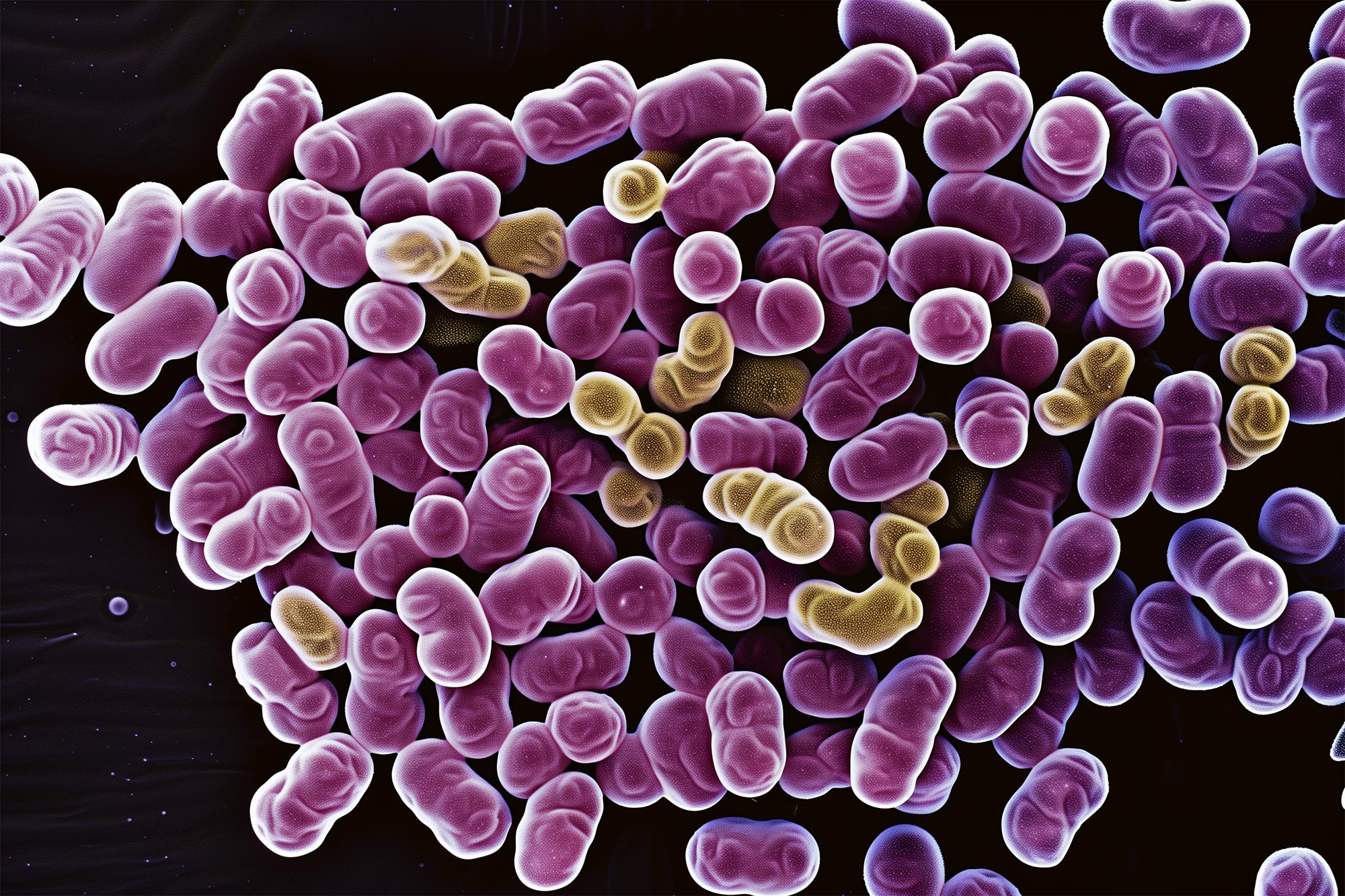
A deadly hospital superbug has evolved into a global force by weaponizing a genetic tool to wipe out its microbial competition.
Eesearchers discovered that vancomycin-resistant Enterococcus faecium (VREfm) developed the ability to produce bacteriocins—natural bacterial toxins—to eliminate rival strains.
Superbug Evolves in Hospitals Worldwide
A drug-resistant bacterium commonly found in healthcare settings has evolved over the past several years to gain a powerful advantage: it can now produce an antimicrobial compound that allows it to kill off related strains and rise to dominance. Researchers at the University of Pittsburgh School of Medicine first identified this shift in local hospital data and then confirmed it was happening around the world.
The discovery, published today (March 21) in Nature Microbiology, could lead to new strategies for treating some of the deadliest bacterial infections. It also highlights a new use for a system developed at Pitt and UPMC that combines genomic sequencing with advanced computer algorithms to quickly detect infectious disease outbreaks.

Front-Row View into Bacterial Evolution
“Our lab has a front-row seat to the parade of pathogens that move through the hospital setting,” said senior author Daria Van Tyne, Ph.D., associate professor of medicine in Pitt’s Division of Infectious Diseases. “And when we took a step back and zoomed out, it quickly became apparent that big changes were afoot with one of the world’s more difficult-to-treat bacteria.”
The Enhanced Detection System for Healthcare-Associated Transmission (EDS-HAT) analyzes the genetic signatures of infections in hospitalized patients and flags patterns, allowing clinicians to intervene and stop potential outbreaks in real-time. But lead author Emma Mills, a microbiology and immunology graduate student in Van Tyne’s lab, realized that EDS-HAT was also a treasure trove of detailed historic information that she could mine to learn about the evolution of bacteria over time.
A Closer Look at VREfm
Mills focused on vancomycin-resistant Enterococcus faecium (VREfm), so-called because it can’t be eradicated with the popular antibiotic vancomycin. VREfm kills about 40% of the people it infects and is a particular plague on immunocompromised and hospitalized patients, who are often taking antibiotics that decrease the diversity of bacteria in their microbiomes, allowing drug-resistant bacteria, such as VREfm, to thrive.
After analyzing the genomic sequences of 710 VREfm infection samples from hospitalized patients entered into EDS-HAT over a six-year time span, Mills discovered that the variety of VREfm strains had shrunk from about eight fairly evenly distributed types in 2017 to two dominant strains that began to emerge in 2018 and, by the end of 2022, were the culprit in four out of every five patient VREfm samples.

The Weapon: A Bacteriocin
Upon closer examination, Mills found that the dominant strains had acquired the ability to produce a bacteriocin, which is an antimicrobial that bacteria use to kill or inhibit one another. They’d weaponized this new capability to destroy the other VREfm strains, giving them unfettered access to nutrients for easier reproduction.
This further sparked Mills’s curiosity: If this was happening at the local hospital, was it happening elsewhere? No prior research publications had explored the possibility that this was a global phenomenon, so she consulted a publicly available library of more than 15,000 VREfm genomes collected globally from 2002 through 2022. Sure enough, what she’d observed locally had also been happening on a global scale.
The “Kill Your Buddies” Effect
“This was a completely unexpected discovery – I was surprised to see such a dramatic signal,” said Mills. “Once these strains are in an institutional setting – such as a hospital – and are matched up against other strains of VRE in a patient’s gut, they take over. It’s a ‘kill your buddies and eat their food’ scenario.”
A Path Toward Future Therapies
Van Tyne said the finding doesn’t have immediate clinical consequences – it does not appear that the bacteriocin-wielding VREfm are making patients any sicker than their predecessors did. But it could point to potential avenues for the development of new therapies.
“The diversity of the VRE population appears to be narrowing from lots of different types causing infection to only a few. That means we may soon have only one single target for which to design therapeutics such as antibiotics or phage therapy,” Van Tyne said. “It also suggests that bacteriocins are very potent and perhaps we could weaponize them for our own purposes.”
Reference: “Bacteriocin production facilitates nosocomial emergence of vancomycin-resistant Enterococcus faecium” by Emma G. Mills, Katharine Hewlett, Alexander B. Smith, Marissa P. Griffith, Lora Pless, Alexander J. Sundermann, Lee H. Harrison, Joseph P. Zackular and Daria Van Tyne, 21 March 2025, Nature Microbiology.
DOI: 10.1038/s41564-025-01958-0
Additional authors of the study are Katharine Hewlett, Alexander B. Smith, Ph.D., and Joseph P. Zackular, Ph.D., of Children’s Hospital of Philadelphia; and Marissa P. Griffith, Lora Pless, Ph.D., Alexander J. Sundermann, Dr.P.H., and Lee H. Harrison, M.D., of Pitt.
This research was funded by National Institutes of Health grants R01AI165519, R01AI127472 and R35GM138369.
Never miss a breakthrough: Join the SciTechDaily newsletter.
Follow us on Google and Google News.
1 Comment
Why do I feel compelled to save this article for reference in the next mass hysteria caused by the NIH unleashing something “accidentally” that’s been weaponixed by them through Gain of Function research?