
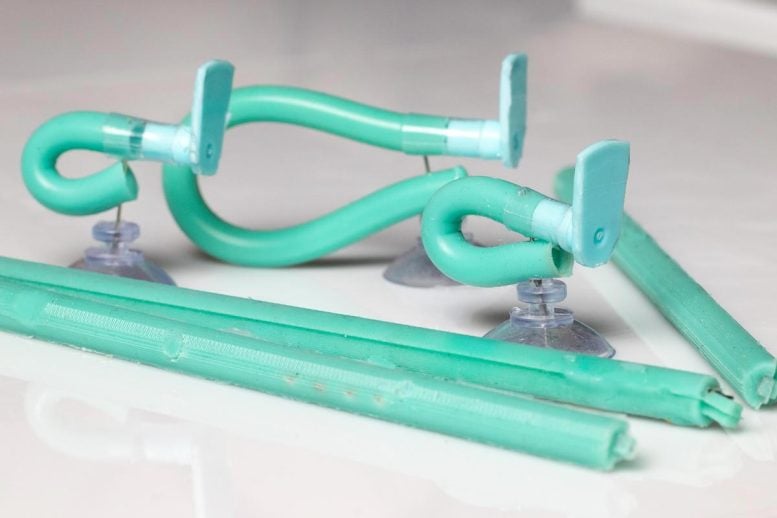
By studying a slender, leaping parasite thinner than a human hair, engineers at Georgia Tech developed a soft robot capable of hopping both forward and backward.
Inspired by the jumping movements of a tiny parasitic worm, engineers at Georgia Tech have developed a 5-inch soft robot capable of leaping as high as a basketball hoop.
The robot, constructed from a silicone rod reinforced with a carbon-fiber spine, achieves jumps reaching heights of up to 10 feet despite lacking legs. The design was inspired by high-speed video recordings of nematodes, which revealed how these worms contract their bodies into unusual shapes to propel themselves forward and backward.
Their findings were recently published in the journal Science Robotics. According to the researchers, their work could advance the creation of robotic systems capable of navigating diverse terrains by jumping varying heights and moving flexibly in multiple directions.
Understanding nematode jump mechanics
“Nematodes are amazing creatures with bodies thinner than a human hair,” said Sunny Kumar, lead coauthor of the paper and a postdoctoral researcher in the School of Chemical and Biomolecular Engineering (ChBE). “They don’t have legs but can jump up to 20 times their body length. That’s like me laying down and somehow leaping onto a three-story building.”
Nematodes, also known as round worms, are among the most abundant creatures on Earth. They live in the environment and within humans, insects, and animals. They can cause illnesses in their host, which sometimes can be beneficial. For instance, farmers and gardeners use nematodes instead of pesticides to kill invasive insects and protect plants.
One way they latch onto their host before entering their bodies is by jumping. Using high-speed cameras, Victor Ortega-Jimenez — a former Georgia Tech research scientist who’s now a faculty member at the University of California, Berkeley — watched the creatures bend their bodies into different shapes based on where they wanted to go.
Physics of direction control through body shape
To hop backward, nematodes point their head up while tightening the midpoint of their body to create a kink. The shape is similar to a person in a squat position. From there, the worm uses stored energy in its contorted shape to propel backward, end over end, just like a gymnast doing a backflip.
To jump forward, the worm points its head straight and creates a kink on the opposite end of its body, pointed high in the air. The stance is similar to someone preparing for a standing broad jump. But instead of hopping straight, the worm catapults upward.

“Changing their center of mass allows these creatures to control which way they jump. We’re not aware of any other organism at this tiny scale that can efficiently leap in both directions at the same height,” Kumar said.
And they do it despite nearly tying their bodies into a knot.
“Kinks are typically dealbreakers,” said Ishant Tiwari, a ChBE postdoctoral fellow and lead coauthor of the study. “Kinked blood vessels can lead to strokes. Kinked straws are worthless. Kinked hoses cut off water. But a kinked nematode stores energy that is used to propel itself in the air.”

Building and testing the leaping robot
After watching their videos, the team created simulations of the jumping nematodes. Then they built soft robots to replicate the leaping worms’ behavior, later reinforcing them with carbon fibers to accelerate the jumps
Kumar and Tiwari work in Associate Professor Saad Bhamla’s lab. They collaborated on the project with Ortega-Jimenez and researchers at the University of California, Riverside.
The group found that the kinks allow nematodes to store more energy with each jump. They rapidly release it — in a tenth of a millisecond — to leap, and they’re tough enough to repeat the process multiple times.

The study suggests that engineers could create simple elastic systems made of carbon fiber or other materials that could withstand and exploit kinks to hop across various terrain.
“A jumping robot was recently launched to the moon, and other leaping robots are being created to help with search and rescue missions, where they have to traverse unpredictable terrain and obstacles,” Kumar said. “Our lab continues to find interesting ways that creatures use their unique bodies to do interesting things, then build robots to mimic them.”
Reference: “Reversible kink instability drives ultrafast jumping in nematodes and soft robots” by Sunny Kumar, Ishant Tiwari, Victor M. Ortega-Jimenez, Adler R. Dillman, Dongjing He, Yuhang Hu and Saad Bhamla, 23 April 2025, Science Robotics.
DOI: 10.1126/scirobotics.adq3121
The work was supported by the National Institutes of Health, grant Nos. R35GM142588 and R35GM137934, and the National Science Foundation, grant Nos. PHY-2310691 and CMMI-2218382.
Never miss a breakthrough: Join the SciTechDaily newsletter.
Follow us on Google and Google News.