
Close Menu
    Facebook X (Twitter) Instagram
    SciTechDaily
    • Biology
    • Chemistry
    • Earth
    • Health
    • Physics
    • Science
    • Space
    • Technology
    Facebook X (Twitter) Pinterest YouTube RSS
    SciTechDaily
    Home»Science»Three-Eyed “Fossil Monster” – 520 Million-Year-Old Fossil Reveals Amazing Detail of Early Animal Evolution
    Science

    Three-Eyed “Fossil Monster” – 520 Million-Year-Old Fossil Reveals Amazing Detail of Early Animal Evolution

    By University of LeicesterSeptember 1, 20231 Comment4 Mins Read
    Facebook Twitter Pinterest Telegram LinkedIn WhatsApp Email Reddit
    Share
    Facebook Twitter LinkedIn Pinterest Telegram Email Reddit
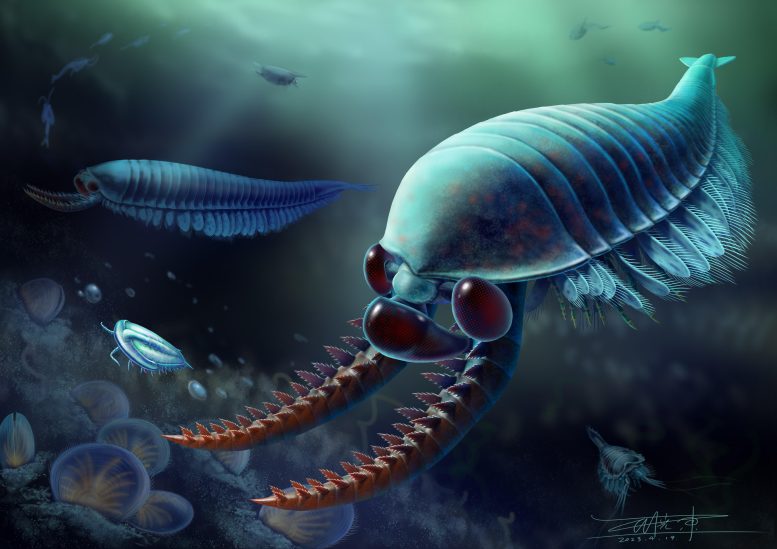
    Artistic Reconstruction of Kylinxia
    Artistic reconstruction of Kylinxia. Credit: X. Wang

    Researchers from the University of Leicester and the Yunnan Key Laboratory for Palaeobiology employed advanced scanning technology to recreate a ‘fossil monster’ that lived half a billion years ago.

    A collaborative team involving researchers from the University of Leicester, Yunnan Key Laboratory for Palaeobiology, Yunnan University’s Institute of Palaeontology, the Chengjiang Fossil Museum, and London’s Natural History Museum have re-examined a unique fossil animal found in nearly 520-million-year-old rocks. This reevaluation helps fill a knowledge gap in the evolutionary history of animals known as arthropods.

    The animal, which has the scientific name Kylinxia, was imaged using a CT scanner which revealed its soft anatomy buried in the rock. The size of a large shrimp, its surprising features include three eyes on the head and a pair of fearsome limbs presumably used to catch prey.

    The study was recently published in the journal Current Biology.
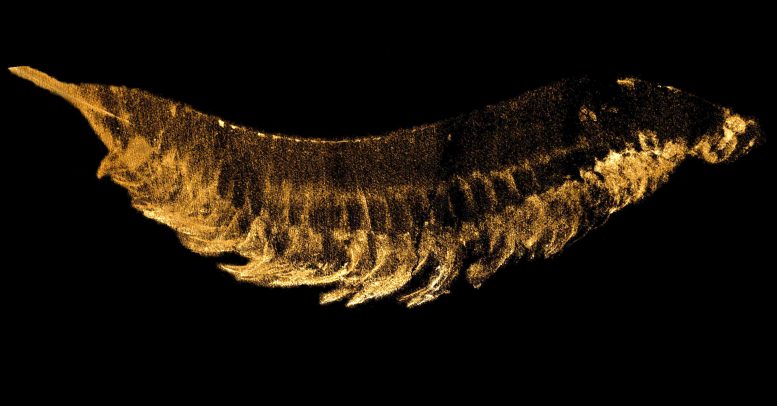
    CT Scan Kylinxia zhangi
    CT images of the fossil animal Kylinxia zhangi from southern China. The animal is the size of a large shrimp, with its front end to the right. This image clearly shows the segmentation of the body and the large eyes at the front. Credit: Courtesy of Professor Yu Liu, Yunnan University

    Fossils of many kinds of marine animals first appeared in rocks from about half a billion years ago and signal a time when complex ecosystems were developing in the world’s oceans. One of the key localities for such fossils is the area around the town of Chengjiang in southern China, where the fossils in this study were collected by the Chinese team. The fossils were recovered from the Cambrian Chengjiang biota of China’s Yunnan Province, from which over 250 species of exceptionally preserved fossil organisms have been described.

    The new find is important for deciphering the history of arthropods. These are animals whose bodies are divided into segments, most of which bear a paired of jointed limbs, like crabs, lobsters, insects, and spiders.
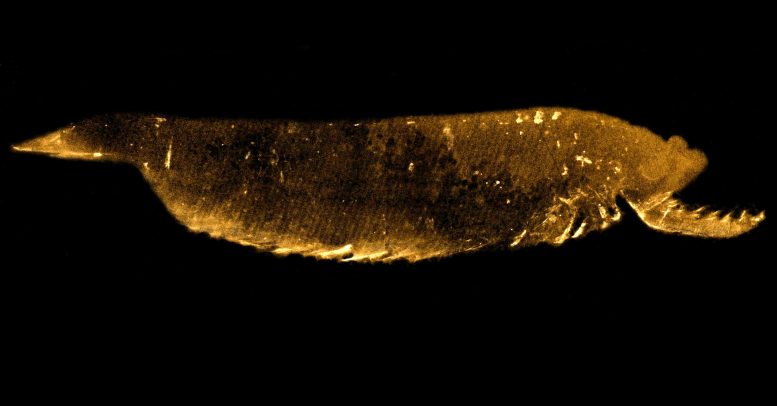
    CT Scan Limbs Extended Kylinxia zhangi
    CT images of the fossil animal Kylinxia zhangi from southern China. This image shows the large frontal limbs extended. Credit: Courtesy of Professor Yu Liu, Yunnan University

    Although there are plenty of arthropods in the fossil record – most famously the trilobites – the vast majority only preserve their hard skeletons. Because the new Chinese material is preserved nearly completely, the team was able to image the head of Kylinxia, identifying six segments: the front one bearing eyes, the second with a pair of large grasping limbs, and the other four each bearing a pair of jointed limbs.

    Lead author of the study Robert O’Flynn, a Ph.D. student at the University of Leicester School of Geography, Geology and the Environment, said: “The preservation of the fossil animal is amazing. After CT-scanning we can digitally turn it around and literally stare into the face of something that was alive over 500 million years ago. As we spun the animal around, we could see that its head possesses six segments, just as in many living arthropods.”
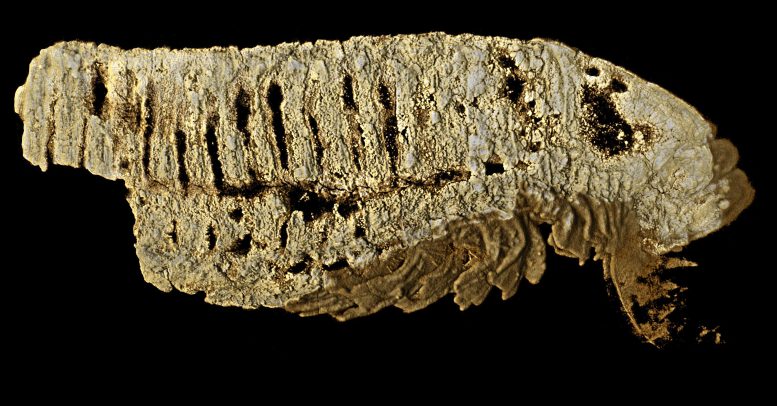
    Micro Ct Model of Kylinxia
    Micro-CT model of Kylinxia showing features in the head. Credit: Courtesy of Professor Yu Liu, YKLP

    Professor Mark Williams, Robert’s primary supervisor at the University of Leicester, said: “Kylinxia, and the Chengjiang biota whence it came, are instrumental to building our understanding of early euarthropod evolution. I like to think that similar discoveries will continue to be made by Robert.”

    Professor Yu Liu from the Yunnan Key Laboratory for Palaeobiology said: “Robert and I were examining the micro-CT data as part of his doctoral thesis in the hope of refining and correcting previous interpretation of head structures in this genus, Kylinxia. Amazingly, we found that its head is composed of six segments, as in, e.g., insects.”

    Dr Greg Edgecombe from the Natural History Museum added: “Most of our theories on how the head of arthropods evolved were based on these early-branching species having fewer segments than living species. Discovering two previously undetected pairs of legs in Kylinxia suggests that living arthropods inherited a six-segmented head from an ancestor at least 518 million years ago.”

    Reference: “The early Cambrian Kylinxia zhangi and evolution of the arthropod head” by Robert J. O’Flynn, Yu Liu, Xianguang Hou, Huijuan Mai, Mengxiao Yu, Songling Zhuang, Mark Williams, Jin Guo and Gregory D. Edgecombe, 28 August 2023, Current Biology.
    DOI: 10.1016/j.cub.2023.08.022

    The study was funded by the Science Foundation of Yunnan Province.

    Never miss a breakthrough: Join the SciTechDaily newsletter.
    Follow us on Google and Google News.

    Evolutionary Biology Fossils Paleobiology Paleontology Popular University of Leicester
    Share. Facebook Twitter Pinterest LinkedIn Email Reddit

    Related Articles

    Historic Discovery: Ancient Venomous Reptile Species Discovered in Arizona

    Hell Creek’s Deadly Predators: Newly Discovered Prehistoric Birds of Prey Hunted Baby Dinosaurs

    Scientists Uncover Terrestrial Secret Behind Pterosaurs’ Enormous Size

    What a Bizarre Taco-Shaped Sea Creature Can Teach Us About Evolution

    “Utterly Bizarre” – Scientists Discover Another New Species of Dinosaur on Isle of Wight

    Scientists Discover New “Primitive Cousins of T. Rex” – Finding Sheds Light on the End of the Age of Dinosaurs in Africa

    500-Million-Year-Old Fossil Reveals Astonishing Secrets of a Strange Group of Marine Invertebrates

    Bizarre: Scientists Discover New Species of Mosasaur With Strange “Screwdriver Teeth”

    Controversial Prehistoric Egg Identified To Be the Last of the “Demon Ducks of Doom”

    1 Comment

    1. Mark R Reed on September 2, 2023 10:27 am

      ANOTHER ONE OF NATURES AMAZING CREATURES.

      Reply
    Leave A Reply Cancel Reply

    • Facebook
    • Twitter
    • Pinterest
    • YouTube

    Don't Miss a Discovery

    Subscribe for the Latest in Science & Tech!

    Trending News

    Millions Take These IBS Drugs, But a New Study Finds Serious Risks

    Scientists Unlock Hidden Secrets of 2,300-Year-Old Mummies Using Cutting-Edge CT Scanner

    Bread Might Be Making You Gain Weight Even Without Eating More Calories

    Scientists Discover Massive Magma Reservoir Beneath Tuscany

    Europe’s Most Active Volcano Just Got Stranger – Here’s Why Scientists Are Rethinking It

    Alzheimer’s Symptoms May Start Outside the Brain, Study Finds

    Millions Take This Popular Supplement – Scientists Discover a Concerning Link to Heart Failure

    The Universe Is Expanding Too Fast and Scientists Can’t Explain Why

    Follow SciTechDaily
    • Facebook
    • Twitter
    • YouTube
    • Pinterest
    • Newsletter
    • RSS
    SciTech News
    • Biology News
    • Chemistry News
    • Earth News
    • Health News
    • Physics News
    • Science News
    • Space News
    • Technology News
    Recent Posts
    • Doctors Surprised by the Power of a Simple Drug Against Colon Cancer
    • Why Popular Diabetes Drugs Like Ozempic Don’t Work for Everyone: The “Genetic Glitch”
    • Scientists Create Improved Insulin Cells That Reverse Diabetes in Mice
    • Scientists Stunned After Finding Plant Thought Extinct for 60 Years
    • A Common Diabetes Drug May Hold the Key to Stopping HIV From Coming Back
    Copyright © 1998 - 2026 SciTechDaily. All Rights Reserved.
    • Science News
    • About
    • Contact
    • Editorial Board
    • Privacy Policy
    • Terms of Use

    Type above and press Enter to search. Press Esc to cancel.