
Close Menu
    Facebook X (Twitter) Instagram
    SciTechDaily
    • Biology
    • Chemistry
    • Earth
    • Health
    • Physics
    • Science
    • Space
    • Technology
    Facebook X (Twitter) Pinterest YouTube RSS
    SciTechDaily
    Home»Science»Tiny GPS Backpacks Uncover the Secret Life of Desert Bats
    Science

    Tiny GPS Backpacks Uncover the Secret Life of Desert Bats

    By Ricardo Rocha & Irene Conenna, University of HelsinkiAugust 19, 20192 Comments3 Mins Read
    Facebook Twitter Pinterest Telegram LinkedIn WhatsApp Email Reddit
    Share
    Facebook Twitter LinkedIn Pinterest Telegram Email Reddit
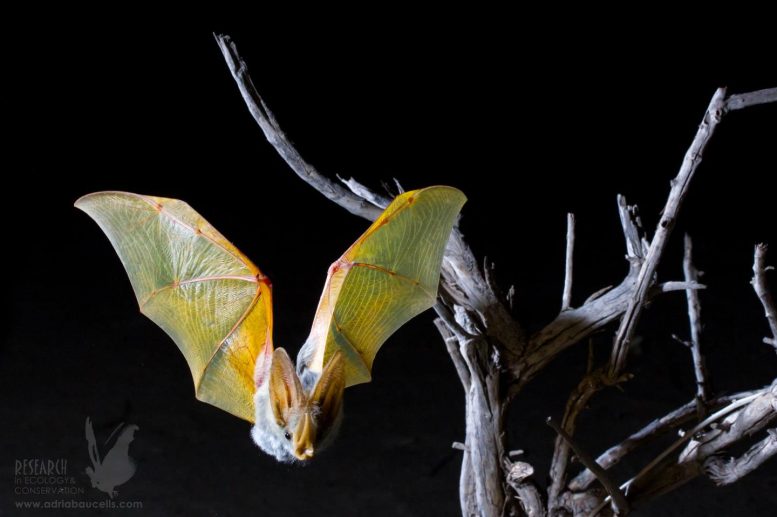
    Yellow Winged Bat
    Yellow Winged Bat. Bats are some of the most successful desert mammals. Credit: Adrià López-Baucells

    A new study from the University of Helsinki using miniaturized satellite-based tags revealed that during drier periods desert bats must fly further and longer to fulfill their nightly needs. According to researchers, this signals their struggle in facing dry periods.

    Wildlife tracking has revolutionized the study of animal movement and their behavior. Yet, tracking small, flying animals such as desert bats remained challenging. Now a new generation of miniaturized satellite-based tags is allowing unique insights into the life of these mysterious mammals.

    Researchers used 1 g (0.35 oz) GPS devices to reconstruct the movements of yellow-winged bats, one of two false vampire bats occurring in Africa and one of the few desert bats large enough to carry this innovative technology. “GPS tags have seen up to now a limited use with insectivorous bats due to weight constraints and low success in data collection – we achieved great results in tracking such a light species”, says Irene Conenna, a Ph.D. candidate at the University of Helsinki and the lead author of the study.

    Future under the changing climate?

    “Bats are some of the most successful desert mammals. Powered flight allows them to efficiently track scarce resources and their nocturnal lifestyle buffers them from the baking sun. However, they still struggle to find enough resources during the drier periods of the year”, says Ricardo Rocha, one of the co-authors of the paper.

    The study was conducted in Sibiloi National Park, Northern Kenya, along the shores of Lake Turkana, the world’s largest desert lake. Researchers placed GPS loggers in 29 bats, 15 in the rainy season and 14 in the dry season, for one week. Their whereabouts were recorded every 30 to 60 minutes every night. This revealed that during dry periods bats used larger home ranges and had extended activity periods, potentially to compensate for a shortage in food resources.

    Bats comprise roughly one-fifth of all mammal species and deserts are home to over 150 bat species. They display wide variation in morphology, foraging behavior, and habitat use, making them an excellent indicator group for assessing how species respond to changes in their habitats. “The responses exhibited by bats offer important insights into the responses of other taxonomic groups”, explains Conenna. “These new miniaturized satellite-based tags now allow us to better understand how increased aridity affects bats foraging efficiency, leading us one step forward to understanding limits in aridity tolerance and impacts of climate change”, adds Conenna.

    Deserts around the world are getting warmer and as they warm desert creatures need to cope with even harsher conditions. “Understanding how animals cope with seasonal changes is key to understand how they might react to the challenges in the horizon. New technological devices, such as miniaturized satellite-based loggers, go a long way to help us in this task.”, adds Mar Cabeza, senior author of the study, University of Helsinki.

    Reference: “Movement seasonality in a desert-dwelling bat revealed by miniature GPS loggers” by Irene Conenna, Adrià López-Baucells, Ricardo Rocha, Simon Ripperger and Mar Cabeza, 16 August 2019, Movement Ecology,  
    DOI : 10.1186/s40462-019-0170-8

    Never miss a breakthrough: Join the SciTechDaily newsletter.
    Follow us on Google and Google News.

    Bats GPS University of Helsinki
    Share. Facebook Twitter Pinterest LinkedIn Email Reddit

    Related Articles

    Giant Crocodylians Ruled South America’s Ancient Food Chain

    Rewriting History: Researchers Uncover a Forgotten Amazon Civilization That May Have Housed 3 Million People

    This Fossil Upends a Decades-Old Debate About Snake Evolution

    Study of 30,000 Shoppers Reveals Hidden Environmental Cost of Treat Foods

    Researcher Finally Solves Math Question Left Unanswered for Over 40 Years

    Storm Surfers of the Sky: How Bats Harness Winds to Power Migration

    Storm Surfers: How Bats Harness Weather to Travel Thousands of Miles

    The Surprising Science and Hidden History of Traditional String Figures

    Fukushima’s Lingering Mystery: Scientists Conduct First-Ever Imaging of Radioactive Cesium

    2 Comments

    1. Ben Sherman on August 19, 2019 9:54 am

      it looks interesting

      Reply
    2. Dr.S on August 20, 2019 7:43 am

      1g GPS? This sounds like an agency device…

      Reply
    Leave A Reply Cancel Reply

    • Facebook
    • Twitter
    • Pinterest
    • YouTube

    Don't Miss a Discovery

    Subscribe for the Latest in Science & Tech!

    Trending News

    These Toads Are Surviving a Deadly Fungus – Scientists May Finally Know Why

    These Brain Cells May Explain Why We Eventually Have To Sleep

    Tomatoes Contain an Invisible Ingredient With Surprising Effects on Liver Health

    World’s First Heat-Powered Cooling System Turns Waste Heat Into Cold

    Antarctica Gained a Record 695 Billion Tons of Ice in Just Two Years

    Don’t Miss: A Brilliant Venus and Glowing Harvest Moon Light Up the Sky

    New Twist on the Einstein Problem Reveals Unexpected Physics

    JWST Captures Stunning Evidence of How Supermassive Black Holes Feed

    Follow SciTechDaily
    • Facebook
    • Twitter
    • YouTube
    • Pinterest
    • Newsletter
    • RSS
    SciTech News
    • Biology News
    • Chemistry News
    • Earth News
    • Health News
    • Physics News
    • Science News
    • Space News
    • Technology News
    Recent Posts
    • Cardiac Breakthrough Could Offer Lifesaving Treatment to More Patients
    • Scientists Uncover New Clues Behind the “Suicide Headache” Mystery
    • Depression in Later Life May Be an Early Warning Sign of Alzheimer’s
    • Physicists Find Useful Energy Hiding in Quantum “Waste Heat”
    • Largest-Ever Physics Survey Raises New Doubts About Our Model of the Universe
    Copyright © 1998 - 2026 SciTechDaily. All Rights Reserved.
    • Science News
    • About
    • Contact
    • Editorial Board
    • Privacy Policy
    • Terms of Use

    Type above and press Enter to search. Press Esc to cancel.