
Close Menu
    Facebook X (Twitter) Instagram
    SciTechDaily
    • Biology
    • Chemistry
    • Earth
    • Health
    • Physics
    • Science
    • Space
    • Technology
    Facebook X (Twitter) Pinterest YouTube RSS
    SciTechDaily
    Home»Earth»Tiny Magnetic Particles in Microscopic Fossils Record Ancient Climate Conditions
    Earth

    Tiny Magnetic Particles in Microscopic Fossils Record Ancient Climate Conditions

    By University of UtahMay 30, 20211 Comment3 Mins Read
    Facebook Twitter Pinterest Telegram LinkedIn WhatsApp Email Reddit
    Share
    Facebook Twitter LinkedIn Pinterest Telegram Email Reddit
    Magnetofossils With Cuboctahedra
    Transmission electron microscope images of magnetofossils with examples of cuboctahedra (top center, rounded) and elongated prisms (bottom center, square). Credit: Courtney Wagner/University of Utah

    Microscopic fossils in New Jersey’s coastal sediments reveal how ocean chemistry shifted during ancient global warming, helping scientists forecast modern climate effects.

    Fifty-six million years ago, as the Earth’s climate warmed by five to eight degrees C, new land mammals evolved, tropical forests expanded, giant insects and reptiles appeared and the chemistry of the ocean changed. Through it all, bacteria in the ocean in what is now New Jersey kept a record of the changes in their environment through forming tiny magnetic particles. Now, those particles and their record are all that’s left of these microorganisms. Thanks to new research tools, that record is finally being read.

    In research published in the journal Paleoceanography and Paleoclimatology, researchers including University of Utah doctoral student Courtney Wagner and associate professor Peter Lippert report the climate clues that can be found by analyzing the magnetic fossil particles, or magnetofossils.

    “We interpret the relative abundances of these different populations of magnetofossils based on shape and size, which are a function of bacteria species, to encode environmental changes that are not as apparent in other fossil data sets or geochemical proxies,” Lippert says.

    Using their FORC method (which stands for first-order reversal curves, a way of magnetically measuring and statistically describing the magnetic signatures in a sample of rock or sediment) they teased out three different subsets of magnetofossils from ancient coastal marine sediments.
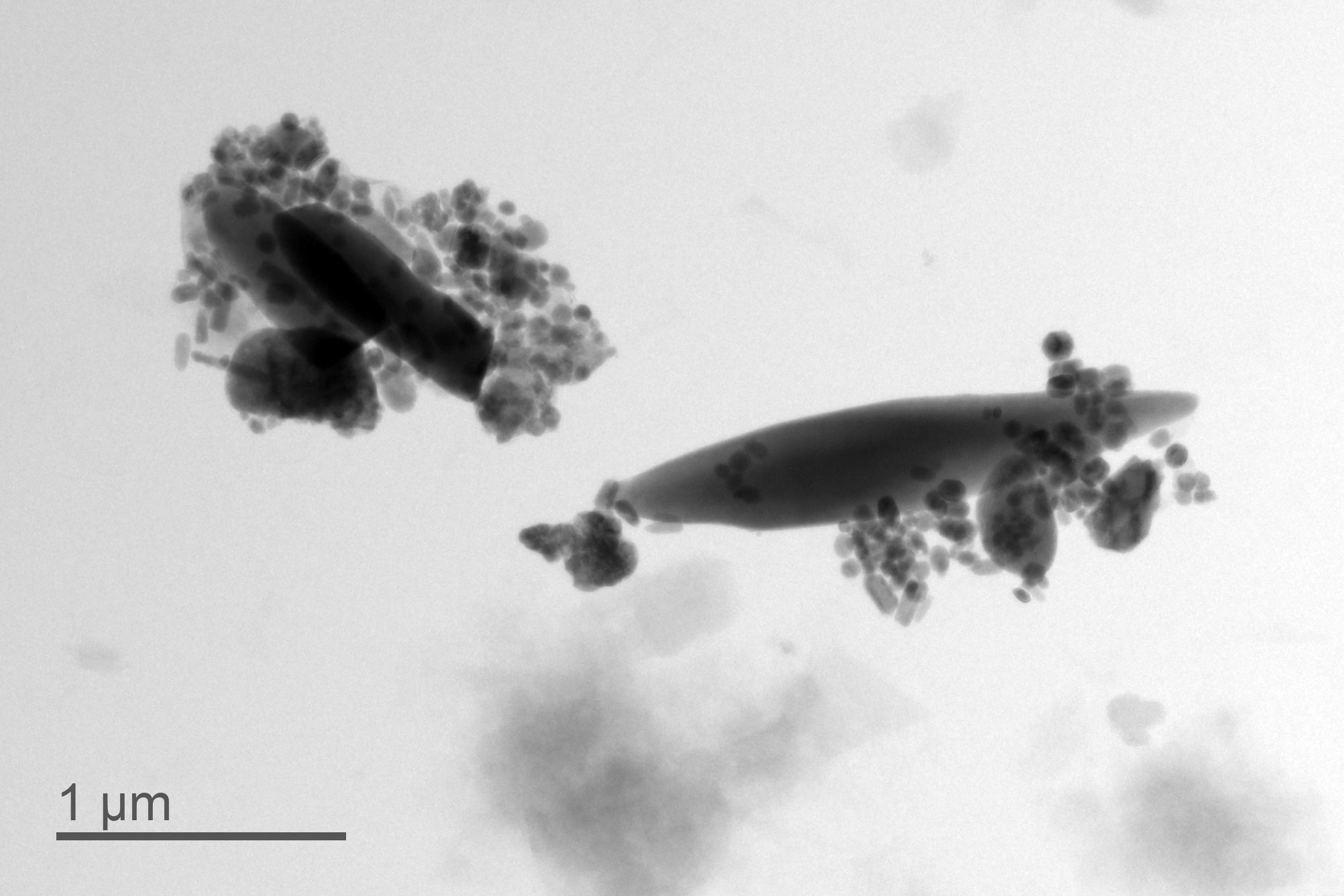
    Examples of Giant Magnetofossils
    Transmission electron microscope image of magnetofossils with examples of giant magnetofossils (giant bullets, in left cluster, and spindles, in right cluster). Credit: Courtney Wagner/University of Utah

    Oxygen, Iron, and Environmental Instability

    “Each of the magnetofossil populations tells us something a little different about the environment,” Wagner says. One consists of “giant needle-shaped” magnetofossils, associated with increased iron and an expansion of a gradient between oxygenated and deoxygenated seawater. Another contains “equant” magnetofossils, which may record more stable, long-term conditions in the ocean and the last contains “elongated” magnetofossils, which may indicate seasonal conditions.

    The results are important because they allow researchers to track the chemistry of the ocean throughout a global warming event similar to what the Earth is currently experiencing. For example, the results seem to show that the New Jersey coast rapidly declined in oxygen near the beginning of the ancient warming event and then oxygen levels fluctuated thereafter.

    “All this has potential implications for understanding how climate change will affect these sensitive coastal ecosystems today and in the future,” Wagner says.

    Reference: “Diversification of Iron-Biomineralizing Organisms During the Paleocene-Eocene Thermal Maximum: Evidence From Quantitative Unmixing of Magnetic Signatures of Conventional and Giant Magnetofossils” by Courtney L. Wagner, Ioan Lascu, Peter C. Lippert, Ramon Egli, Kenneth J. T. Livi and Helen B. Sears, 23 April 2021, Paleoceanography and Paleoclimatology.
    DOI: 10.1029/2021PA004225

    Funding: Robert Hevey and Constance M. Filling Fellowship, Evolving Earth Foundation Research Grant, P.E.O. Scholar Award, Schlanger Ocean Drilling Fellowship, Edward and Hellen Hintz Secretarial Scholarship, National Museum of Natural History Research Grant, U.S. Geological Survey, University of California, Santa Cruz, Yale University, Paleontological Society, and Evolving Earth Foundation

    Never miss a breakthrough: Join the SciTechDaily newsletter.
    Follow us on Google and Google News.

    Bacteria Climate Change Climate Science Oceanography Paleontology Popular University of Utah
    Share. Facebook Twitter Pinterest LinkedIn Email Reddit

    Related Articles

    How Cold Was the Last Ice Age? Researchers Have Now Mapped the Temperature Differences Across the Globe

    “Carnian Pluvial Episode” Revealed: Climate Change During Origin of Dinosaurs

    Ringing of the Global Atmosphere Detected by Scientists

    Archaeologists Uncover a Lost World and Extinct Ecosystem

    Shedding New Light on the Ocean’s Living Carbon Pump

    Proof in an Ancient Shell: Earth Turned Faster 70 Million Years Ago

    Ancient Antarctica Rainforest Discovery Suggests Prehistoric World Much Warmer Than Thought

    Global Warming, Ocean Acidification: Earth Was Stressed Before Dinosaur Extinction

    Mystery in Global Carbon Cycle Uncovered by Investigation of Oceanic ‘Black Carbon’

    1 Comment

    1. Dr. Ken Towe on June 1, 2021 6:25 am

      I’m skeptical. These magnetobacteria are found today in many environments. What do these modern versions tell us about the current climate wherever they have been found? There should be some reasonable correlation if using a few curious pieces of magnetite from the New Jersey past can mean anything.

      Reply
    Leave A Reply Cancel Reply

    • Facebook
    • Twitter
    • Pinterest
    • YouTube

    Don't Miss a Discovery

    Subscribe for the Latest in Science & Tech!

    Trending News

    Millions Take These IBS Drugs, But a New Study Finds Serious Risks

    Scientists Unlock Hidden Secrets of 2,300-Year-Old Mummies Using Cutting-Edge CT Scanner

    Bread Might Be Making You Gain Weight Even Without Eating More Calories

    Scientists Discover Massive Magma Reservoir Beneath Tuscany

    Europe’s Most Active Volcano Just Got Stranger – Here’s Why Scientists Are Rethinking It

    Alzheimer’s Symptoms May Start Outside the Brain, Study Finds

    Millions Take This Popular Supplement – Scientists Discover a Concerning Link to Heart Failure

    The Universe Is Expanding Too Fast and Scientists Can’t Explain Why

    Follow SciTechDaily
    • Facebook
    • Twitter
    • YouTube
    • Pinterest
    • Newsletter
    • RSS
    SciTech News
    • Biology News
    • Chemistry News
    • Earth News
    • Health News
    • Physics News
    • Science News
    • Space News
    • Technology News
    Recent Posts
    • Simple Blood Test May Predict Alzheimer’s Years Before Brain Scans Show Signs
    • Scientists Say Adding This Unusual Seafood to Your Diet Could Reverse Signs of Aging
    • U.S. Waste Holds $5.7 Billion Worth of Crop Nutrients
    • Scientists Say a Hidden Structure May Exist Inside Earth’s Core
    • Doctors Surprised by the Power of a Simple Drug Against Colon Cancer
    Copyright © 1998 - 2026 SciTechDaily. All Rights Reserved.
    • Science News
    • About
    • Contact
    • Editorial Board
    • Privacy Policy
    • Terms of Use

    Type above and press Enter to search. Press Esc to cancel.