
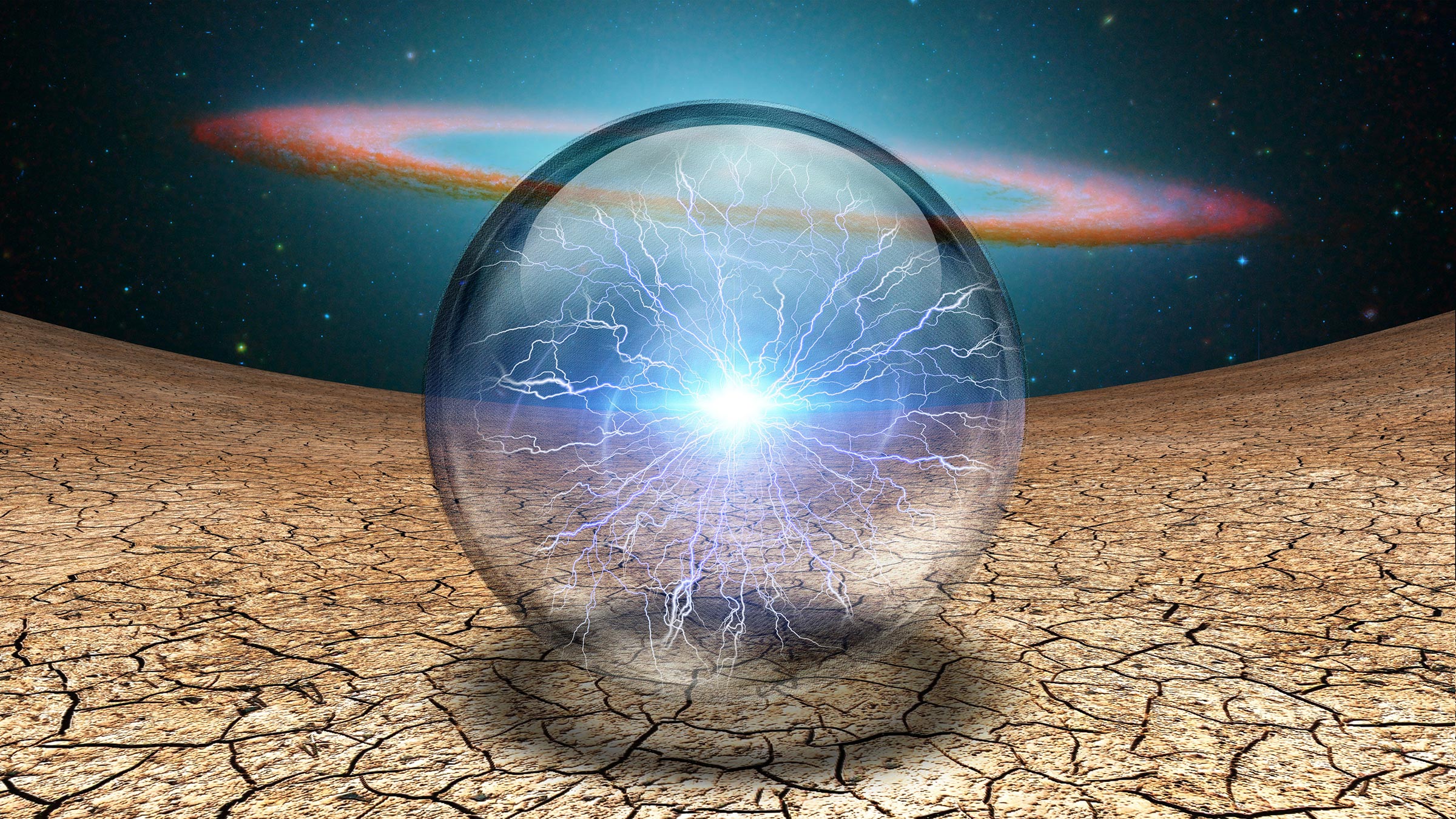
Forget the dramatic lightning strike – life may have started with countless tiny sparks from crashing water droplets!
Scientists found that when mist and sprays collide, they generate microlightning capable of forming essential organic molecules. This discovery challenges old theories and suggests life may have begun in places as simple as waterfalls or ocean waves.
Microlightning: A New Theory for Life’s Origins
Life may not have started with a dramatic lightning bolt striking the ocean. Instead, tiny “microlightning” sparks generated by water droplets from crashing waves and waterfalls may have played a key role.
New research from Stanford University reveals that when water is sprayed into a mixture of gases resembling Earth’s early atmosphere, it can produce organic molecules containing carbon-nitrogen bonds. These molecules include uracil, a fundamental component of DNA and RNA.
Challenging the Miller-Urey Hypothesis
Published today (March 14) in Science Advances, the study provides fresh support for the long-debated Miller-Urey hypothesis, which suggests that life began with a lightning strike. This idea originated from a 1952 experiment demonstrating that organic compounds could form when electricity interacted with water and inorganic gases.
However, the latest findings suggest that electricity wasn’t necessarily required. The researchers discovered that water droplets naturally generate tiny electrical charges, creating the same organic molecules without the need for an external energy source.
“Microelectric discharges between oppositely charged water microdroplets make all the organic molecules observed previously in the Miller-Urey experiment, and we propose that this is a new mechanism for the prebiotic synthesis of molecules that constitute the building blocks of life,” said senior author Richard Zare, the Marguerite Blake Wilbur Professor of Natural Science and professor of chemistry in Stanford’s School of Humanities and Sciences.
Microlightning’s power and potential
For a couple of billion years after its formation, Earth is believed to have had a swirl of chemicals but almost no organic molecules with carbon-nitrogen bonds, which are essential for proteins, enzymes, nucleic acids, chlorophyll, and other compounds that make up living things today.
How these biological components came about has long puzzled scientists, and the Miller-Urey experiment provided one possible explanation: that lightning striking into the ocean and interacting with early planet gases like methane, ammonia, and hydrogen could create these organic molecules. Critics of that theory have pointed out that lightning is too infrequent and the ocean too large and dispersed for this to be a realistic cause.
How Water Droplets Generate Energy
Zare, along with postdoctoral scholars Yifan Meng and Yu Xia, and graduate student Jinheng Xu, propose another possibility with this research. The team first investigated how droplets of water developed different charges when divided by a spray or splash. They found that larger droplets often carried positive charges, while smaller ones were negative. When the oppositely charged droplets came close to each other, sparks jumped between them. Zare calls this “microlightning,” since the process is related to the way energy is built up and discharged as lightning in clouds. The researchers used high-speed cameras to document the flashes of light, which are hard to detect with the human eye.
Even though the tiny flashes of microlightning may be hard to see, they still carry a lot of energy. The researchers demonstrated that power by sending sprays of room temperature water into a gas mixture containing nitrogen, methane, carbon dioxide, and ammonia gases, which are all thought to be present on early Earth. This resulted in the formation of organic molecules with carbon-nitrogen bonds including hydrogen cyanide, the amino acid glycine, and uracil.
Crashing Waves, Waterfalls, and the Spark of Life
The researchers argue that these findings indicate that it was not necessarily lightning strikes, but the tiny sparks made by crashing waves or waterfalls that jump-started life on this planet.
“On early Earth, there were water sprays all over the place – into crevices or against rocks, and they can accumulate and create this chemical reaction,” Zare said. “I think this overcomes many of the problems people have with the Miller-Urey hypothesis.”
Reevaluating Water’s Role in Chemistry
Zare’s research team focuses on investigating the potential power of small bits of water, including how water vapor may help produce ammonia, a key ingredient in fertilizer, and how water droplets spontaneously produce hydrogen peroxide.
“We usually think of water as so benign, but when it’s divided in the form of little droplets, water is highly reactive,” he said.
Reference: “Spraying of water microdroplets forms luminescence and causes chemical reactions in surrounding gas” by Yifan Meng, Yu Xia, Jinheng Xu and Richard N. Zare, 14 March 2025, Science Advances.
DOI: 10.1126/sciadv.adt8979
Acknowledgments
Zare is also a member of Stanford Bio-X, the Cardiovascular Institute, Stanford Cancer Institute, and the Wu Tsai Neurosciences Institute as well as an affiliate of the Stanford Woods Institute for the Environment.
This research received support from the Air Force Office of Scientific Research and the National Natural Science Foundation of China.
Never miss a breakthrough: Join the SciTechDaily newsletter.
Follow us on Google and Google News.