

Close Menu
    Facebook X (Twitter) Instagram
    SciTechDaily
    • Biology
    • Chemistry
    • Earth
    • Health
    • Physics
    • Science
    • Space
    • Technology
    Facebook X (Twitter) Pinterest YouTube RSS
    SciTechDaily
    Home»Science»Titanium Made Affordable: Japanese Scientists Unveil New Low-Cost Production Method
    Science

    Titanium Made Affordable: Japanese Scientists Unveil New Low-Cost Production Method

    By Institute of Industrial Science, The University of TokyoJune 18, 20242 Comments3 Mins Read
    Facebook Twitter Pinterest Telegram LinkedIn WhatsApp Email Reddit
    Share
    Facebook Twitter LinkedIn Pinterest Telegram Email Reddit
    Stainless Steel Titanium
    Researchers at the University of Tokyo have developed a new method to produce titanium with minimal oxygen content, significantly reducing the production costs. Their study introduces a cost-effective process using yttrium to lower oxygen levels to 0.02% by mass. This breakthrough could enable wider industrial use of titanium, although the presence of yttrium, up to 1% by mass in the titanium alloy, poses a challenge that needs addressing to fully realize the potential applications in manufacturing.

    A new method developed by Tokyo researchers significantly cuts the cost of producing low-oxygen titanium, promising broader industrial use once issues with yttrium contamination are resolved.

    Titanium ranks as the ninth most abundant element in the Earth’s crust, but products made from pure titanium are rare due to the high cost of extracting oxygen from titanium ore. Lowering these costs could prompt manufacturers to leverage titanium’s beneficial properties more widely in their products.

    Now, in a study recently published in Nature Communications, researchers from the Institute of Industrial Science at the University of Tokyo, have developed a procedure that reduces the cost of producing titanium that’s almost entirely free of oxygen. This oxygen removal protocol might benefit technological development and environmental sustainability.

    Properties and Challenges of Titanium

    Titanium is an incredibly versatile material because not only does it typically resist chemical damage, it’s strong yet light. For example, its lightweight compared with other metals is why the base frame of modern iPhones consists of titanium alloy, despite the increased cost.
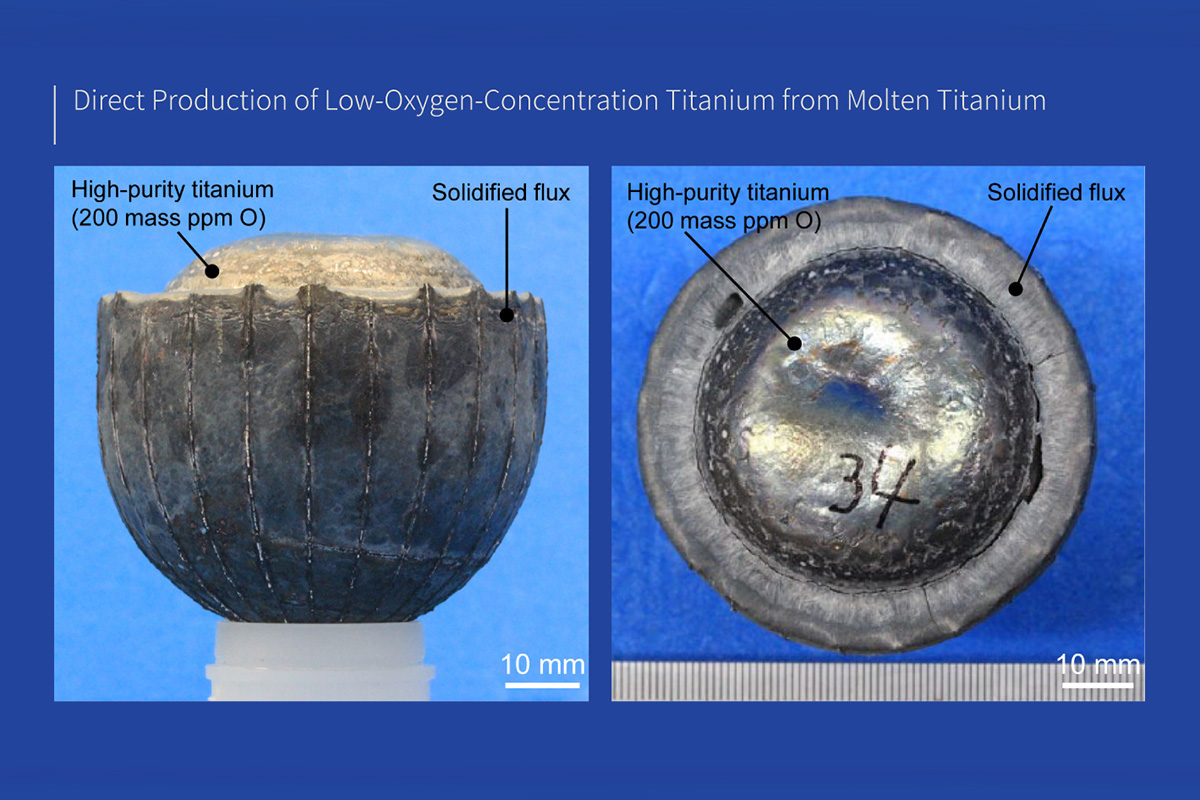
    Direct Production of Low Oxygen Concentration Titanium From Molten Titanium
    Researchers from the Institute of Industrial Science, The University of Tokyo, have efficiently removed oxygen from high-oxygen-concentration titanium, which might help reduce the production cost of an otherwise versatile metal. Credit: Institute of Industrial Science, The University of Tokyo

    Unfortunately, producing ultrapure titanium is significantly more expensive than manufacturing steel (an iron alloy) and aluminum, owing to the substantial use of energy and resources in preparing high-purity titanium. Developing a cheap, easy way to prepare it—and facilitate product development for industry and common consumers—is the problem the researchers aimed to address.

    Innovative Oxygen Removal Technology

    “Industry mass-produces iron and aluminum metal—but not titanium metal, because of the expense of removing the oxygen from the ore,” explains Toru H. Okabe, lead author of the study. “We use an innovative technology based on rare-earth metals that removes oxygen from titanium to 0.02% on a per-mass basis.”

    A critical step in the researchers’ protocol is reacting molten titanium with yttrium metal and yttrium trifluoride or a similar substance. The end result is a low-cost, solid, de-oxygenated titanium alloy. The reacted yttrium can be recycled for further use. A highlight of the researchers’ work is that even titanium scrap that contains large amounts of oxygen can be processed in this manner.

    “We’re excited by the versatility of our protocol,” says Toru H. Okabe. “The lack of intermediate compounds and straightforward procedures will facilitate adoption in industry.”

    This work is an important step forward in making more efficient use of high-purity titanium than at present. A limitation of this work is that the resulting de-oxygenated titanium contains yttrium, up to 1% by mass; yttrium can influence the mechanical and chemical properties of titanium alloy. After solving the yttrium contamination problem, applications to industrial manufacturing will be straightforward.

    Reference: “Direct production of low-oxygen-concentration titanium from molten titanium” by Toru H. Okabe, Gen Kamimura, Takashi Ikeda and Takanari Ouchi, 12 June 2024, Nature Communications.
    DOI: 10.1038/s41467-024-49085-4

    Never miss a breakthrough: Join the SciTechDaily newsletter.
    Follow us on Google and Google News.

    Materials Science Metal University of Tokyo
    Share. Facebook Twitter Pinterest LinkedIn Email Reddit

    Related Articles

    “Absolutely Stunning” – Scientists Discover Metals That Can Heal Themselves

    A Magical Combination – Scientists Develop a New Class of Materials

    A Shock to the PPE System: New Method for Recharging N95 Masks to Meet COVID Demand

    Scientists Clearer View of What Makes Glass Rigid May Lead to New Advances in High-Strength Glass

    Ultimate Strength of Metals Accurately Predicted With New Theoretical Model

    Making Stronger 3D-Printed Alloys Using Ultrasound

    Atomic-Level Imaging May Enable Metals With Unprecedented Properties

    Revolutionary New Discovery on Metal Malleability

    Discovery May Lead to New Crack-resistant Metal Alloys

    2 Comments

    1. Dan on June 19, 2024 7:04 am

      Great news, sounds like one step to go. Make it happen!

      Reply
    2. Donald Roy Stephani on June 19, 2024 7:29 am

      In the 1970’s RMI tried to introduce interstitial amounts of yttrium into aircraft grade titanium. It was found (I’m going from memory here) to allow for easier extrusion of titanium metal and possibly easier forging but, I think that it was finally disallowed for aircraft use. So, yttrium’s influence on the final titanium product has been known for at least 50 years.

      Reply
    Leave A Reply Cancel Reply

    • Facebook
    • Twitter
    • Pinterest
    • YouTube

    Don't Miss a Discovery

    Subscribe for the Latest in Science & Tech!

    Trending News

    The Universe Is Expanding Too Fast and Scientists Can’t Explain Why

    “Like Liquid Metal”: Scientists Create Strange Shape-Shifting Material

    Early Warning Signals of Esophageal Cancer May Be Hiding in Plain Sight

    Common Blood Pressure Drug Shows Surprising Power Against Deadly Antibiotic-Resistant Superbug

    Scientists Uncover Dangerous Connection Between Serotonin and Heart Valve Disease

    Scientists Discover a “Protector” Protein That Could Help Reverse Hair Loss

    Bone-Strengthening Discovery Could Reverse Osteoporosis

    Scientists Uncover Hidden Trigger Behind Stem Cell Aging

    Follow SciTechDaily
    • Facebook
    • Twitter
    • YouTube
    • Pinterest
    • Newsletter
    • RSS
    SciTech News
    • Biology News
    • Chemistry News
    • Earth News
    • Health News
    • Physics News
    • Science News
    • Space News
    • Technology News
    Recent Posts
    • A Common Diabetes Drug May Hold the Key to Stopping HIV From Coming Back
    • Ancient “Syphilis-Like” Disease in Vietnam Challenges Key Scientific Assumptions
    • Drinking Alcohol To Cope in Your 20s Could Damage Your Brain for Life
    • Scientists Crack Alfalfa’s Chromosome Mystery After Decades of Debate
    • Ancient Ant-Plant Alliance Collapses As Predatory Wasps Move In
    Copyright © 1998 - 2026 SciTechDaily. All Rights Reserved.
    • Science News
    • About
    • Contact
    • Editorial Board
    • Privacy Policy
    • Terms of Use

    Type above and press Enter to search. Press Esc to cancel.