
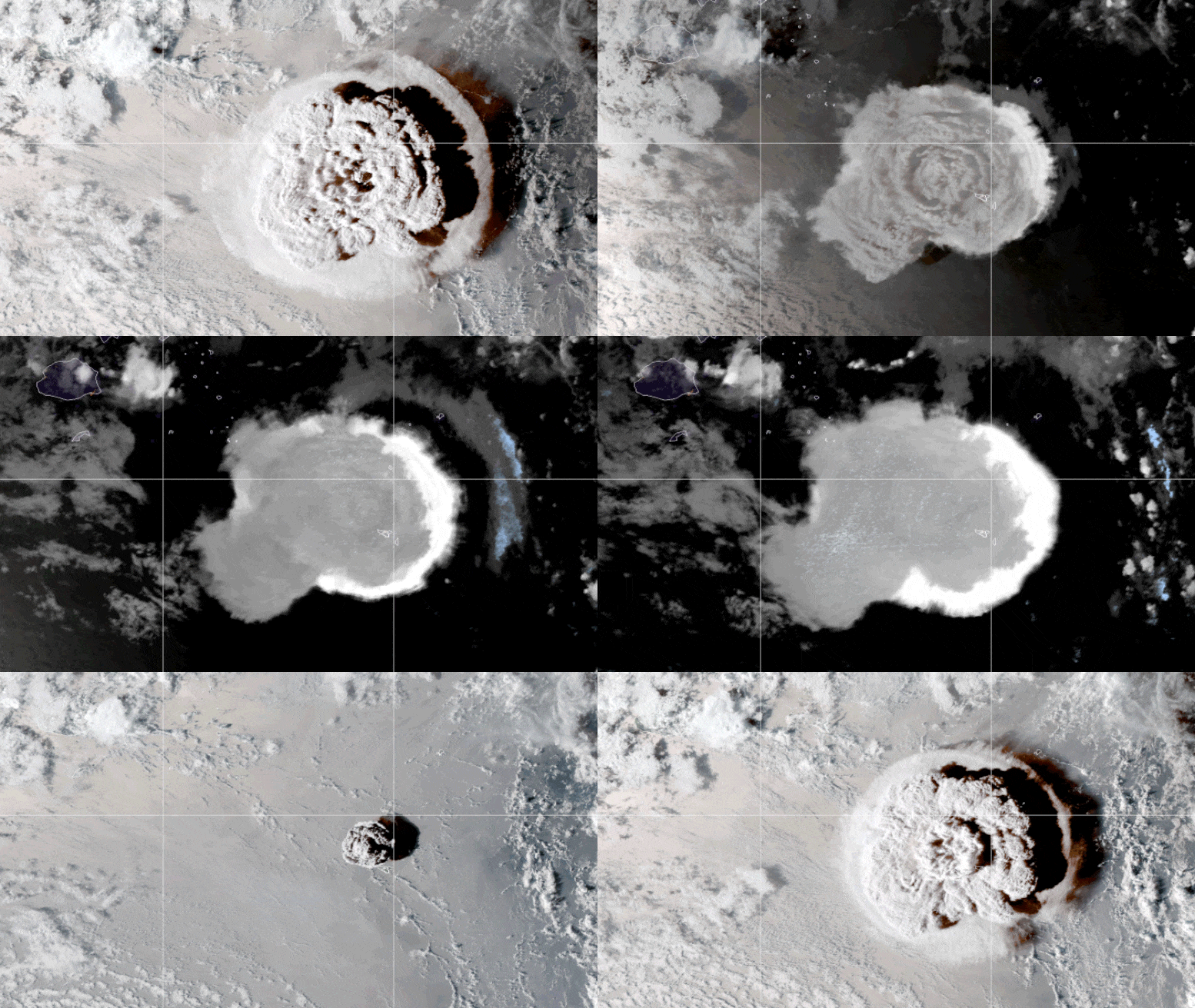
MIT Haystack Observatory identifies long-duration atmospheric waves launched by the recent Tonga eruption.
The recent eruption of Tonga’s Hunga Tonga–Hunga Ha‘apai volcano, at 04:14:45 UT on January 15, 2022, was recently confirmed to have launched far-reaching, massive global disturbances in the Earth’s atmosphere.
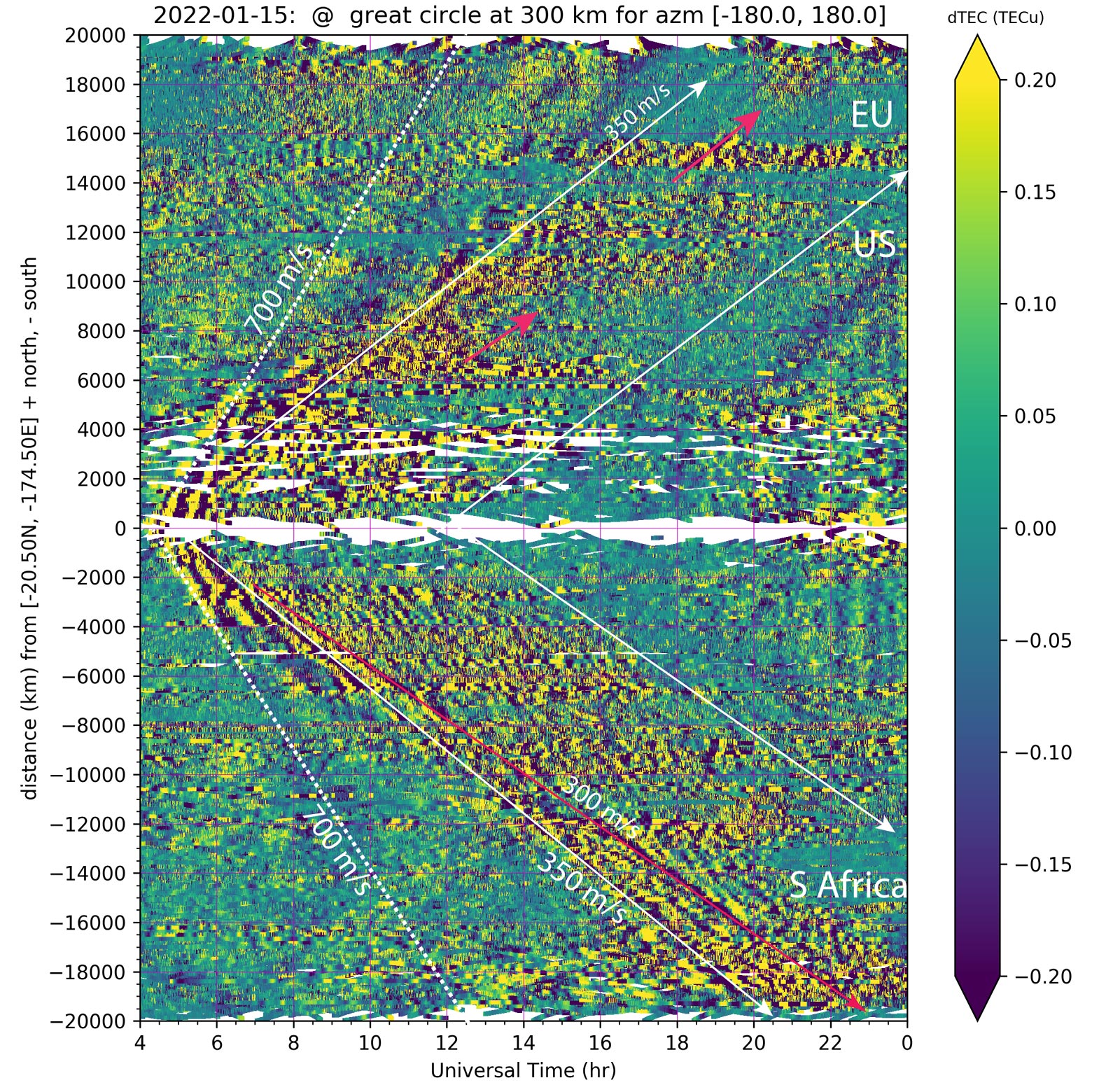
Using data recorded by more than 5,000 Global Navigation Satellite System (GNSS) ground receivers located around the globe, MIT Haystack Observatory scientists and their international partners from the Arctic University of Norway have observed substantial evidence of eruption-generated atmospheric waves and their ionospheric imprints 300 kilometers above the Earth’s surface over an extended period. These atmospheric waves were active for at least four days after the eruption and circled the globe three times. Ionospheric disturbances passed over the United States six times, at first from west to east and later in reverse.
This volcanic event was extraordinarily powerful, releasing energy equivalent to 1,000 atomic bombs of the size deployed in 1945. Scientists have known that explosive volcanic eruptions and earthquakes can trigger a series of atmospheric pressure waves, including acoustic waves, and that they can perturb the upper atmosphere a few hundred kilometers above the epicenter. When over the ocean, they can trigger tsunami waves, and therefore upper-atmospheric disturbances. Results from this Tonga eruption have surprised this international team, particularly in their geographic extent and multiple-day durations. These discoveries ultimately suggest new ways in which the atmospheric waves and the global ionosphere are connected.
A new study, led by researchers at MIT Haystack Observatory and the Arctic University of Norway, reporting the results was published on March 23, 2022, in the peer-reviewed journal Frontiers in Astronomy and Space Sciences.
The Role of Lamb Waves in Global Propagation
The authors believe the disturbances to be an effect of Lamb waves; these waves, named after mathematician Horace Lamb, travel at the speed of sound globally without much reduction in amplitude. Although they are located predominantly near Earth’s surface, these waves can exchange energy with the ionosphere through complex pathways. As stated in the new paper, “prevailing Lamb waves have been reported before as atmospheric responses to the Krakatoa eruption in 1883 and other geohazards. This study provides substantial first evidence of their long-duration imprints up in the global ionosphere.”
Under National Science Foundation support, Haystack has been assembling global GNSS network observations to study important total electron content information on a daily basis since 2000. The observatory shares this data with the international geospace community to enable innovative research on a variety of frontiers, ranging from solar storm effects to low atmospheric forcing. A particular form of space weather, caused by ionospheric waves called traveling ionospheric disturbances (TIDs), are often excited by processes including sudden energy inputs from the sun, terrestrial weather, and human-made disturbances. For example, Haystack scientists used TID observations to provide the first evidence that solar eclipses can trigger bow waves in Earth’s atmosphere.
Lead author Shunrong Zhang says, “Only severe solar storms are known to produce TID global propagation in space for several hours, if not for days; volcanic eruptions and earthquakes normally yield ionospheric disturbances only within thousands of kilometers. By detecting these significant eruption-induced ionospheric disturbances in space over very large distances, we found not only generation of Lamb waves and their global propagation over several days (often monitored as sound waves on the ground for compliance with Comprehensive Nuclear Test Ban Treaties) but also a fundamental new physical process. In the end, surface and lower atmospheric signals can make a loud splash, even deep in space.”
Beyond these results, Haystack scientists continue additional studies of the Tonga eruption’s generation of severe space weather effects.
Reference: “2022 Tonga Volcanic Eruption Induced Global Propagation of Ionospheric Disturbances via Lamb Waves” by Shun-Rong Zhang, Juha Vierinen2, Ercha Aa, Larisa P. Goncharenko, Philip J. Erickson, William Rideout, Anthea J. Coster and Andres Spicher, 23 March 2022, Frontiers in Astronomy and Space Sciences.
DOI: 10.3389/fspas.2022.871275
Never miss a breakthrough: Join the SciTechDaily newsletter.
Follow us on Google and Google News.
3 Comments
As a former Thresher Class sonarman, I want to say ‘Thank you, you guys’ for this data. The atmosphere is not as dense as the ocean, but some things work the same way.
As of curiosity do we have an idea of how much C02 associated with the eruption ? compared to man made during the same period?
Fantastic…