
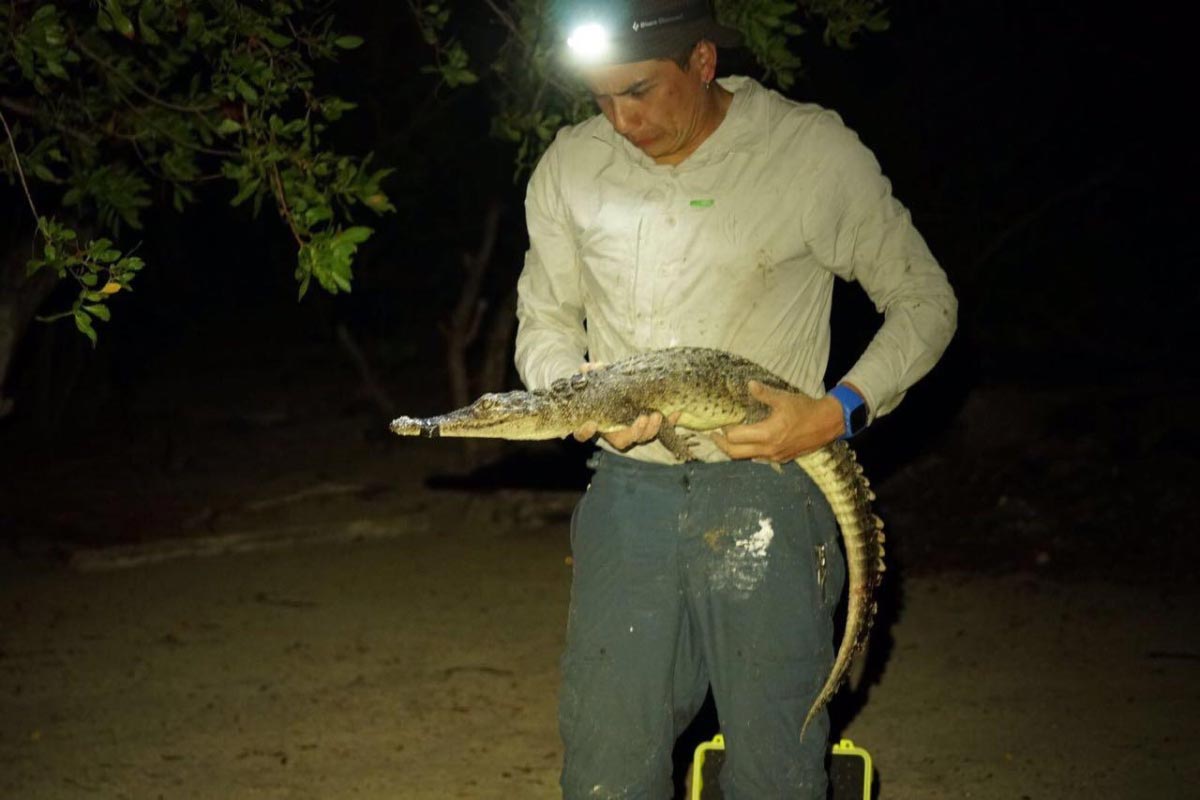
Professor Hans Larsson emphasizes that the surprising discovery on Caribbean islands off the coast of Mexico highlights the urgent need to protect the animals’ natural habitats.
Researchers from McGill University, working in collaboration with scientists in Mexico, have identified two previously unrecognized species of crocodiles. One population inhabits the island of Cozumel, while the other lives on the atoll of Banco Chinchorro. Both locations lie just off the eastern coast of Mexico’s Yucatán Peninsula.
These findings challenge long-standing assumptions about the American crocodile, Crocodylus acutus, which was thought to be a single widespread species.
“Biodiversity is disappearing faster than we can discover what we’re losing,” said Biology Professor Hans Larsson, the principal investigator. “Most species of crocodiles are already endangered, and rapid shoreline development threatens nearly every population. Our research aimed to uncover the true diversity of crocodiles on these isolated islands.”
The research team conducted a genetic analysis of crocodile populations from Cozumel and Banco Chinchorro. When these sequences were compared with those from crocodiles across the Caribbean, Central America, and Mexico’s Pacific coast, the results revealed high levels of genetic divergence. Based on this evidence, the team concluded that the island populations represent distinct species rather than local variations of Crocodylus acutus. The two new species have not yet been named.
A Surprise in the Data
“These results were totally unexpected,” former Larsson graduate student and lead author José Avila-Cervantes said. “We assumed Crocodylus acutus was a single species ranging from Baja California to Venezuela and across the Caribbean. Our study is the first to extensively explore genomic and anatomical variation in these animals.”
This discovery has significant conservation implications, the researchers said. The newly identified species live in small, isolated populations, each numbering fewer than 1,000 breeding individuals. While both populations appear stable, their limited numbers and habitat restrictions make them vulnerable.
“The rapid loss of biodiversity can only be slowed if we know what species are most at risk,” said Larsson. “Now that we recognize these crocodiles as distinct species, it’s crucial to protect their habitats. Limiting land development and implementing careful conservation strategies on Cozumel and Banco Chinchorro will be key to ensuring their survival.”
The research was conducted with the help of local colleagues, including Pierre Charruau at El Colegio de la Frontera Sur in Mexico. The team captured and released crocodiles, collecting blood and scale samples for analysis. Genetic sequencing was carried out at McGill by José Avila-Cervantes during his graduate studies, with additional research on skull morphology by fellow McGill graduate student Hoai-Nam Bui.
Reference: “Novel island species elucidate a species complex of Neotropical crocodiles” by Jose Avila-Cervantes, Pierre Charruau, J. Rogelio Cedeño-Vázquez, Hoai-Nam Bui, Miryam Venegas-Anaya, Marta Vargas, Marco A. López-Luna, Héctor González-Cortés, David A. Macías-Díaz, Jonathan S. Pérez-Flores, Gabriel Barrios-Quiroz, J. Miguel Salazar, W. Owen McMillan and Hans C.E. Larsson, 28 March 2025, Molecular Phylogenetics and Evolution.
DOI: 10.1016/j.ympev.2025.108341
This research was funded by the Canadian Foundation for Innovation, the Digital Research Alliance of Canada), the Comisión Nacional para el Conocimiento y Uso de la Biodiversidad, and the Natural Sciences and Engineering Research Council of Canada.
Never miss a breakthrough: Join the SciTechDaily newsletter.
Follow us on Google and Google News.
1 Comment
Thanks for ALL the INTERESTING subjects!!!