
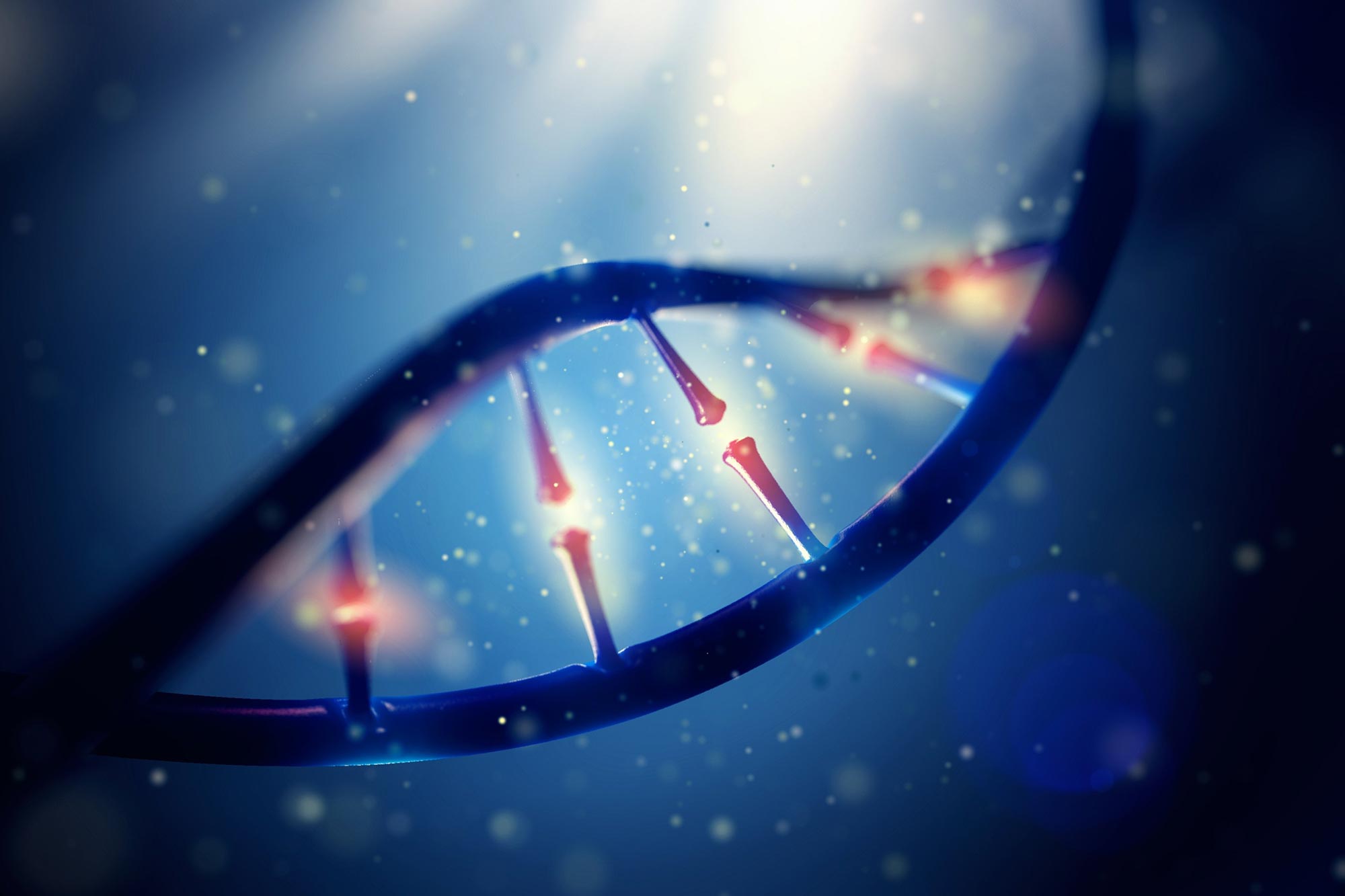
Scientists used light-activated droplets to reposition DNA, offering new insights into gene expression and disease treatment.
With the flick of a light, researchers have discovered a method to reshape the fabric of life, folding DNA strands back on themselves to reveal the material nature of the genome.
Scientists have long debated the physical nature of chromosomes – structures located deep within cells, made up of long DNA strands tightly wound around millions of proteins. Do they act more like a liquid, a solid, or something in between?
Much progress in understanding and treating disease depends on the answer.
A Princeton team has now developed a way to probe chromosomes and quantify their mechanical properties: how much force is required to move parts of a chromosome around and how well it snaps back to its original position. The answer to the material question, according to their findings, is that in some ways the chromosome acts like an elastic material and in other ways, it acts like a fluid. By leveraging that insight in exacting detail, the team was able to physically manipulate DNA in new and precisely controlled ways.
They published their findings in the journal Cell on August 20.
“What’s happening here is truly incredible,” said Cliff Brangwynne, the June K. Wu ’92 Professor of Chemical and Biological Engineering, director of Princeton’s Omenn-Darling Bioengineering Institute, and principal investigator of the study. “Basically we’ve turned droplets into little fingers that pluck on the genomic strings within living cells.”
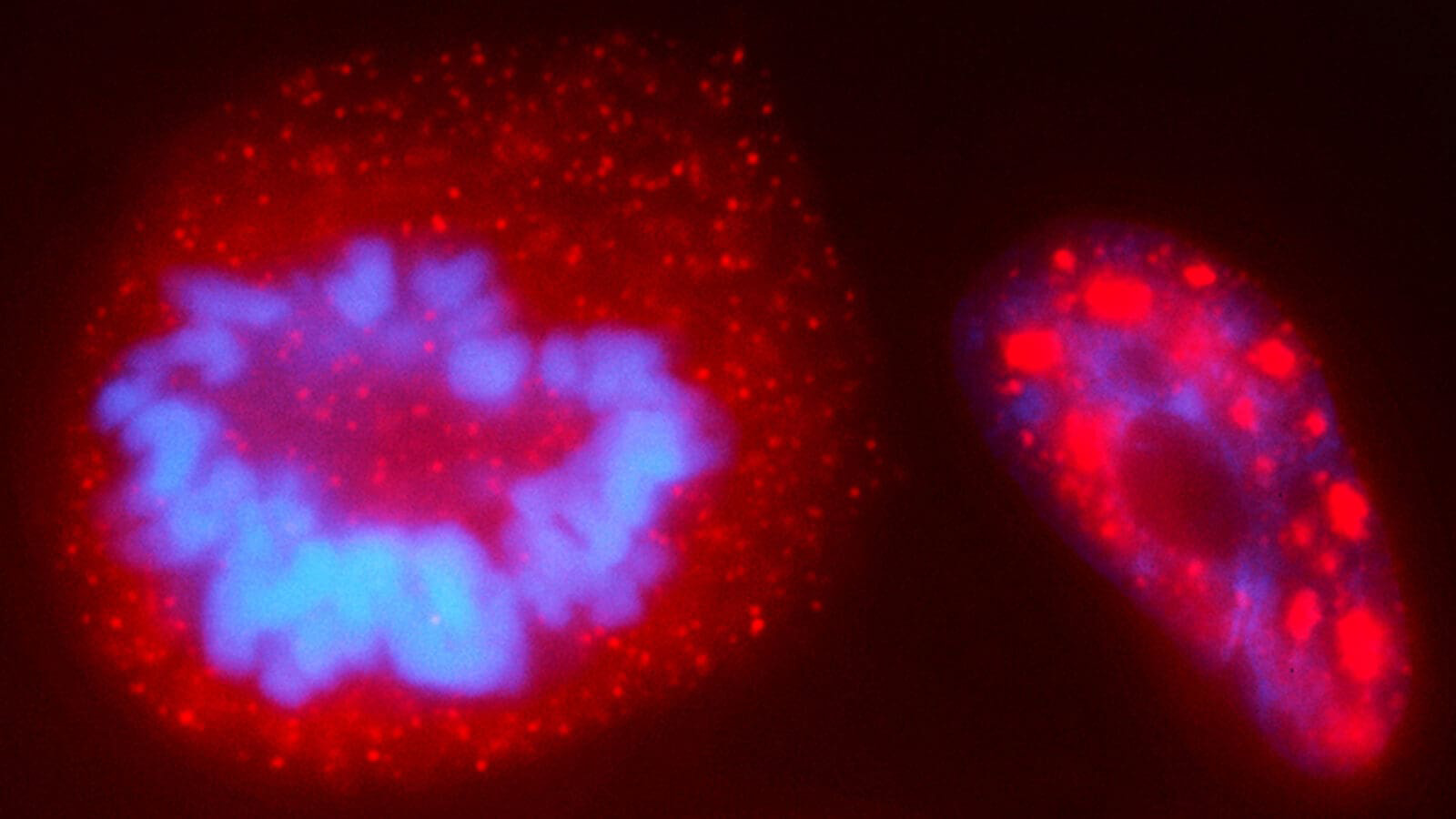
The key to the new method lies in the researchers’ ability to generate tiny liquid-like droplets within a cell’s nucleus. The droplets form like oil in water and grow larger when exposed to a specific wavelength of blue light. Because the droplets are initiated at a programmable protein — a modified version of the protein used in the gene-editing tool known as CRISPR — they can also attach the droplet to DNA in precise locations, targeting genes of interest.
With their ability to control this process using light, the team found a way to grow two droplets stuck to different sequences, merge the two droplets together, and finally shrink the resulting droplet, pulling the genes together as the droplet recedes. The entire process takes about 10 minutes.
Using condensates (green), the researchers pulled two sections of a DNA strand together, enabling them to touch. Illustration by Wright Seneres
Physically repositioning DNA in this way represents a completely new direction for engineering cells to improve health and could lead to new treatments for disease, according to the researchers. For example, they showed that they could pull two distant genes toward each other until the genes touch. Established theory predicts this could lead to greater control over gene expression or gene regulation — life’s most fundamental processes.
The material science of our genome
A DNA molecule is structured like a long double strand. In living cells, this long strand is wrapped around specialized proteins to form a material called chromatin, which in turn coils on itself to form the structures we know as chromosomes. If uncoiled and stretched end-to-end, all of a person’s chromosomes would measure about six-and-a-half feet long. Human cells must fit 23 pairs of these chromosomes, collectively called the genome, into each cell’s nucleus. Hence the need for tight coiling.
Since DNA is both a carrier of information and a physical molecule, the cell needs to unfurl the tightly coiled parts of the DNA to copy its information and make proteins. The areas along the genome that are more likely to be expressed are less rigid physically and easier to open up. The areas that are silenced are physically more coiled and compact and therefore harder for the cell to open up and read. Like an instruction manual that opens more easily to some pages than others.
Amy R. Strom, Yoonji Kim, and Cliff Brangwynne. Photo of Strom by Monica Khanna, photo of Kim by Wright Seneres, photo of Brangwynne by the Princeton University Office of Communications
The research team, including postdoctoral scholar Amy R. Strom and recently graduated Ph.D. student Yoonji Kim, turned to blobs of liquid known as condensates to do the work of bending the DNA strands and moving them around.
While some cellular components known to science are like soap bubbles, with a distinct membrane keeping the insides separated from the outside, condensates are liquid-like droplets that fuse together more like raindrops, with no membrane holding them together. After forming and carrying out a cellular function, they can break apart and disperse again.
To study chromatin in more detail, Strom and Kim built upon previous research from the Brangwynne lab that engineered condensates from biological molecules in the cell using laser light to create and fuse droplets together. In this new work, they utilized an additional component that attaches the condensate to specific locations on the DNA strands and directs their movement quickly and precisely via surface tension-mediated forces also known as capillary forces, which Princeton researchers had suggested could be ubiquitous in living cells. Previously, moving DNA like this relied on random interactions over a period of hours or even days.
“We haven’t been able to have this precise control over nuclear organization on such quick timescales before,” said Brangwynne.
Like CRISPR but different
Now that they can move the strands around in this controlled way, they can start to look at whether the genes in their new positions are expressed differently. This is potentially important for furthering our understanding of the physical mechanisms and material science of gene expression.
Strom said that scientists have looked at the stiffness of the nucleus by poking at it from the outside, and taking a measurement of the whole nucleus. Scientists can also look at one gene and see if it is turned on or off. But the space in between is not well understood.
“We can use this technology to build a map of what’s going on in there and better understand when things are disorganized like in cancer,” said Strom.
This new tool is poised to help researchers understand gene expression better, but it is not intended to edit the DNA. “Our tool does not actually cleave the DNA sequences like CRISPR does,” said Kim.
“CRISPR is really good for diseases that are related to the need to cut and actually change the DNA sequence,” said Strom. This technology could work for a different class of diseases, especially those related to protein imbalances such as cancer.
“If we can control the amount of expression by repositioning the gene,” said Strom, “there is a potential future for something like our tool.”
Reference: “Condensate interfacial forces reposition DNA loci and probe chromatin viscoelasticity” by Amy R. Strom, Yoonji Kim, Hongbo Zhao, Yi-Che Chang, Natalia D. Orlovsky, Andrej Košmrlj, Cornelis Storm and Clifford P. Brangwynne, 20 August 2024, Cell.
DOI: 10.1016/j.cell.2024.07.034
The paper was published with support from the Howard Hughes Medical Institute, the Princeton Biomolecular Condensate Program, the Princeton Center for Complex Materials, a MRSEC (NSF DMR-2011750), the St. Jude Collaborative on Membraneless Organelles, and the Air Force Office of Scientific Research Multidisciplinary Research Program of the University Research Initiative (AFOSR MURI) (FA9550-20-1-0241). In addition to Brangwynne, Strom, and Kim, contributing authors include Cornelis Storm of Eindhoven University of Technology, and Hongbo Zhao, Yi-Che Chang, Natalia D. Orlovsky, and Andrej Košmrlj, all from Princeton University.
Never miss a breakthrough: Join the SciTechDaily newsletter.
Follow us on Google and Google News.
19 Comments
“The research team, including postdoctoral scholar Amy R. Strom and recently graduated Ph.D. student Yoonji Kim, turned to blobs of liquid known as condensates to do the work of bending the DNA strands and moving them around.”
One could misread this excerpt for a humorous effect (“The research team… turned to blobs of liquid….”).
Amazing, I would volunteer 2 try this 4 removal of prostate cancer.
My background is Astrophysics (Ph C.), but this area always fascinated me. But what I never could grasp is how you modify human DNA to have system effect. One cell at a time? It would take years to replicate a significant change. And who knows what mutations might occur in the process. On a small scale, this hopefully would have remarkable effect to eradicate cancerous growths So much advancement, and so much yet to do. Congratulations on these phenomenal breakthroughs.
Or negative effects that disable reproductive activities. Who really knows if it could work? Better than nothing, and a beginning..
Will this study be applicable to Parkinson’s disease?
Thanks.
Memo 2409130357
Physical laser light and microdroplet manipulation made it possible to alter the folding of an organism’s dna. We discovered a way to reconstruct the structure of life by simply blinking light and to fold the DNA strand again to reveal the material properties of the dielectric.
When the universe created life, the flicker of light must have been on msbase. The light must have been the way of manipulating qpeoms droplets. Huh.
The researchers separated dna or chromosomes into their size by generating fine droplets in the condensate with laser light. It became possible to move the position of the base or chromosome by combining and then reducing and pulling the net droplets again. Now, they have provided new insights into gene expression and disease treatment by rearranging DNA using light-activated droplets.
According to their findings, the answer to material questions is that chromosomes act in some ways like elastic materials and in other ways like fluids. The team was able to physically manipulate DNA in new and precisely controlled ways by utilizing that insight with precise details.
Basically, they made droplets with tiny fingers that unwound the dielectric string inside a living cell. Uh-huh.
It was based on previous work that used light to manipulate condensates in biological molecules in cells to create and fuse droplets. In this new work, they utilized additional components that attach condensates to specific locations on the DNA strand and direct their migration quickly and accurately through surface tension mediators, also known as capillary forces. It has been suggested that these forces are common in living cells. Previously, DNA displacement like this depended on random interactions over hours or days.
Sauce 1. Punjip
Researchers have developed a method of physically manipulating DNA using light, allowing them to precisely control the way chromosomes are rearranged within cells. This groundbreaking discovery can affect the physical composition of DNA without editing the DNA sequence, providing new insights into gene expression and potential treatments for diseases such as cancer.
The key to the new method lies in the researchers’ ability to create tiny liquid-like droplets inside the cell nucleus. Droplets form like oil in water and grow when exposed to blue light of a specific wavelength. Droplets start with programmable proteins, which are modified versions of the proteins used in CRISPR, a gene-editing tool, so they can also be attached to the DNA in the right place to target genes of interest.
With the ability to control this process using light, the team found a way to grow two droplets attached to different sequences, combine the two droplets, and finally reduce the resulting droplet to pull genes together as the droplet retracts. The entire process takes about 10 minutes.
To study chromatin in more detail, Strom and Kim based their previous work in the Brangwynne lab, where laser light was used to manipulate condensates from biological molecules in cells to create and fuse water droplets. In this new work, they utilized additional components that attach condensates to specific locations on the DNA strand and direct their migration quickly and accurately through surface tension mediators, also known as capillary forces. Princeton researchers have suggested that these forces are common in living cells. Previously, DNA displacement like this depended on random interactions that spanned hours or days.
According to the researchers, this way of physically rearranging DNA represents a whole new direction for cell engineering to improve health and may lead to new treatments for diseases. For example, they showed that they can pull two distant genes together until they touch each other. The established theory predicts that this could lead to greater control over gene expression or gene regulation (the most fundamental processes of life).
the material science of our genome
DNA molecules are structured like long double strands. In living cells, these long strands are wound around specialized proteins to form a substance called chromatin, which then rolls itself out to form a structure known as chromosome. All human chromosomes are about 6 1/2 feet long when untied and stretched from end to end. Human cells need to put 23 pairs of these chromosomes, called the genome, into each cell’s nucleus. Therefore, they must be dried tightly.
Because DNA is a carrier of information and a physical molecule, cells must untangle the tightly twisted parts of the DNA to copy the information and make proteins. Regions along the genome, which are more likely to be expressed, are less physically rigid and easier to open. Silent regions are more difficult for cells to open and read because they are physically twisted and compact. Some pages are like instruction manuals that open more easily than others.
1.
The dna is similar to the msbase. It’s as if it’s placed on a vertical and horizontal line with important information. There are 3 billion human sequences listed, which are roughly the 54,772nd msbase. They’re very tightly folded. Huh. It’s ignorant to solve it physically. But it’s very easy and simple to solve with 54,772 qpeoms droplets. Huh.
Now, what is qpeoms? It’s really… It’s really… It’s crazy! Go away! The last student went to kindergarten and came back a few years later. Hehe.
ㅡㅡㅡㅡㅡㅡㅡㅡㅡㅡㅡㅡ
Source 1.
https://scitechdaily.com/truly-incredible-princeton-researchers-have-discovered-a-new-method-to-reshape-the-fabric-of-life/
“Really Incredible” – Princeton researchers find new way to rebalance life’s structure
What in the world are you talking about?
For what it’s worth, in a dream I was told the cure for all cancers is to “tilt” the DNA.
I hope the scientists tread carefully. There are those scientists who have concluded that DNA is not actually “self” replicating, and that the code for life goes much deeper than the gene level. The process is so complex, and 1 physical change can elicit thousands of physiological and psychological effects, some of which are unknown and unintended. Life IS complicated.
“Like an instruction manual that opens more easily to some pages than others.” This quotation appears in the article and is not a complete sentence. Grammar police, here.
Agreed. That sort of writing is amateurish for a professional scientific writer.
Yeah he should have spent his years studying Shakespeare and Sentence composition instead of science. Then he would have more respect and money smh.
For years, I’ve been reading about one amazing discovery after another in this discipline. When, though, might the average person begin to benefit from these advances? These reports are probably great for helping to generate more research funding, but I have yet to see any benefit for folks who are still suffering from myriad diseases. Where are the new treatments and cures?
Could this have any impact on prader-willi syndrome?
It’s confounding that we ALL make up things to explain things we know NOTHING about. Just continue dying and contemplate why NOTHING matters for WE mortal organisms!
Who cares?
Stop thinking.
Take a deep breath and wait to die.
Parents with children of incurable life altering and fatal diseases. But feel free to take your own advice.
Parents with children of incurable life altering and fatal diseases. But feel free to take your own advice.
Just because you can, it doesn’t mean you should. “It’s not nice to fool Mother Nature”. Best to not tempt fate.