
Proof-of-principle research shows that genes can be accurately edited in cells throughout the body.
Researchers at the University of California San Diego have laid the groundwork for a potential new type of gene therapy using novel CRISPR-based techniques.
Working in fruit flies and human cells, research led by UC San Diego Postdoctoral Scholar Zhiqian Li in Division of Biological Sciences Professor Ethan Bier’s laboratory demonstrates that new DNA repair mechanisms could be designed to address the effects of debilitating diseases and damaged cell conditions.
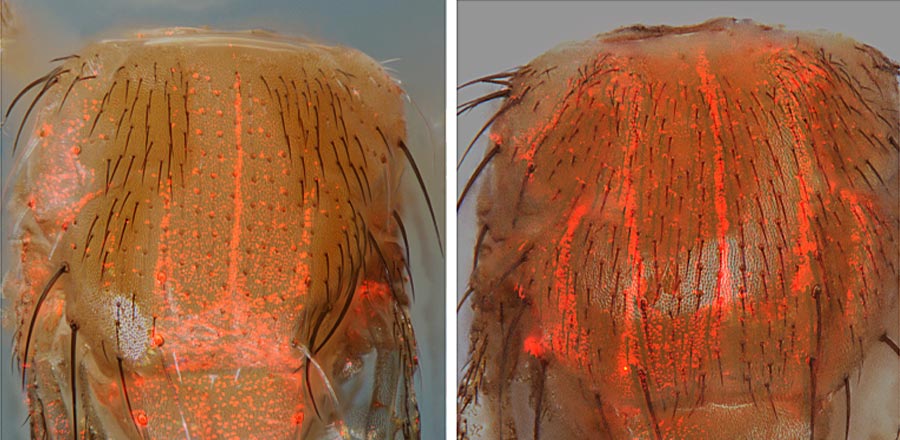
The scientists developed a novel genetic sensor called a “CopyCatcher,” which capitalizes on CRISPR-based gene drive technology, to detect instances in which a genetic element is copied precisely from one chromosome to another throughout cells in the body of a fruit fly.
Details are explained in the journal Nature Communications.
Gene-drive technology is being developed to copy and distribute desired traits in reproductive cells of the body (sperm and eggs), which allows these traits to be spread throughout populations — potentially preventing transmission of insect-vectored diseases such as malaria and fortifying agricultural crops. For human health applications, next-generation CopyCatcher systems will measure how often such perfect copying might take place in different cells of the human body. As this system detects a very high rate of copying in fruit flies, similar success in human cells would allow scientists to make desired precise genome edits throughout the body, and particularly in cells that rely on the function of that gene for normal health.
A New Strategy for Gene Repair
“These studies provide a clear proof of principle for a new type of gene therapy in which one copy of a mutated gene could be repaired from a partially intact second copy of the gene,” said Bier, senior author of the Nature Communications study and science director for the Tata Institute for Genetics and Society-UC San Diego. “The need for such a design occurs in genetic situations with patients with inherited genetic disorders, if their parents were carriers for two different mutations in the same gene.”
Bier says the strategy of fixing a mutated gene in its normal context within the genome differs greatly from current gene therapy strategies in which a surrogate copy of a gene is placed at a different site in the genome and acts as a crude “patch.”
“This method restores enough gene activity to allow the patient to limp by,” said Bier. “In these cases, genes are often activated in cells where they should normally be silent and may not be activated in others where they should be.”
If the high efficiency of precise in vivo gene editing detected by CopyCatchers in fruit flies could be achieved in human cells, then a variety of genetic disorders might be treated including blood diseases, diseases affecting vision or hearing and diseases targeting specific organs such as muscular dystrophy, cystic fibrosis (lung and kidney) and congenital heart defects.
“This restorative form of gene therapy would represent a major improvement over existing methods in which a functional copy of the gene is typically activated in all cells of the body but in an abnormal pattern,” said Li.
Although the researchers detected highly efficient copying of genetic information in three genes active in different tissues of the fly body (eyes, epidermis, and embryonic cells), this ability to copy information from one chromosome to another was less efficient in human cells (4-8% of cells) than in flies (in 30-50% of cells), the researchers found. However, in human cells where specific cuts were made to one chromosome using CRISPR, the researchers rigorously established that the other chromosome could be used to repair the damage resulting in a genetic element being precisely copied into the cut site. Moreover, measures to improve copying in flies also translated to enhanced copying in human cells suggesting that further research may increase the efficiency of human in vivo genetic repair.
How CopyCatchers Work
CopyCatchers are designed based on the fact that cells have two copies of each chromosome. In its starting location, a CopyCatcher is rendered inactive, preventing it from producing a red fluorescent detector protein. If the CopyCatcher copies itself precisely to the other chromosome, however, then it can free itself from the constraint imposed on the original element thereby leading to cells becoming fluorescent. The fraction of red fluorescing cells tabulated throughout a tissue is a quantitative indicator of the frequency of precise CRISPR editing. Since cells of the body have been thought to be relatively recalcitrant to precise CRISPR editing, it was surprising that CopyCatchers reveal an unexpected potential of cells throughout the body to do so, such as in the eyes and in the epidermis.
In the next series of planned experiments Li and colleagues in the Bier lab will use CopyCatchers and related systems to further optimize the efficiency of corrective editing and develop model systems for human diseases to enhance the efficacy of this technology for gene therapy applications.
Reference: “CopyCatchers are versatile active genetic elements that detect and quantify inter-homolog somatic gene conversion” by Zhiqian Li, Nimi Marcel, Sushil Devkota, Ankush Auradkar, Stephen M. Hedrick, Valentino M. Gantz and Ethan Bier, 11 May 2021, Nature Communications.
DOI: 10.1038/s41467-021-22927-1
The co-authors of the study include: Zhiqian Li, Nimi Marcel, Sushil Devkota, Ankush Auradkar, Stephen Hedrick, Valentino Gantz, and Ethan Bier.
The research was funded by the National Institutes of Health (grant R01 GM117321), a Paul G. Allen Frontiers Group Distinguished Investigators Award, and a gift from the Tata Trusts in India to TIGS-UC San Diego and TIGS-India.
Note: Bier has equity interest in two companies he co-founded: Synbal Inc. and Agragene, Inc., which may potentially benefit from the research results. He also serves on Synbal’s board of directors and the scientific advisory board for both companies.
Never miss a breakthrough: Join the SciTechDaily newsletter.
Follow us on Google and Google News.
1 Comment
I was a bit confused since those photos look like the back of President Trump’s head if we dyed some hairs black.