
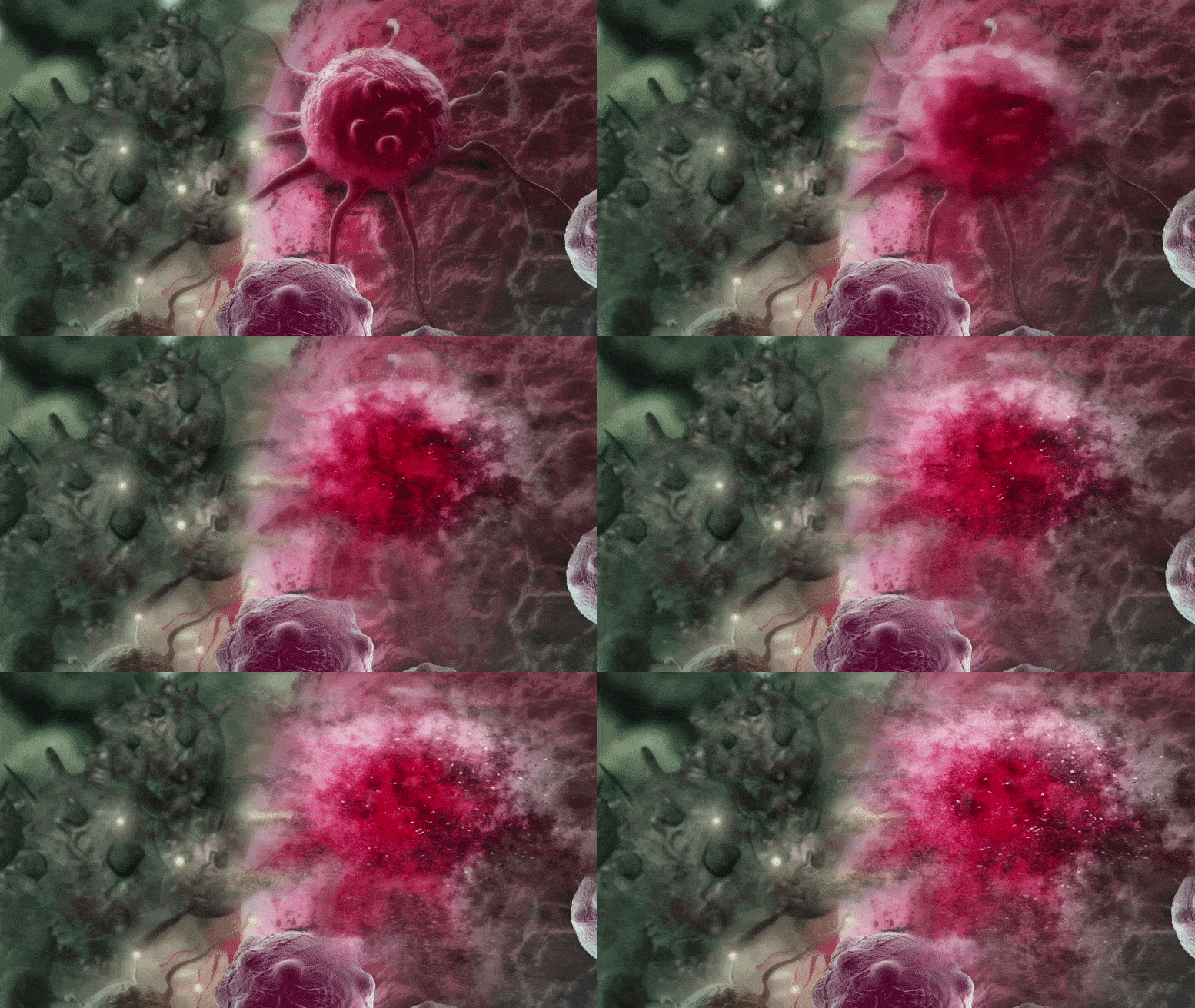
Processes in the human body transform harmless immune cells into ruthless killers
According to a recent study, the human body has the capability to change normally harmless immune cell clusters into merciless killers that can attack tumor cells and other cells harboring viruses or parasites.
Gamma delta T cells were formerly believed to be “pre-programmed” to identify and eliminate other rogue cells, but it now seems that certain types of the cells have a lot in common with well-known “adaptive” subsets of conventional T cells.
Adaptive Behaviors in Gamma Delta T Cells
In a recent publication in Cell Reports, an international team of scientists from the UK, Australia, China, the Netherlands, and the USA—led by the University of Birmingham—noted striking parallels to typical adaptive “killer” T cells.
Senior co-author Professor Ben Willcox, from the University of Birmingham, commented: “Human gamma delta T cells have typically been assumed to be pre-programmed, however, our study shows that at least in blood, some types mirror the behavior of conventional T cells – suggesting they can be ‘trained’ to become extremely potent killers once they recognize aberrant target cells – including those infected with viruses, parasites, or possibly tumor cells.
“Our discovery has implications for efforts to develop gamma delta T cells as novel cellular therapies. We hope that it will change the way scientists think about these cells and how they might contribute to the treatment of cancer and infectious disease.”
Gene Expression and Adaptive Responses
Funded substantially by a Wellcome Trust Investigator Award, the group examined the profile of gene expression in human gamma delta T cells – showing the cells in a much more ‘adaptive’ light.
Gamma delta cells exist alongside alpha beta T cells and B cells in vertebrates. Researchers have discovered that select human gamma delta T cells appear to transform their pattern of gene expression to activate a ‘killer’ program – dependent on their exposure to abnormal target cells, with successful recognition of such targets likely a key factor triggering this transformation and subsequent attack.
An extremely strong similarity to conventional adaptive killer T cells suggests that the unique contribution of gamma delta T cells is not the type of response they ultimately mount – such as killing a target cell – but that they are able to recognize abnormal target cells in a very different way.
This suggests that they can mount unconventional adaptive responses in situations when conventional adaptive T cells cannot:
Lead author Jack McMurray, from the University of Birmingham, commented: “There are a number of scenarios in which gamma delta T cells may be uniquely suited to respond, due to their unconventional recognition capabilities. These include particular microbial, parasitic, and viral infections, and potentially some cancers.
“Our research provides a basis for ongoing studies to understand how such unconventional adaptive gamma delta T cell responses are triggered, and also for efforts to harness such responses to develop new and more effective treatments for infections and cancer.”
Reference: “Transcriptional profiling of human Vδ1 T cells reveals a pathogen-driven adaptive differentiation program” by Jack L. McMurray, Anouk von Borstel, Taher E. Taher, Eleni Syrimi, Graham S. Taylor, Maria Sharif, Jamie Rossjohn, Ester B.M. Remmerswaal, Frederike J. Bemelman, Felipe A. Vieira Braga, Xi Chen, Sarah A. Teichmann, Fiyaz Mohammed, Andrea A. Berry, Kirsten E. Lyke, Kim C. Williamson, Michael J.T. Stubbington, Martin S. Davey and Carrie R. Willcox, 24 May 2022, Cell Reports.
DOI: 10.1016/j.celrep.2022.110858
Never miss a breakthrough: Join the SciTechDaily newsletter.
Follow us on Google and Google News.