
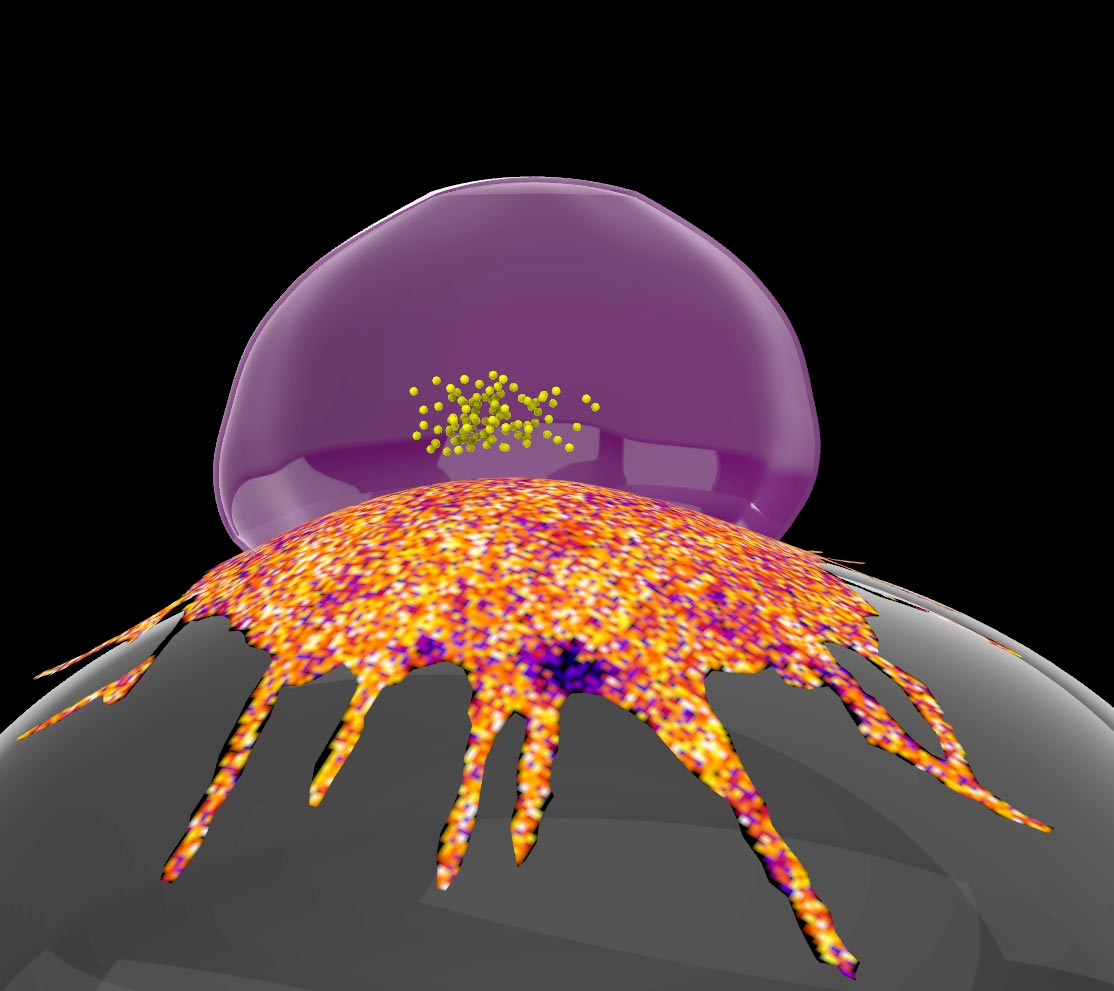
Natural killer cells use lipid shields to survive attacks. Some cancer cells mimic this defense, potentially explaining their resistance to immune attack and revealing a new therapeutic target.
A newly discovered fat ‘shield’ that prevents natural killer cells from being destroyed by their own deadly biological weapons also allows some cancer cells to evade an immune system attack, a study at Columbia University has found.
The findings, which may lead to new treatments for aggressive cancers, were reported on August 3, 2021, in the journal PLoS Biology by scientists in the Department of Pediatrics at Columbia University Vagelos College of Physicians and Surgeons.
Natural Killer Cells Are Prolific Assassins
Natural killer cells are our body’s first line of defense against pathogens and cancer cells, always present and ready to strike at a moment’s notice.
Natural killer cells are efficient assassins that can eliminate up to six infected or cancer cells each day. The deadly immune cells grab onto their target and blast it with toxic substances—proteins and enzymes—that punch holes in the cell’s membrane. These substances are not especially selective and could easily destroy the natural killer cell’s membrane during the attack.
But if these substances are so deadly, how do natural killer cells survive the blast? “I’ve been working on natural killer cells since the early 1990s, and every time I gave a talk about these cells, someone always asked that question,” says study leader and immunology expert Jordan Orange, MD, PhD, the Reuben S. Carpentier Professor of Pediatrics and chair of the Department of Pediatrics at Columbia University Vagelos College of Physicians and Surgeons. “And nobody really knew until now.”
Shielded by Fat
Yu Li, a graduate student working with Orange to understand how natural killer cells work and co-author of the study, thought the answer might lay in the double layer of lipids—a type of fat—that makes up the outer membranes of all cells. Compared with other cells, Li noticed, the membranes of natural killer cells looked more orderly and more densely packed with lipids when viewed under a microscope.
“There were a lot of hypotheses about why natural killer cells don’t kill themselves during their attack on other cells, but they all proposed there might be a magic, unknown protein protecting these cells,” Li says. But Li had doubts. “Based on biophysical considerations, I didn’t think a protein would be strong enough to protect the cells. When I looked at the cells, I thought of lipids.”
Li put his theory to the test: he exposed the membranes to a compound that weakens the structure of the lipid layer. With less dense and less orderly membranes, the natural killer cells were unprotected from their own toxic blast—and perished along with their targets.
Reinforcement Arrives Before Natural Killer Cells Attack
To ensure their ability to survive, natural killer cells reinforce their membranes immediately before they launch an attack, Li found. Small granules that contain the deadly substances move to the outer edge of the natural killer cell. As the granule releases its cargo into the space between the killer and target cells, its own unusually dense lipid membrane merges with and reinforces the natural killer cell membrane.
“In essence, Li found that the membrane turns into a blast shield,” Orange says. “And the protection comes from the way the membrane’s lipids are arranged. When the lipids are arranged in a more orderly fashion, more lipids can be packed into the membrane. The toxic substances simply can’t find a way into the membrane,” Orange says.
Lipid Blast Shield Also Protects Some Cancer Cells
Natural killer cells are not the only ones to adopt lipid blast shields, Li and Orange also found.
At least some cancer cells have adopted the defense to protect themselves during attacks by natural killer cells (and possibly from cytotoxic T cells, another immune cell that uses lipids for protection).
Li found that cells from an aggressive breast cancer known to be impervious to natural killer cells fortify their membranes during the attack. The fortification is essential in protecting the cancer cells, Li discovered, because when he added a membrane compound that disrupts lipid packing, the cancer cells were made vulnerable.
“We don’t know yet if this is a general mechanism by which cancer cells resist natural killer cells,” Li says. “If it is generalizable, we can start to think of therapies that disrupt the tumor cell membrane and make it more susceptible to attack by the immune system.”
Reference: “Degranulation enhances presynaptic membrane packing, which protects NK cells from perforin-mediated autolysis” by Yu Li and Jordan S. Orange, 3 August 2021, PLoS Biology.
DOI: 10.1371/journal.pbio.3001328
The study was supported by the National Institutes of Health (R01 AI067946-14).
Never miss a breakthrough: Join the SciTechDaily newsletter.
Follow us on Google and Google News.