
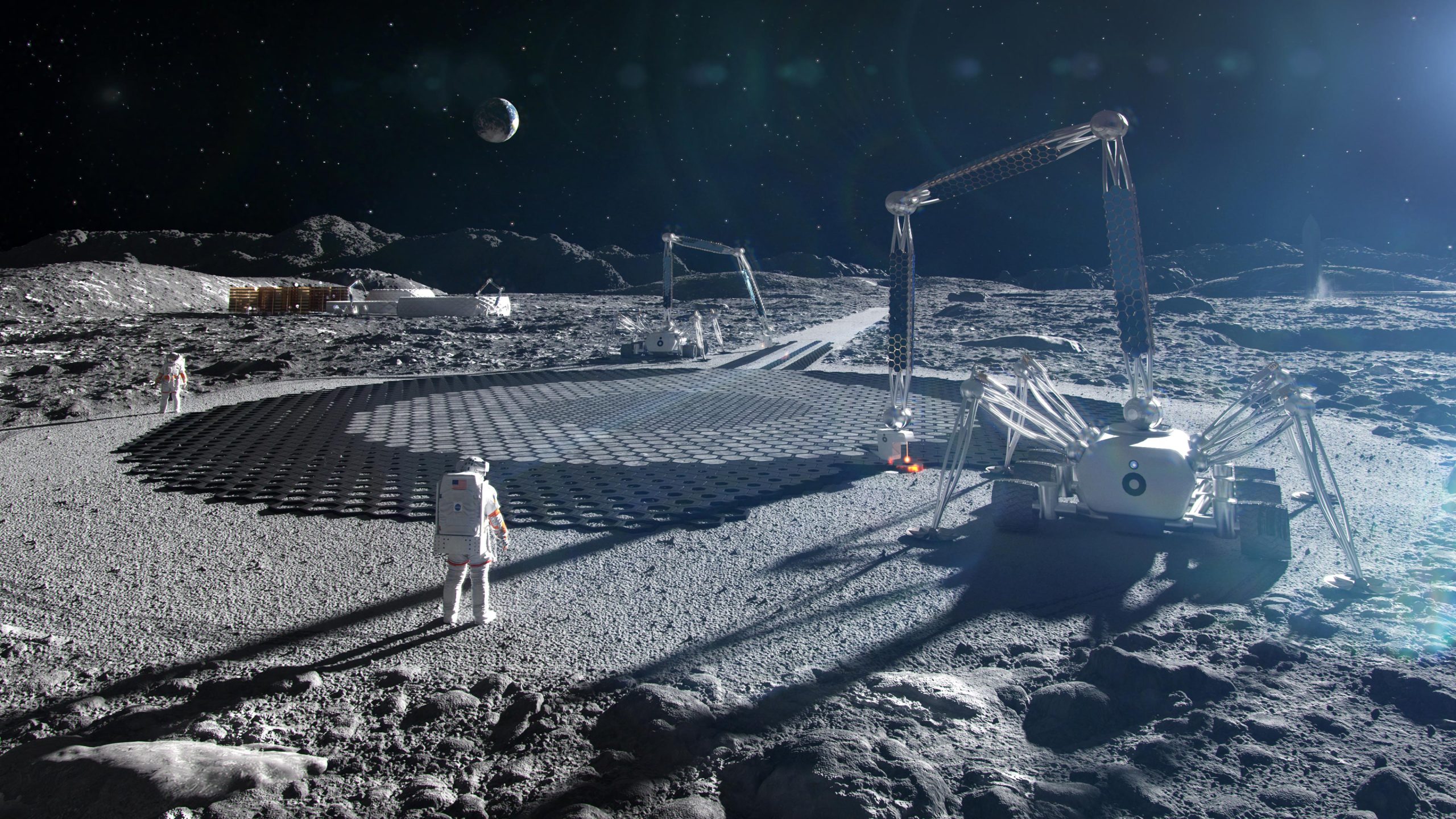
Manufacturing the world’s largest uniform microwave-sintered lunar regolith simulant bricks.
The discovery of lunar energy resources and high transport costs have led to innovations in using lunar regolith for construction. The Korea Institute has developed a method to produce strong, homogeneous building materials using microwave sintering, which could significantly reduce the cost of lunar infrastructure development.
Lunar Resources and the Artemis Mission
The Moon’s recent discovery of energy resources, such as water ice, has refocused interest on its potential as a sustainable hub for space exploration. NASA has also announced the Artemis mission, aiming for long-term human presence on the lunar surface. However, infrastructure expansion, such as lunar base construction plays a vital role.
Yet, transporting construction materials from Earth to the lunar surface via landers incurs a significant cost of 1.2 million USD per kilogram. Weight directly translates to cost, making the transportation of construction materials from Earth to the Moon nearly impossible.

Innovative Lunar Construction Technologies
To solve this problem, Korea Institute of Civil Engineering and Building Technology (KICT, President Kim, Byung-Suk), has developed technology for producing construction materials using in-situ resources from the moon.
The most readily available in-situ resource on the Moon is lunar regolith, which is the Moon’s surface soil. Utilizing lunar regolith can lead to cost savings. Composed of fine particles, lunar regolith can be sintered through heat. However, in space environments, energy efficiency considerations are crucial for applying heat. And Microwaves are particularly advantageous in terms of energy efficiency.
The research team (Dr. Jangguen, Lee, Dr. Young-Jae, Kim, Dr. Hyunwoo, Jin) led by Dr. Hyu-Soung, Shin at the Future & Smart Construction Research Division of KICT, utilized microwave sintering to produce blocks from lunar regolith simulant by heating and compacting it.
Advantages of Microwave Sintering in Space
When using microwaves to heat lunar regolith, localized hot & cold spots can form. These spots lead to localized thermal runaway, hindering uniform heating and sintering. To address this, a stepwise heating program with specific temperature and dwell time was established. Additionally, lunar regolith contains volatile substances, including water. Heating these volatile materials can cause internal cracks during sintering. The research team mitigated crack formation by using preheated lunar regolith simulant under vacuum conditions at 250°C.
To assess the completeness of sintered blocks intended for construction materials, the produced blocks were core-drilled at specific locations. The average density, porosity, and compressive strength of the core-drilled samples were approximately 2.11 g/cm³, 29.23%, and 13.66 MPa, respectively. The corresponding standard deviations were 0.03, 1.01, and 1.76, confirming the homogeneity of the sintered blocks.
KICT has secured technology for producing construction materials using lunar regolith. The plan is to validate this technology in space environments. By verifying it under space conditions, we can better address the increasing demand for space construction technology.
Future Prospects for Lunar Infrastructure
Dr. Shin said, “Many previous space construction studies related to microwave sintering technology have resulted in small or heterogeneous sintered bodies.” He further expressed plans to utilize this technology for various infrastructure construction needs on the lunar surface in the future.
Reference: “Optimized manufacturing process of homogeneous microwave-sintered blocks of KLS-1 lunar regolith simulant” by Hyunwoo Jin, Jangguen Lee, Li Zhuang, Sun Yeom, Hyu-Soung Shin and Young-Jae Kim, 30 March 2024, Journal of Building Engineering.
DOI: 10.1016/j.jobe.2024.109193
Research for this work was carried out under the KICT Research Program (project no. 20230081-001 & 20240184-001, Development of Environmental Simulator and Advanced Construction Technologies over TRL6 in Extreme Conditions) funded by the Ministry of Science and ICT. An article explaining the results of this research was published in the latest issue of Journal of Building Engineering, a renowned international journal in the Civil Engineering field (IF:6.4).
Never miss a breakthrough: Join the SciTechDaily newsletter.
Follow us on Google and Google News.
1 Comment
Yeah, good luck with that, chums. They cannot even solve the housing crisis here on Earth.