
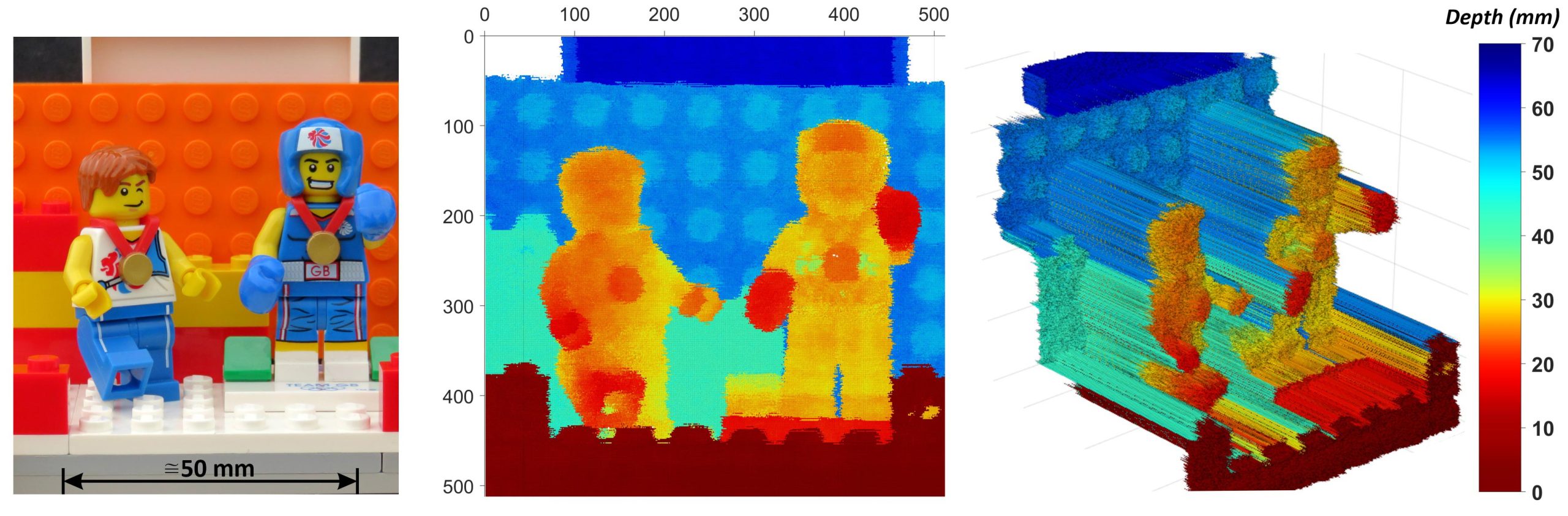
Imagine being able to capture a high-resolution 3D image of a distant object—even a human face—through fog, foliage, or camouflage netting. That’s exactly what a new single-photon LiDAR system can do from up to a kilometer away.
By using an advanced detector twice as efficient as previous versions and a timing resolution ten times better, researchers have unlocked incredible precision in long-range imaging.
High-Resolution LiDAR Imaging
Researchers have developed a single-photon time-of-flight LiDAR system capable of capturing high-resolution 3D images from up to 1 kilometer away. This advanced system enhances security, monitoring, and remote sensing by providing detailed imaging, even in difficult conditions or when objects are partially hidden by foliage or camouflage.
“Our system uses a single-photon detector approximately twice as efficient as detectors deployed in similar LiDAR systems reported by other research groups and has a system timing resolution at least 10 times better,” said research team member Aongus McCarthy, from Heriot-Watt University in the UK. “These improvements allow the imaging system to collect more scattered photons from the target and achieve a much higher spatial resolution.”
Capturing Faces from Hundreds of Meters Away
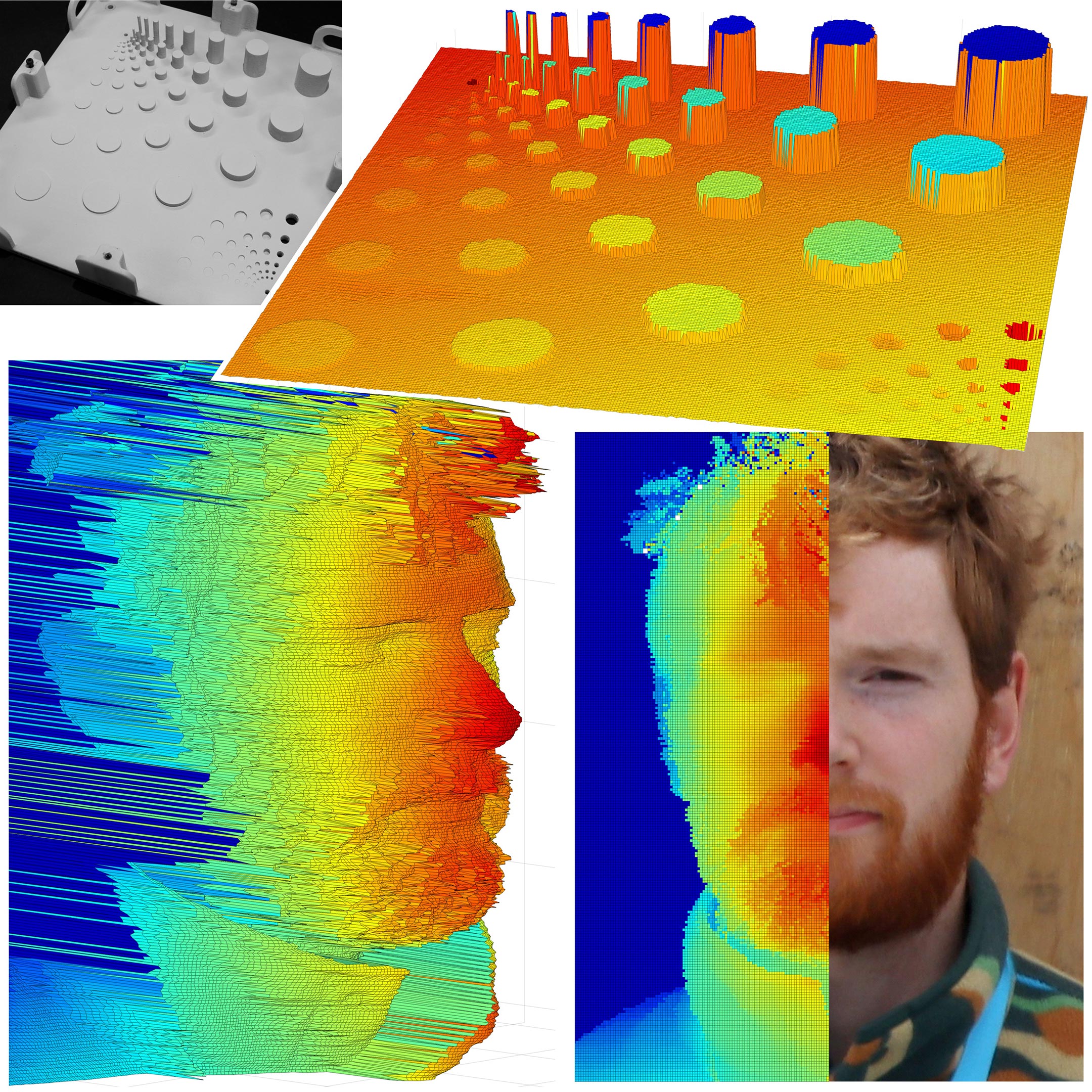
In Optica, Optica Publishing Group’s journal for high-impact research, a multi-institutional group of researchers from the UK and USA shows that the new system can construct a 3D image depicting a clearly recognizable human face from a person 325 meters away. The researchers were from Gerald Buller’s group at Heriot-Watt University, Robert Hadfield’s group at the University of Glasgow, Matthew Shaw’s group at the NASA Jet Propulsion Laboratory, and Karl Berggren’s group at MIT.
“This type of measurement system could lead to improved security and monitoring systems that could, for example, acquire detailed depth images through smoke or fog and of cluttered scenes,” said McCarthy, first author of the new paper. “It could also enable the remote identification of objects in various environments and monitoring of movement of buildings or rock faces to assess subsidence or other potential hazards.”
Light-Based Range Finding
The single-photon time-of-flight depth imaging system uses the time it takes for a laser pulse to travel from the system to a point on an object and back to calculate the distance to the object. These time-of-flight measurements are then repeated for points across the object to obtain 3D information.
The new system uses an ultrasensitive detector called a superconducting nanowire single-photon detector (SNSPD) developed by the MIT and JPL research groups. The SNSPD can detect a single photon of light, which means that lasers with very low powers, including eye-safe lasers, can be used to perform measurements in a very short time and over long distances. To reduce noise levels, the detector was cooled to just below 1 Kelvin in a compact cryocooler system designed and built by the University of Glasgow group.
Precision and Performance Enhancements
The researchers combined the cooled SNSPD with a new custom single-pixel scanning transceiver operating at a 1550-nm wavelength that was designed by McCarthy at Heriot-Watt University. They also added advanced timing equipment to measure extremely precise time intervals — accurate down to trillionths of a second (picoseconds). To put that into perspective, in just 1,000 picoseconds, light can travel about 300 millimeters (about 1 foot). This precision made it possible to distinguish surfaces separated by about 1 mm in depth from 325 meters away.
“These factors all provide improved flexibility in the trade-off between standoff distance, laser power levels, data acquisition time and depth resolution,” said McCarthy. “Also, since SNSPD detectors can operate at wavelengths longer than 1550 nm, this design opens the door to developing a mid-infrared single-photon LiDAR system, which could further enhance imaging through fog and smoke and other obscurants.”
3D Measurements of Distant Objects
The researchers performed field tests of their LiDAR system on the Heriot-Watt University campus by taking measurements from objects that were 45 meters, 325 meters or 1 kilometer away.
To evaluate the spatial and depth resolution, they scanned a custom 3D-printed target with varying pillar sizes and heights. The system resolved features as small as 1 mm in daylight at 45 and 325 meters — a depth resolution approximately 10 times better than they had achieved previously. They also captured a 3D image of a human face at these distances using a 1 ms per-pixel acquisition time, an eye-safe 3.5 mW laser, and minimal data processing.
Seeing Through Foliage and Camouflage
“The excellent depth resolution of the system means that it would be particularly well suited for imaging objects behind clutter, such as foliage or camouflage netting, a scenario that would be difficult for a digital camera,” said McCarthy. “For example, it could distinguish an object located a few centimeters behind a camouflage netting while systems with poorer resolution would not be able to make out the object.”
While the field trials for the LiDAR system were limited to a range of 1 kilometer, researchers plan to test the system at distances of up to 10 km and explore imaging through atmospheric obscurants like smoke and fog. Future work will also focus on using advanced computational methods to accelerate data analysis and enable imaging of more distant scenes.
Reference: “High-resolution long-distance depth imaging LiDAR with ultra-low timing jitter superconducting nanowire single-photon detectors” by Robert H. Hadfield, Dmitry V. Morozov, Matthew D. Shaw, Andrew D. Beyer, Di Zhu, Gerald S. Buller, Jorge Garcia-Armenta, Marco Colangelo, Aongus McCarthy, Ryan M. Briggs, Bruce Bumble, Gregor G. Taylor, Jason P. Allmaras, Boris Korzh and Karl K. Berggren, 19 February 2025, Optica.
DOI: 10.1364/OPTICA.544877
Never miss a breakthrough: Join the SciTechDaily newsletter.
Follow us on Google and Google News.
1 Comment
Can it see under the rubble in Gaza? Could be good for search and rescue………