
Close Menu
    Facebook X (Twitter) Instagram
    SciTechDaily
    • Biology
    • Chemistry
    • Earth
    • Health
    • Physics
    • Science
    • Space
    • Technology
    Facebook X (Twitter) Pinterest YouTube RSS
    SciTechDaily
    Home»Technology»Overcoming Two Long-Standing Bottlenecks: New Advance Paves Way to More Realistic 3D Holograms
    Technology

    Overcoming Two Long-Standing Bottlenecks: New Advance Paves Way to More Realistic 3D Holograms

    By OpticaApril 7, 2023No Comments5 Mins Read
    Facebook Twitter Pinterest Telegram LinkedIn WhatsApp Email Reddit
    Share
    Facebook Twitter LinkedIn Pinterest Telegram Email Reddit
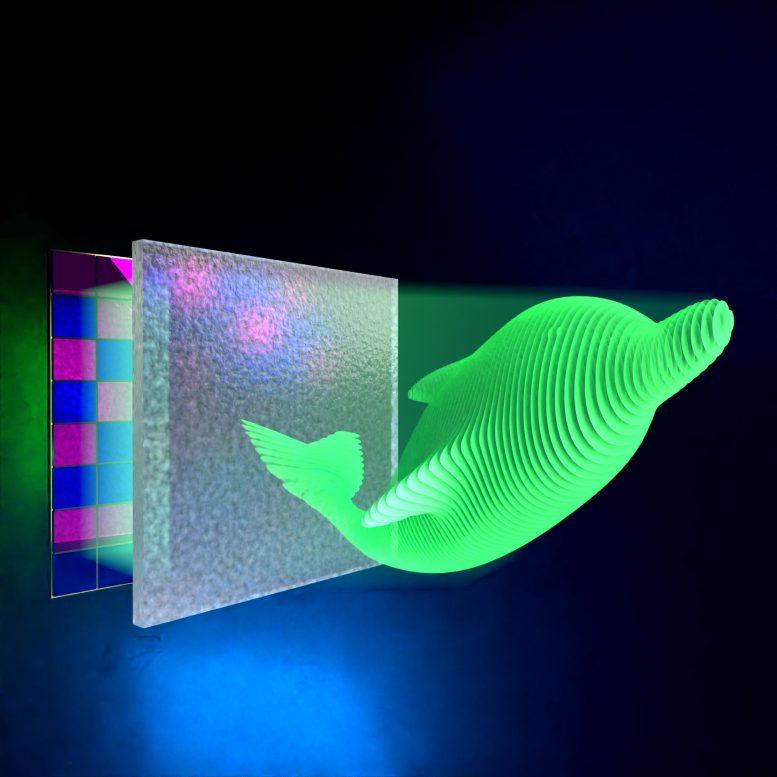
    High Density Multi Plane Projection Illustration
    Researchers have developed a new way to achieve dynamic projection of 3D objects onto ultrahigh-density successive planes. By packing more details into a 3D image, this approach could enable realistic representations for use in virtual reality and other applications. Credit: Lei Gong, University of Science and Technology of China

    Scientists Successfully Overcome Two Obstacles in Existing Digital Holographic Methods

    A new method for producing dynamic ultra-high-density 3D holographic projections has been developed by researchers. This cutting-edge hologram technology is capable of incorporating greater levels of detail into 3D images, potentially leading to more realistic depictions of the world for use in virtual reality and various other applications.

    “A 3D hologram can present real 3D scenes with continuous and fine features,” said Lei Gong, who led a research team from the University of Science and Technology of China. “For virtual reality, our method could be used with headset-based holographic displays to greatly improve the viewing angles, which would enhance the 3D viewing experience. It could also provide better 3D visuals without requiring a headset.”

    Creating a realistic holographic display involves projecting high-resolution images onto multiple layers that are positioned closely together. This process results in high-depth resolution, which is crucial for delivering the depth perception necessary for the hologram to appear three-dimensional.
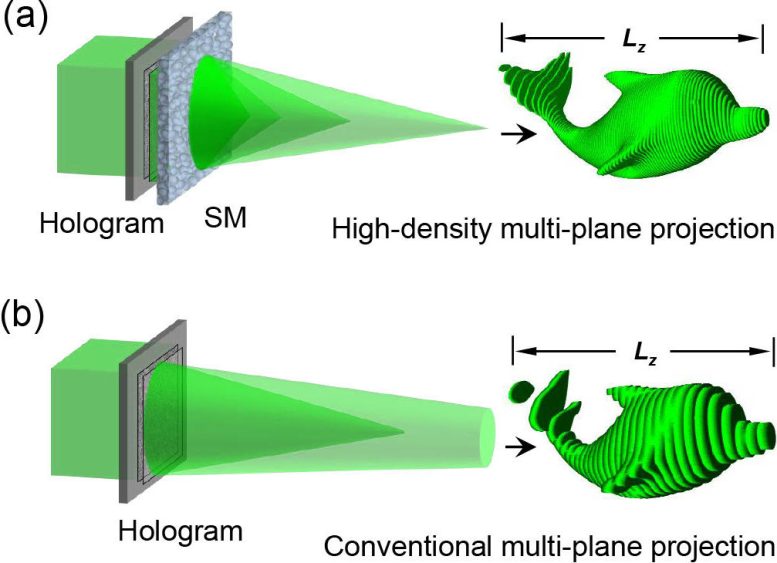
    Conventional and High Density Multi Plane Projection
    The new 3D scattering-assisted dynamic holography approach creates a digital hologram by projecting high-resolution images onto planes spaced closely together (a), achieving a more realistic representation than conventional holography techniques (b). Credit: Lei Gong, University of Science and Technology of China

    In Optica, Optica Publishing Group’s journal for high-impact research, Gong’s team and Chengwei Qiu’s research team at the National University of Singapore describe their new approach, called three-dimensional scattering-assisted dynamic holography (3D-SDH). They show that it can achieve a depth resolution of more than three orders of magnitude greater than state-of-the-art methods for multiplane holographic projection.

    “Our new method overcomes two long-existing bottlenecks in current digital holographic techniques — low axial resolution and high interplane crosstalk — that prevent fine depth control of the hologram and thus limit the quality of the 3D display,” said Gong. “Our approach could also improve holography-based optical encryption by allowing more data to be encrypted in the hologram.”

    Producing More Detailed Holograms

    Creating a dynamic holographic projection typically involves using a spatial light modulator (SLM) to modulate the intensity and/or phase of a light beam. However, today’s holograms are limited in terms of quality because current SLM technology allows only a few low-resolution images to be projected onto separate planes with low-depth resolution.

    To overcome this problem, the researchers combined an SLM with a diffuser that enables multiple image planes to be separated by a much smaller amount without being constrained by the properties of the SLM. By also suppressing crosstalk between the planes and exploiting scattering of light and wavefront shaping, this setup enables ultrahigh-density 3D holographic projection.
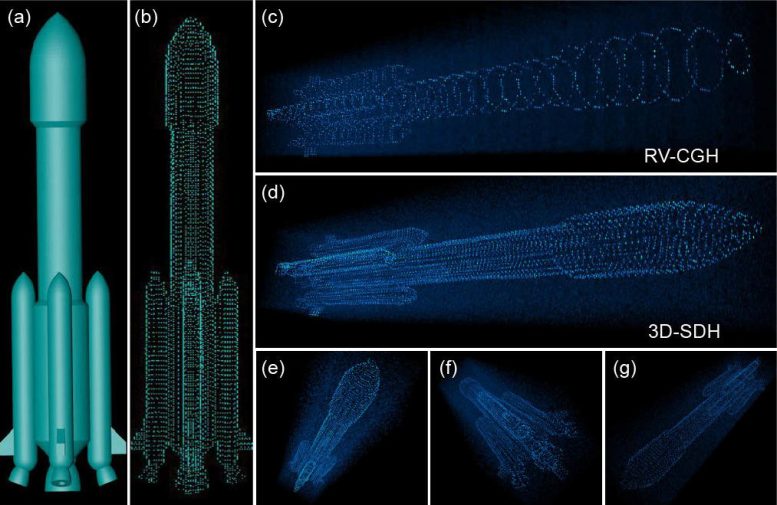
    Multiplane 3D Projection Simulation
    The researchers used their new method to simulate a holographic representation of a rocket [drawing shown in (a), point-cloud model in (b)]. A volume-rendered image of the 3D rocket projected by the random vector-based computer-generated holography (RV-CGH) method is shown in (c), using a single 1000×1000-pixel hologram. The 3D projection is represented by 32 images with a depth interval of 3.75 mm. Volume-rendered image of the object projected by 3D-SDH is shown in (d). 125 image planes with a uniform distance of 0.96 mm are simultaneously projected from a single 1000×1000-pixel hologram. Volume-rendered images of the simulated 3D rocket with varying perspective views are pictured in (e–g). Credit: Lei Gong, University of Science and Technology of China
    To test the new method, the researchers first used simulations to show that it could produce 3D reconstructions with a much smaller depth interval between each plane. For example, they were able to project a 3D rocket model with 125 successive image planes at a depth interval of 0.96 mm in a single 1000×1000-pixel hologram, compared to 32 image planes with a depth interval of 3.75 mm using another recently developed approach known as random vector-based computer-generated holography.

    To validate the concept experimentally, they built a prototype 3D-SDH projector to create dynamic 3D projections and compared this to a conventional state-of-the-art setup for 3D Fresnel computer-generated holography. They showed that 3D-SDH achieved an improvement in axial resolution of more than three orders of magnitude over the conventional counterpart.

    The 3D holograms the researchers demonstrated are all point-cloud 3D images, meaning they cannot present the solid body of a 3D object. Ultimately, the researchers would like to be able to project a collection of 3D objects with a hologram, which would require a higher pixel-count hologram and new algorithms.

    Reference: “Ultrahigh-density 3D holographic projection by scattering-assisted dynamic holography” by Panpan Yu, Yifan Liu, Ziqiang Wang, Jinyang Liang, Xingsi Liu, Yinmei Li, Chengwei Qiu and Lei Gong, 6 April 2023, Optica.
    DOI: 10.1364/OPTICA.483057

    Never miss a breakthrough: Join the SciTechDaily newsletter.
    Follow us on Google and Google News.

    National University of Singapore Optica Photonics University of Science and Technology of China Virtual Reality
    Share. Facebook Twitter Pinterest LinkedIn Email Reddit

    Related Articles

    Unlocking the Future of VR: New Algorithm Turns iPhones Into Holographic Projectors

    UV Photonic Optical Resonator Chips Pave Way for Miniature Communications and Quantum Computing Devices

    The Future of Medical Diagnostics: All-Purpose Biosensor Chip With 10,000-Fold Increase in Detection Range

    Unprecedented Transmission Speeds – Scientists Develop New Quantum Key Distribution System

    A Game-Changer for Space Telescopes: Membrane Mirrors Revolutionize Astronomy

    Smaller, Cheaper Lidar With New Chip-Based Beam Steering Device

    Inspired by an Ancient Light Trick, “Flat Magic Window” Technology Could Enable a New Type of 3D Display

    Harvesting Energy From the Air: Metasurface-Based Antenna Turns Ambient Radio Waves Into Electric Power

    Eliminating Lenses: Ghost Imaging Speeds Up X-Ray Fluorescence Chemical Mapping

    Leave A Reply Cancel Reply

    • Facebook
    • Twitter
    • Pinterest
    • YouTube

    Don't Miss a Discovery

    Subscribe for the Latest in Science & Tech!

    Trending News

    These Toads Are Surviving a Deadly Fungus – Scientists May Finally Know Why

    These Brain Cells May Explain Why We Eventually Have To Sleep

    Tomatoes Contain an Invisible Ingredient With Surprising Effects on Liver Health

    World’s First Heat-Powered Cooling System Turns Waste Heat Into Cold

    Antarctica Gained a Record 695 Billion Tons of Ice in Just Two Years

    Don’t Miss: A Brilliant Venus and Glowing Harvest Moon Light Up the Sky

    New Twist on the Einstein Problem Reveals Unexpected Physics

    JWST Captures Stunning Evidence of How Supermassive Black Holes Feed

    Follow SciTechDaily
    • Facebook
    • Twitter
    • YouTube
    • Pinterest
    • Newsletter
    • RSS
    SciTech News
    • Biology News
    • Chemistry News
    • Earth News
    • Health News
    • Physics News
    • Science News
    • Space News
    • Technology News
    Recent Posts
    • Scientists Discover a Hidden Defect That Could Explain Why IBD Keeps Coming Back
    • Millions Take Blood Pressure Drugs, but Many May Be Missing Their Heart-Protective Benefits
    • Could Alien Life Be Conscious in Ways We Can’t Imagine?
    • Scientists Develop a Fruit Wash That Removes Pesticide Residues and Keeps Produce Fresh Longer
    • Scientists May Have Finally Explained Why Astronauts Get Constipated in Space
    Copyright © 1998 - 2026 SciTechDaily. All Rights Reserved.
    • Science News
    • About
    • Contact
    • Editorial Board
    • Privacy Policy
    • Terms of Use

    Type above and press Enter to search. Press Esc to cancel.