
Detection across widely varying concentrations down to single-molecule could enable multiple medical tests to be performed on a single portable device.
UC Santa Cruz scientists have significantly improved chip-based biosensors, expanding their concentration range detection by over 10,000 times. These advancements enable a single device to perform multiple medical tests simultaneously on different biomolecules, even at vastly different concentrations. The team leveraged machine learning for high accuracy particle recognition, making these devices suitable for real-time data analysis in point-of-care scenarios.
Researchers have demonstrated significant improvements for chip-based sensing devices used to detect or analyze substances. The achievements lay the groundwork for highly sensitive portable integrated optofluidic sensing devices that could be used to perform various types of medical tests simultaneously even if they involve completely different types of bioparticles — such as viral particles and DNA — at widely varying concentrations.
As reported in Optica, Optica Publishing Group’s journal for high-impact research, researchers led by Holger Schmidt from the W.M. Keck Center for Nanoscale Optofluidics at the University of California, Santa Cruz (UCSC), applied new signal-processing techniques to an optofluidic chip-based biosensor. These advances enabled seamless fluorescence detection of a mixture of nanobeads in concentrations across eight orders of magnitude, from attomolar to nanomolar. This extends the concentration range in which these sensors can work by a factor of more than 10,000.
“This work is our latest step in developing integrated optofluidic sensing devices that are sensitive enough to detect single biomolecules and work over a very wide range of concentrations,” said Schmidt. “We have shown that this can be done with a single method, which allows us to simultaneously measure and distinguish multiple particle types at once even if they have very different concentrations.”

Creating a Multipurpose Testing Device
Although many types of chip-based testing devices have been developed, most focus on one target or type of test because biomolecules come in many different forms and in vastly different amounts. For example, the concentrations of various proteins used as disease biomarkers can vary by over ten orders of magnitude.
Schmidt’s group, in collaboration with Aaron Hawkins at Brigham Young University, is working to develop a testing platform that could be used for multiple types of analyses. It is based on optofluidic chips, which combine optics and microfluidic channels on a silicon or plastic chip. Particles are detected by illuminating them with a laser beam and then measuring the response from the particles with a light-sensitive detector.
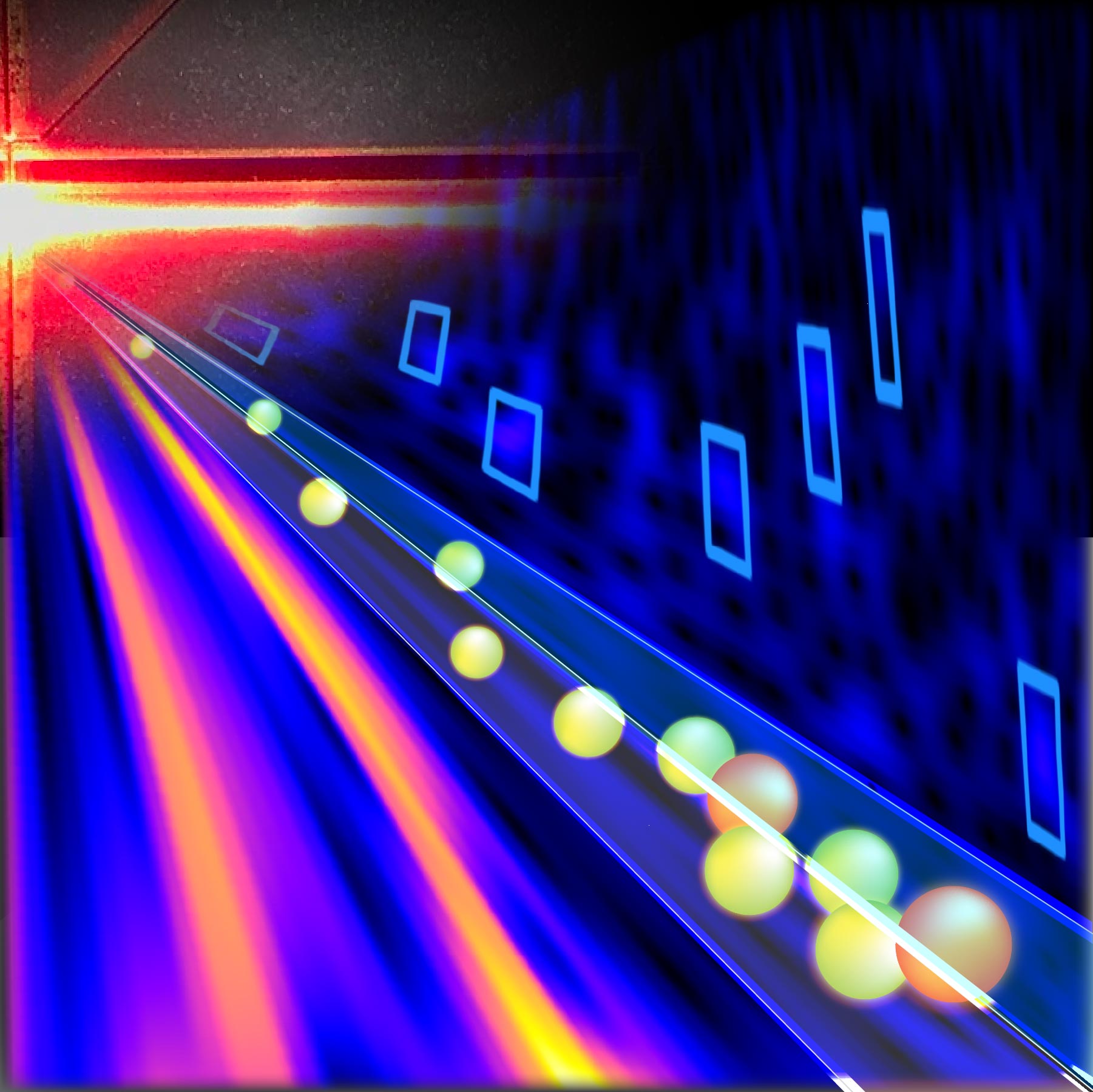
The researchers implemented a feedback loop that detects when signals are very large and adjusts the input laser power accordingly. This allowed them to detect large signals from high concentrations without overwhelming the weak signals that may be present from another species at low concentrations. Credit: Holger Schmidt, ECE Department, University of California, Santa Cruz
The researchers have previously demonstrated that their platform has the sensitivity necessary to perform various types of analyses and can detect many different particle types, including nucleic acids, proteins, viruses, bacteria, and cancer biomarkers. However, until now, they have used separate detectors and signal analysis techniques to measure particles with high and low concentrations. This was necessary because if one type of particle type is present at a very high concentration, it creates a very large response that overwhelms the much smaller signals from another particle type present at low concentrations.
Better Signal Processing
In the new work, Schmidt and graduate student Vahid Ganjalizadeh developed signal processing methods that can be used to detect particles in both high and low concentrations simultaneously, even if the concentrations are not known in advance. To do this, they combined different signal modulation frequencies: High-frequency laser modulation to distinguish single particles at low concentrations and low-frequency laser modulation to detect large signals from many particles simultaneously at high concentrations.
“Secondly, we implemented a feedback loop that detects when signals are really large and adjusts the input laser power accordingly,” said Schmidt. “In this way, we can detect large signals from high concentrations without overwhelming the weak signals that may be present from another species at low concentrations. This allowed us to simultaneously detect particles that were present in very different concentrations.”
The researchers also applied an extremely fast algorithm they recently developed to identify single particle signals at low concentrations in real-time. Machine learning also helped with recognizing signal patterns so that different particle types could be distinguished with high accuracy. “These signal analysis advances are ideal for enabling device operation at the point of care where signal quality can be poor and where data analysis is required in real-time,” said Schmidt.
Distinguishing Low and High Concentrations
The researchers demonstrated their new signal analysis approach by pumping optofluidic biosensor chips with a solution of nanobeads at different concentrations and with various fluorescence colors. They were able to correctly identify the concentration of both yellow-green and crimson bead concentrations even though their concentrations differed by a factor of more than 10,000 in the mixture.
“While this work advances a specific integrated sensor that is based on optical fluorescence signals, the signal analysis technique can be used with any type of time-dependent signal that covers a wide concentration range,” said Schmidt. “This can include different optical signals but also electrical sensors.”
The team’s optofluidic biosensing technology is currently being commercialized by medical device company Fluxus Inc. The researchers are also working to adapt their methods to study molecular products from artificial neuronal cell tissue organoids. This project, which is part of the UCSC Center for Live Cell Genomics, an NIH Center for Excellence in Genomic Science, could provide further insight into areas such as neurogenerative disease and pediatric cancer.
Reference: “Adaptive time modulation technique for multiplexed on-chip particle detection across scales” by V. Ganjalizadeh, A. R. Hawkins and H. Schmidt, 22 June 2023, Optica.
DOI: 10.1364/OPTICA.489068
Never miss a breakthrough: Join the SciTechDaily newsletter.
Follow us on Google and Google News.