

Close Menu
    Facebook X (Twitter) Instagram
    SciTechDaily
    • Biology
    • Chemistry
    • Earth
    • Health
    • Physics
    • Science
    • Space
    • Technology
    Facebook X (Twitter) Pinterest YouTube RSS
    SciTechDaily
    Home»Physics»Ultracold Quantum Particles Break Classical Symmetry
    Physics

    Ultracold Quantum Particles Break Classical Symmetry

    By Heidelberg UniversityAugust 11, 2019No Comments2 Mins Read
    Facebook Twitter Pinterest Telegram LinkedIn WhatsApp Email Reddit
    Share
    Facebook Twitter LinkedIn Pinterest Telegram Email Reddit
    Stock Photo Representing Quantum Symmetry
    Researchers have proven for the first time the theoretically predicted deviation from classical symmetry in laboratory experiments with ultracold lithium atoms.

    Experiments in quantum physics confirm theoretically predicted deviation.

    Many phenomena of the natural world evidence symmetries in their dynamic evolution which help researchers to better understand a system’s inner mechanism. In quantum physics, however, these symmetries are not always achieved. In laboratory experiments with ultracold lithium atoms, researchers from the Center for Quantum Dynamics at Heidelberg University have proven for the first time the theoretically predicted deviation from classical symmetry. Their results were published in the journal Science.
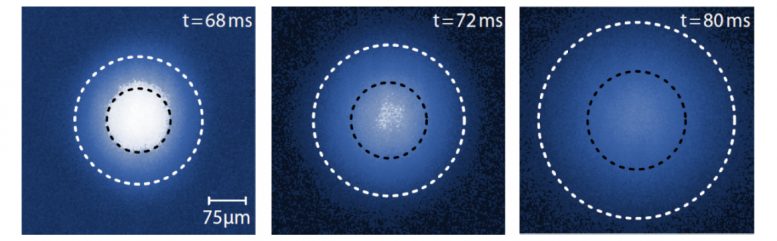
    Expanding Cloud of Quantum Particles
    An expanding cloud of quantum particles violates the scaling symmetry. Caption: Enss

    “In the world of classical physics, the energy of an ideal gas rises proportionally with the pressure applied. This is a direct consequence of scale symmetry, and the same relation is true in every scale invariant system. In the world of quantum mechanics, however, the interactions between the quantum particles can become so strong that this classical scale symmetry no longer applies”, explains Associate Professor Dr. Tilman Enss from the Institute for Theoretical Physics. His research group collaborated with Professor Dr. Selim Jochim’s group at the Institute for Physics.

    In their experiments, the researchers studied the behavior of an ultracold, superfluid gas of lithium atoms. When the gas is moved out of its equilibrium state, it starts to repeatedly expand and contract in a “breathing” motion. Unlike classical particles, these quantum particles can bind into pairs and, as a result, the superfluid becomes stiffer the more it is compressed. The group headed by primary authors Dr. Puneet Murthy and Dr. Nicolo Defenu – colleagues of Prof. Jochim and Dr. Enss – observed this deviation from classical scale symmetry and thereby directly verified the quantum nature of this system. The researchers report that this effect gives a better insight into the behavior of systems with similar properties such as graphene or superconductors, which have no electrical resistance when they are cooled below a certain critical temperature.

    Reference: “Quantum scale anomaly and spatial coherence in a 2D Fermi superfluid” by “Puneet A. Murthy, Nicolò Defenu, Luca Bayha, Marvin Holten, Philipp M. Preiss, Tilman Enss and Selim Jochim, 19 July 2019, Science.
    DOI: 10.1126/science.aau4402

    Never miss a breakthrough: Join the SciTechDaily newsletter.
    Follow us on Google and Google News.

    Heidelberg University Popular Quantum Physics
    Share. Facebook Twitter Pinterest LinkedIn Email Reddit

    Related Articles

    Experiment Using Photons Could Detect Quantum-Scale Black Holes

    Photons Traverse Optical Obstacles as Both a Wave and Particle Simultaneously

    The Experimental Design of a Space-Time Crystal

    “Schrödinger’s Hat” Conceals Matter Waves Inside an Invisible Container

    Physicists Use Cheap Colliders to Probe for Heavy Photons

    Quantum Interference Shown Experimentally in Larger Molecules

    Simulating Quantum Walks in Two Dimensions

    Evidence of Elusive Majorana Fermions Raises Possibilities for Quantum Computing

    Higgs Boson Signals Gain Strength at Large Hadron Collider

    Leave A Reply Cancel Reply

    • Facebook
    • Twitter
    • Pinterest
    • YouTube

    Don't Miss a Discovery

    Subscribe for the Latest in Science & Tech!

    Trending News

    Millions Take These IBS Drugs, But a New Study Finds Serious Risks

    Scientists Unlock Hidden Secrets of 2,300-Year-Old Mummies Using Cutting-Edge CT Scanner

    Bread Might Be Making You Gain Weight Even Without Eating More Calories

    Scientists Discover Massive Magma Reservoir Beneath Tuscany

    Europe’s Most Active Volcano Just Got Stranger – Here’s Why Scientists Are Rethinking It

    Alzheimer’s Symptoms May Start Outside the Brain, Study Finds

    Millions Take This Popular Supplement – Scientists Discover a Concerning Link to Heart Failure

    The Universe Is Expanding Too Fast and Scientists Can’t Explain Why

    Follow SciTechDaily
    • Facebook
    • Twitter
    • YouTube
    • Pinterest
    • Newsletter
    • RSS
    SciTech News
    • Biology News
    • Chemistry News
    • Earth News
    • Health News
    • Physics News
    • Science News
    • Space News
    • Technology News
    Recent Posts
    • U.S. Waste Holds $5.7 Billion Worth of Crop Nutrients
    • Scientists Say a Hidden Structure May Exist Inside Earth’s Core
    • Doctors Surprised by the Power of a Simple Drug Against Colon Cancer
    • Why Popular Diabetes Drugs Like Ozempic Don’t Work for Everyone: The “Genetic Glitch”
    • Scientists Create Improved Insulin Cells That Reverse Diabetes in Mice
    Copyright © 1998 - 2026 SciTechDaily. All Rights Reserved.
    • Science News
    • About
    • Contact
    • Editorial Board
    • Privacy Policy
    • Terms of Use

    Type above and press Enter to search. Press Esc to cancel.