
Close Menu
    Facebook X (Twitter) Instagram
    SciTechDaily
    • Biology
    • Chemistry
    • Earth
    • Health
    • Physics
    • Science
    • Space
    • Technology
    Facebook X (Twitter) Pinterest YouTube RSS
    SciTechDaily
    Home»Chemistry»Ultrastable Catalyst Could Lead to More Efficient and Cheaper Production of Propylene From Propane
    Chemistry

    Ultrastable Catalyst Could Lead to More Efficient and Cheaper Production of Propylene From Propane

    By Hokkaido UniversityJune 5, 2020No Comments3 Mins Read
    Facebook Twitter Pinterest Telegram LinkedIn WhatsApp Email Reddit
    Share
    Facebook Twitter LinkedIn Pinterest Telegram Email Reddit
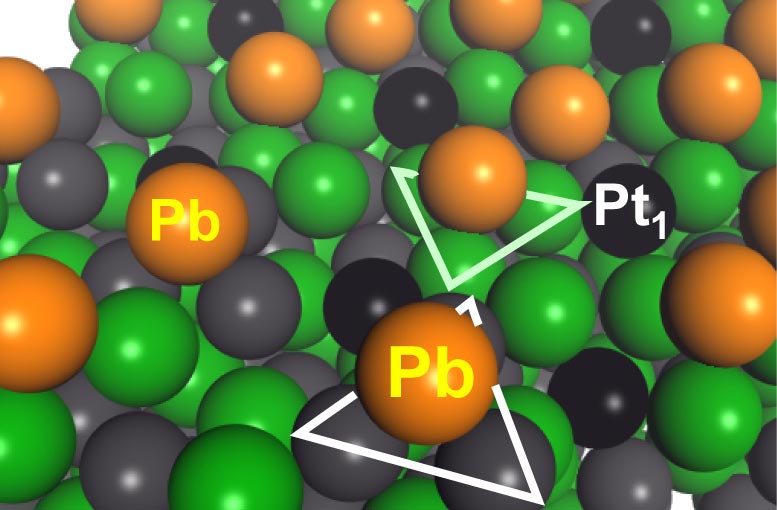
    Newly Developed Catalyst (PtGa-Pb/SiO2)
    On the surface of the newly developed catalyst (PtGa-Pb/SiO2), Pt1 sites remain exposed to facilitate catalytic reaction while Pt3 sites (and Ga3 sites) shown with triangles are blocked by Pb. (Yuki Nakaya, et al., Nature Communications, June 5, 2020). Credit: Yuki Nakaya, et al., Nature Communications, June 5, 2020

    A group of Japanese scientists has developed an ultrastable, selective catalyst to dehydrogenate propane — an essential process to produce the key petrochemical substance of propylene — without deactivation, even at temperatures of more than 600°C (1,100°F)

    Propylene is an important raw material for plastics, synthetic rubber, surfactants, dyes, and pharmaceuticals. In recent years, there has been an increased demand for propylene produced from cheaper, shale-originated propane. Reaction temperatures of more than 600°C are necessary to obtain sufficient propylene yields, but under these harsh conditions, severe catalyst deactivation is inevitable due to carbon deposition and/or sintering. Catalysts in practical use, therefore, must be regenerated either continuously or in short cycles, making the process inefficient and costly.

    In the present study, the group, including a master’s student Yuki Nakaya and Associate Professor Shinya Furukawa at Hokkaido University’s Institute for Catalysis, focused on the intermetallics (PtGa) of platinum (Pt) and gallium (Ga), which have unique properties and structures. PtGa has a high thermal stability and its structure does not change even under high temperatures. It is also known to have two kinds of catalytic sites on its surface: a site with three Pt atoms (Pt3 site) and one with single-atom-like isolated Pt (Pt1 site).

    Yuki Nakaya and Shinya Furukawa
    Yuki Nakaya (left) and Shinya Furukawa (right) of the research team. Credit: Hokkaido University

    The group hypothesized that if the Pt3 sites — which facilitate carbon deposition in addition to producing propylene — are disabled to allow only the Pt1 sites to function, the catalyst will be ultrastable and also able to prevent carbon deposition. The group tried various metals and catalyst synthesis methods to make only the Pt1 site function.

    The newly developed catalyst (PtGa-Pb/SiO2), which is silica-supported and made by adding lead (Pb) to the surface of PtGa, exhibits no deactivation when dehydrogenating propane at 600°C. The catalyst maintained the initial conversion rate of 30 percent for 96 hours after the reaction started, which is significantly more stable than conventional catalysts. Propylene selectivity is as high as 99.6 percent with few side reactions, including carbon deposition. The results showed that this catalyst produces the world’s best performance at temperatures of 580°C or higher. In particular, its life span is more than twice as long as the previously reported record longevity for such catalysts. Furthermore, the catalyst can be produced as cheaply as conventional catalysts. Their structural analysis confirmed Pt3 sites, not Pt1 sites, were covered and disabled by Pb, as they expected.

    “Our finding could lead to a more efficient and cheaper industrial process to produce propylene from propane without the need for catalyst regeneration — which is far superior in selectivity and stability than conventional ones,” says Furukawa. “Moreover, this method could be applicable to dehydrogenation of other lower alkanes such as ethane and isobutane, thus contributing to the petrochemical industry’s development.”

    Reference: “Single-atom Pt in intermetallics as an ultrastable and selective catalyst for propane dehydrogenation” by Yuki Nakaya, Jun Hirayama, Seiji Yamazoe, Ken-ichi Shimizu and Shinya Furukawa, 5 June 2020, Nature Communications.
    DOI: 10.1038/s41467-020-16693-9

    Never miss a breakthrough: Join the SciTechDaily newsletter.
    Follow us on Google and Google News.

    Catalysts Hokkaido University Industrial Engineering Plastic
    Share. Facebook Twitter Pinterest LinkedIn Email Reddit

    Related Articles

    Revolutionary Chemistry: 120-Year-Old Reaction Turned On Its Head

    “Swiss Army Knife” Nanoparticle Catalyst Can Make Natural Gas Burn Cleaner

    Key Step Toward Cleaner, More Efficient Mass-Production of Hydrogen From Water

    Scientists Unveil Surprising Secrets of a 40-Year-Old Catalyst

    Ultra-Efficient Catalyst: Making Biodiesel From Dirty Old Cooking Oil Just Got Way Easier

    Super-Particles: The Importance of Good Neighbors in Catalysis

    Metallic Glass: One Step Closer to Solving a Major Problem of Hydrogen Energy

    Scientists Turn Plastic Waste Into Valuable Chemicals With Sunlight

    Zeolite Catalyst Creates P-Xylene From Biomass

    Leave A Reply Cancel Reply

    • Facebook
    • Twitter
    • Pinterest
    • YouTube

    Don't Miss a Discovery

    Subscribe for the Latest in Science & Tech!

    Trending News

    Scientists Uncover Potential Brain Risks of Popular Fish Oil Supplements

    Scientists Discover a Surprising Way To Make Bread Healthier and More Nutritious

    After 60 Years, Scientists Uncover Unexpected Brain Effects of Popular Diabetes Drug Metformin

    New Research Uncovers Hidden Side Effects of Popular Weight-Loss Drugs

    Scientists Rethink Extreme Warming After Surprising Ocean Discovery

    Landmark Study Links Never Marrying to Significantly Higher Cancer Risk

    Researchers Discover Unknown Beetle Species Just Steps From Their Lab

    Largest-Ever Study Finds Medicinal Cannabis Ineffective for Anxiety, Depression, PTSD

    Follow SciTechDaily
    • Facebook
    • Twitter
    • YouTube
    • Pinterest
    • Newsletter
    • RSS
    SciTech News
    • Biology News
    • Chemistry News
    • Earth News
    • Health News
    • Physics News
    • Science News
    • Space News
    • Technology News
    Recent Posts
    • Not Just Alzheimer’s: Scientists Uncover Clues to a Second, Overlooked Disorder
    • Scientists Uncover Dangerous Connection Between Serotonin and Heart Valve Disease
    • Scientists Discover a “Protector” Protein That Could Help Reverse Hair Loss
    • Powerful Lasers Reveal How Matter Becomes Plasma in Trillionths of a Second
    • A Simpler Path to Super-Resolution: Scientists Reinvent Microscopy
    Copyright © 1998 - 2026 SciTechDaily. All Rights Reserved.
    • Science News
    • About
    • Contact
    • Editorial Board
    • Privacy Policy
    • Terms of Use

    Type above and press Enter to search. Press Esc to cancel.