
Close Menu
    Facebook X (Twitter) Instagram
    SciTechDaily
    • Biology
    • Chemistry
    • Earth
    • Health
    • Physics
    • Science
    • Space
    • Technology
    Facebook X (Twitter) Pinterest YouTube RSS
    SciTechDaily
    Home»Space»Understanding Black Holes: 5 Things to Know [Video]
    Space

    Understanding Black Holes: 5 Things to Know [Video]

    By NASA's Goddard Space Flight CenterDecember 31, 20196 Comments3 Mins Read
    Facebook Twitter Pinterest Telegram LinkedIn WhatsApp Email Reddit
    Share
    Facebook Twitter LinkedIn Pinterest Telegram Email Reddit
    Black Hole Illustration
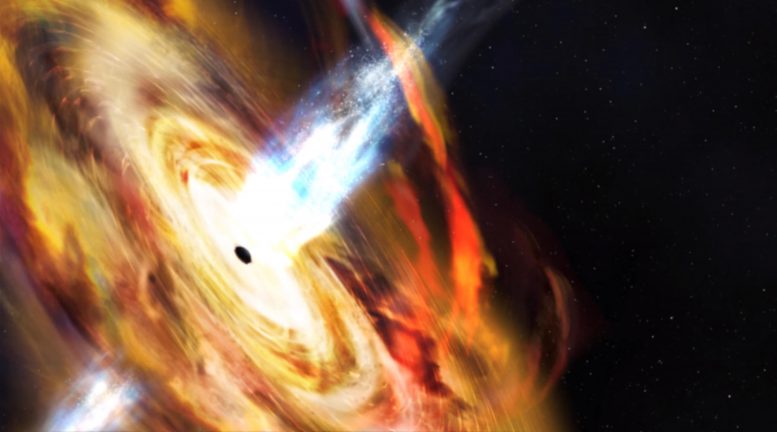
    Artist’s illustration of a black hole.

    Black holes are one of the most mysterious objects in the universe. Here are five things to know!

    A black hole is a single point in space that has a lot of mass. One of the ways that we look for black holes is to develop new instruments and new technologies that can try to search for them.

    As we’ve observed black holes including the supermassive black hole in the center of our galaxy, because it has such a strong gravity because it has lots of mass, stars will orbit black holes and as stars get closer and closer to the center of a black hole as it crosses over the Event Horizon, what will happen is that the material of these stars will get shredded apart, because the gravitational pull of a black hole is so strong that the material of the stars gets pulled apart.

    But there is an event horizon, which is the point at which the black hole’s gravity starts to pull you so much that you can’t escape. So as you approach the black hole, you’ll feel its pull. But then as you get closer and closer and closer towards the event horizon, that’s the point of no return so you couldn’t escape past that.

    The easiest way to think of a black hole is just like anything that has mass. So the Earth has mass, and one of the reasons that the Moon orbits around the Earth is because of the gravitational attraction of these two massive bodies. And so, Earth is distorting the space around the Moon and so that’s what keeps the Moon in orbit.

    And so now take that to an extreme. So take something that’s as massive as the Sun, or as massive as a million Suns and put it at a single point, and that distortion that you get is coming from that amount of mass in a single point.

    Black holes vary in size a lot. We know that black holes can be formed by massive stars exploding and then collapsing into a singular point. And those give us black holes that are about the mass of the Sun. So, those are solar mass black holes.

    However, we also know at the center of galaxies, like the Milky Way, there are supermassive black holes and these are millions or even billions of times the mass of the Sun. And how these form is actually a mystery.

    Studying black holes really gives us a fundamental insight into how gravity works because it’s such a small physical scale, but it’s a supermassive object. And so understanding how black holes work and the interactions of black holes in other parts of the universe really give us a fundamental insight that we could then use to think about how our own solar system works.

    And so if we can understand how black holes work, they’ll give us a key to really understanding our universe.

    Never miss a breakthrough: Join the SciTechDaily newsletter.
    Follow us on Google and Google News.

    Astrophysics Black Hole NASA NASA Goddard Space Flight Center Popular
    Share. Facebook Twitter Pinterest LinkedIn Email Reddit

    Related Articles

    Twin Titans: NASA Tracks Two Monster Black Holes Tearing Up a Distant Galaxy [Video]

    Echoes of Creation: The Roman Telescope’s Quest for Primordial Black Holes

    Early Universe Revelation: Webb Detects Most Distant Active Supermassive Black Hole

    NASA Scientists Use Discover Supercomputer To Create Black Hole Jets

    Webb Space Telescope’s Quest for Primeval Black Holes

    Spontaneous Magnetic Reversal of Monster Black Hole Sparks Enigmatic Outburst

    NASA’s Fermi Space Telescope Hunts for Gravitational Waves From Monster Black Holes

    NASA’s New $10 Billion Webb Space Telescope Will Reveal the Supermassive Black Hole at the Heart of the Milky Way

    The Sun Won’t Become a Black Hole – Here’s Why

    6 Comments

    1. RJS on December 31, 2019 6:39 am

      Sadly, a poor effort at composition. Sharpen writing skills please.

      Reply
    2. Lilly on December 31, 2019 9:30 am

      Your second sentence is not a complete sentence.

      Reply
    3. Gadfly Giznot on January 1, 2020 1:52 pm

      I’m genuinely amazed that grown men and women believe this stuff.

      Reply
    4. Arezoo on January 3, 2020 6:45 am

      Thank you for your efort to introduce the scientific facts in simple words to people.

      Reply
    5. Harsh Raj on January 5, 2020 12:30 am

      By considering it’s mass we can say that it would be a larges planet

      Reply
    6. Dr Mohammad Taqi Jamani on December 31, 2020 9:54 am

      Extra info is useless if it fails to provide relevance to our existing understanding of the universe

      Reply
    Leave A Reply Cancel Reply

    • Facebook
    • Twitter
    • Pinterest
    • YouTube

    Don't Miss a Discovery

    Subscribe for the Latest in Science & Tech!

    Trending News

    Why Popular Diabetes Drugs Like Ozempic Don’t Work for Everyone: The “Genetic Glitch”

    Scientists Stunned After Finding Plant Thought Extinct for 60 Years

    Scientists Discover Tiny New Spider That Hunts Prey 6x Its Size

    Natural Component From Licorice Shows Promise for Treating Inflammatory Bowel Disease

    Scientists Warn: Popular Sweetener Linked to Dangerous Metabolic Effects

    Monster Storms on Jupiter Unleash Lightning Beyond Anything on Earth

    Scientists Create “Liquid Gears” That Spin Without Touching

    The Simple Habit That Could Help Prevent Cancer

    Follow SciTechDaily
    • Facebook
    • Twitter
    • YouTube
    • Pinterest
    • Newsletter
    • RSS
    SciTech News
    • Biology News
    • Chemistry News
    • Earth News
    • Health News
    • Physics News
    • Science News
    • Space News
    • Technology News
    Recent Posts
    • Your Blood Test Might Already Show Alzheimer’s Risk
    • Common Pregnancy Medications Linked to Higher Autism Risk in Massive U.S. Study
    • Scientists Teach AI To Think Like a Professional Chemist
    • Scientists Were Wrong About This Strange “Rule-Breaking” Particle
    • Webb Space Telescope Uncovers Unexpected Ice Clouds on a Jupiter-Like World
    Copyright © 1998 - 2026 SciTechDaily. All Rights Reserved.
    • Science News
    • About
    • Contact
    • Editorial Board
    • Privacy Policy
    • Terms of Use

    Type above and press Enter to search. Press Esc to cancel.