
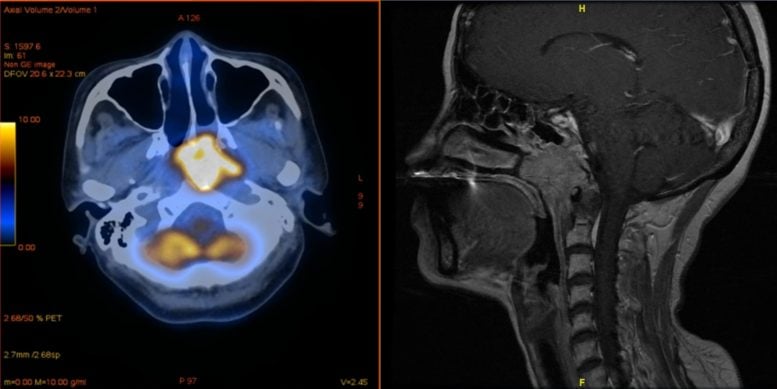
Clinical study on nasopharyngeal cancer with an unexpected result.
Patients with nasopharyngeal cancer are often treated with drugs that activate their immune system against the tumor. Scientists feared that vaccination against COVID-19 could reduce the success of cancer treatment or cause severe side effects—until now. A recent study now gives the all-clear in this regard. According to the study, the cancer drugs actually worked better after vaccination with the Chinese vaccine SinoVac than in unvaccinated patients.
The results of the study, which was conducted by the Universities of Bonn and Shanxi in the People’s Republic of China, are published as a “Letter to the editor” in the journal Annals of Oncology, but are already available online.
Nasopharyngeal cancer is a disease in which malignant (cancer) cells form in the tissues of the nasopharynx. The nasopharynx is the upper part of the throat behind the nose. An opening on each side of the nasopharynx leads into the ear.
Many cancer cells are capable of subverting the body’s immune response. They do this by pushing a kind of button on the immune cells, the PD-1 receptor. In this way, they effectively shut down these endogenous defense forces. Drugs can be used to block PD-1 receptors. This enables the immune system to fight the tumor more effectively.
Vaccination against COVID also stimulates the immune response, involving the PD-1 receptor. “It was feared that the vaccine would not be compatible with anti-PD-1 therapy,” explains Dr. Jian Li of the Institute of Molecular Medicine and Experimental Immunology (IMMEI) at the University Hospital Bonn. “This risk is especially true for nasopharyngeal cancer, which, like the SARS Cov-2 virus, affects the upper respiratory tract.”
Together with cooperation partners from the People’s Republic of China, the bioinformatician has now investigated whether this concern is justified. More than 1,500 patients treated in 23 hospitals from all over China participated in the analysis. Such multi-center studies are considered to be particularly informative because the participants are very diverse and, moreover, the results are not distorted by regional characteristics.
Vaccinated Patients Responded Better to Cancer Therapy
A subset of 373 affected individuals had been vaccinated with the Chinese COVID-19 vaccine SinoVac. “Surprisingly, they responded significantly better to anti-PD-1 therapy than the unvaccinated patients,” explains Prof. Dr. Christian Kurts, Director of IMMEI and member of the Transdisciplinary Research Area “Life & Health” and the Cluster of Excellence ImmunoSensation. “Furthermore, they did not experience severe side effects more often.” The researchers cannot say why the treatment was more successful after vaccination. “We assume that vaccination activates certain immune cells, which then attack the tumor,” says Prof. Dr. Qi Mei of Shanxi University Hospital. “We will now investigate this hypothesis further.”
Nasopharyngeal cancer is quite rare in this country. In southern China and other countries in Southeast Asia, however, the disease is widespread. One of the suspected reasons for this is the frequent use of air conditioning in the hot and humid regions. Nutritional factors also appear to play an important role. In Taiwan, nasopharyngeal cancer is now considered one of the leading causes of death among young men.
Reference: “Potentially improved response of COVID-19 vaccinated nasopharyngeal cancer patients to combination therapy with anti-PD-1 blockade and chemotherapy” by Y.J. Hua, Y.L. Liu, K. Wen, C. Kurts, H. Wu, Q. Mei and J. Li, Annals of Oncology.
DOI: 10.1016/j.annonc.2022.10.002
Participating institutions and funding:
In addition to the University of Bonn and the University Hospital, Shanxi Medical University and Tongji Medical College were involved in the work. The researchers also collaborated with a number of clinics throughout China. The study was funded by the Sino-German Center for Research Promotion (SGC), the DFG Cluster of Excellence ImmunoSensation², and the German Federal Ministry of Education and Research (BMBF).
Never miss a breakthrough: Join the SciTechDaily newsletter.
Follow us on Google and Google News.