

Close Menu
    Facebook X (Twitter) Instagram
    SciTechDaily
    • Biology
    • Chemistry
    • Earth
    • Health
    • Physics
    • Science
    • Space
    • Technology
    Facebook X (Twitter) Pinterest YouTube RSS
    SciTechDaily
    Home»Science»Unlocking the Genetic Secrets Behind Plant Immunity and Growth
    Science

    Unlocking the Genetic Secrets Behind Plant Immunity and Growth

    By RIKENFebruary 1, 2024No Comments4 Mins Read
    Facebook Twitter Pinterest Telegram LinkedIn WhatsApp Email Reddit
    Share
    Facebook Twitter LinkedIn Pinterest Telegram Email Reddit
    Plant Science Genetics Art Concept Illustration
    A team from RIKEN CSRS has traced the evolutionary history of plant immune receptors, revealing their common ancestry with growth proteins and the potential for creating pathogen-resistant crops through genetic engineering. Credit: SciTechDaily.com

    RIKEN researchers have mapped the evolution of plant immunity, uncovering a pathway to engineer crops with enhanced disease resistance.

    Plants are continuously evolving new immune receptors to ever-changing pathogens. Researchers at the RIKEN Center for Sustainable Resource Science (CSRS) have traced the origin and evolutionary trajectory of plant immune receptors. Their discovery will make it easier to identify immune receptor genes from genomic information and could help in the development of pathogen-resistant crops. This study will be published today (February 1) in the scientific journal Nature Communications.

    Plant Immune Responses

    As in animals, plants have immune responses that help them defend against pathogens such as viruses, bacteria, fungi, and oomycetes. Before invaders can be stopped, they must first be detected, and this is accomplished by pattern recognition receptors located on the surface of plant cells. The ability of these receptors to detect molecular patterns associated with pathogens depends on two types of proteins, called RLPs and RLKs, both of which can contain leucine-rich repeats—sections in which the amino acid leucine appears multiple times.

    Tracing Immunity’s Evolution

    To trace the evolution of plant immunity, the international research team led by Ken Shirasu and Yasuhiro Kadota at RIKEN CSRS examined the numbers and patterns of receptors. They analyzed over 170,000 genes encoding RLKs and about 40,000 genes encoding RLPs, which they obtained from publicly available data taken from 350 plant species. They discovered that RLKs and RLPs with leucine-rich repeats were the most abundant receptor types among all the plant species, making up nearly half of RLKs and 70% of RLPs.
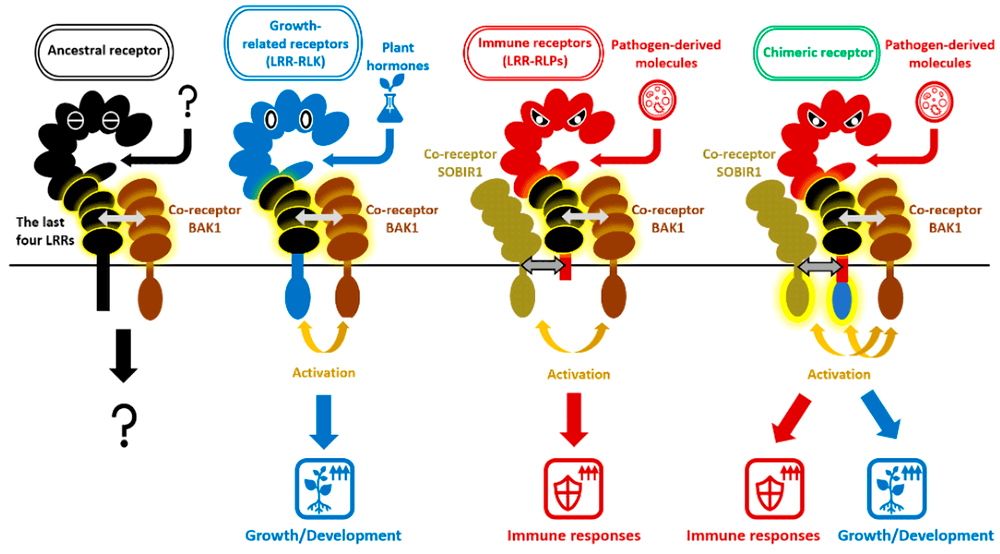
    Immunity-Related LRR-RLPs and Growth-Related LRR-RLKs
    Both immunity-related LRR-RLPs and growth-related LRR-RLKs have evolved from a common ancestor to inherit the last four LRRs and the ability to bind the co-receptor BAK1. The chimeric receptor that incorporates the cytoplasmic kinase domain of a growth-related LRR-RLK into an immunity-related LRR-RLP activates both immune and growth responses upon sensing a pathogen-derived molecule. LRR, leucine-rich repeat; RLP, receptor-like protein; RLK, receptor-like kinase. Credit: RIKEN

    Key Discoveries and Implications

    RLPs, and some RLKs, are known to contain a special island region that is crucial for recognizing parts of pathogens. Investigation by the RIKEN CSRS team revealed that among RLPs that contain the leucine-rich repeats, this special region was almost always located in the same place; between the 4th and 5th leucine-rich repeat. These RLPs were found to be associated with immune responses. They also discovered that the island region was located at the same position in some RLKs, nearly all of which belong to a functional group that regulates growth and development.

    Comparative analysis showed that the sequence of the four repeats below the island region was very similar between the two types of protein detectors, suggesting that they have a common evolutionary ancestry. In particular, these four sets of leucine repeats contained sections needed for bonding to the same co-receptor, called BAK1. This means that immunity-related RLPs and growth-related RLKs inherited the ability to bind BAK1 from a common ancestor.

    “Intriguingly, we found that exchanging the four regions of leucine-rich repeats among these receptors did not disrupt their functionality,” says Bruno Pok Man Ngou, who conducted the study. Creating a hybrid receptor by combining a growth-related RLK with an immunity-related RLP resulted in a hybrid receptor that recognized pathogens and induced both immune and growth-related responses. This means that scientists should be able to engineer receptors with new functions by swapping those modules.

    Future Prospects

    This study addressed the origins of plant immunity at a molecular level, showing that simultaneously analyzing information from multiple plant genomes can allow straightforward and precise prediction of genes involved in plant immunity and growth. “We are currently isolating immune receptors from various plants using this information, aiming for practical applications such as developing disease-resistant crops in the future,” says Shirasu.

    Reference: “Evolutionary trajectory of pattern recognition receptors in plants” by Bruno Pok Man Ngou, Michele Wyler, Marc W. Schmid, Yasuhiro Kadota and Ken Shirasu, 1 February 2024, Nature Communications.
    DOI: 10.1038/s41467-023-44408-3

    Never miss a breakthrough: Join the SciTechDaily newsletter.
    Follow us on Google and Google News.

    Evolution Genetics Immunology Plant Science RIKEN
    Share. Facebook Twitter Pinterest LinkedIn Email Reddit

    Related Articles

    Bioactive Nanocarrier Spray: Better Crops Without Genetic Modification

    Ancient DNA Continues to Rewrite the 9,000-Year Society-Shaping History of Corn

    Genetic Heritage: Rice Has Many Fathers but Only Two Mothers

    Remarkable Discovery of 1 Billion-Year-Old Green Seaweed Micro-Fossils in China

    Unraveling the Mystery of Neanderthal Death Rites – Discovery at ‘Flower Burial’ Site Offers “Unparalleled Opportunity”

    1 Billion Years of Evolution Illuminated by Genetic Sequencing of 1,100 Plants

    Scientists Reveal the Complex Story Behind the Beaker Phenomenon

    Examining the Genes of Stone Age Farmers

    Stickleback Fish Used Pre-Existing Genes to Go from Saltwater to Freshwater Environments

    Leave A Reply Cancel Reply

    • Facebook
    • Twitter
    • Pinterest
    • YouTube

    Don't Miss a Discovery

    Subscribe for the Latest in Science & Tech!

    Trending News

    The Universe Is Expanding Too Fast and Scientists Can’t Explain Why

    “Like Liquid Metal”: Scientists Create Strange Shape-Shifting Material

    Early Warning Signals of Esophageal Cancer May Be Hiding in Plain Sight

    Common Blood Pressure Drug Shows Surprising Power Against Deadly Antibiotic-Resistant Superbug

    Scientists Uncover Dangerous Connection Between Serotonin and Heart Valve Disease

    Scientists Discover a “Protector” Protein That Could Help Reverse Hair Loss

    Bone-Strengthening Discovery Could Reverse Osteoporosis

    Scientists Uncover Hidden Trigger Behind Stem Cell Aging

    Follow SciTechDaily
    • Facebook
    • Twitter
    • YouTube
    • Pinterest
    • Newsletter
    • RSS
    SciTech News
    • Biology News
    • Chemistry News
    • Earth News
    • Health News
    • Physics News
    • Science News
    • Space News
    • Technology News
    Recent Posts
    • Scientists Stunned After Finding Plant Thought Extinct for 60 Years
    • A Common Diabetes Drug May Hold the Key to Stopping HIV From Coming Back
    • Ancient “Syphilis-Like” Disease in Vietnam Challenges Key Scientific Assumptions
    • Drinking Alcohol To Cope in Your 20s Could Damage Your Brain for Life
    • Scientists Crack Alfalfa’s Chromosome Mystery After Decades of Debate
    Copyright © 1998 - 2026 SciTechDaily. All Rights Reserved.
    • Science News
    • About
    • Contact
    • Editorial Board
    • Privacy Policy
    • Terms of Use

    Type above and press Enter to search. Press Esc to cancel.