
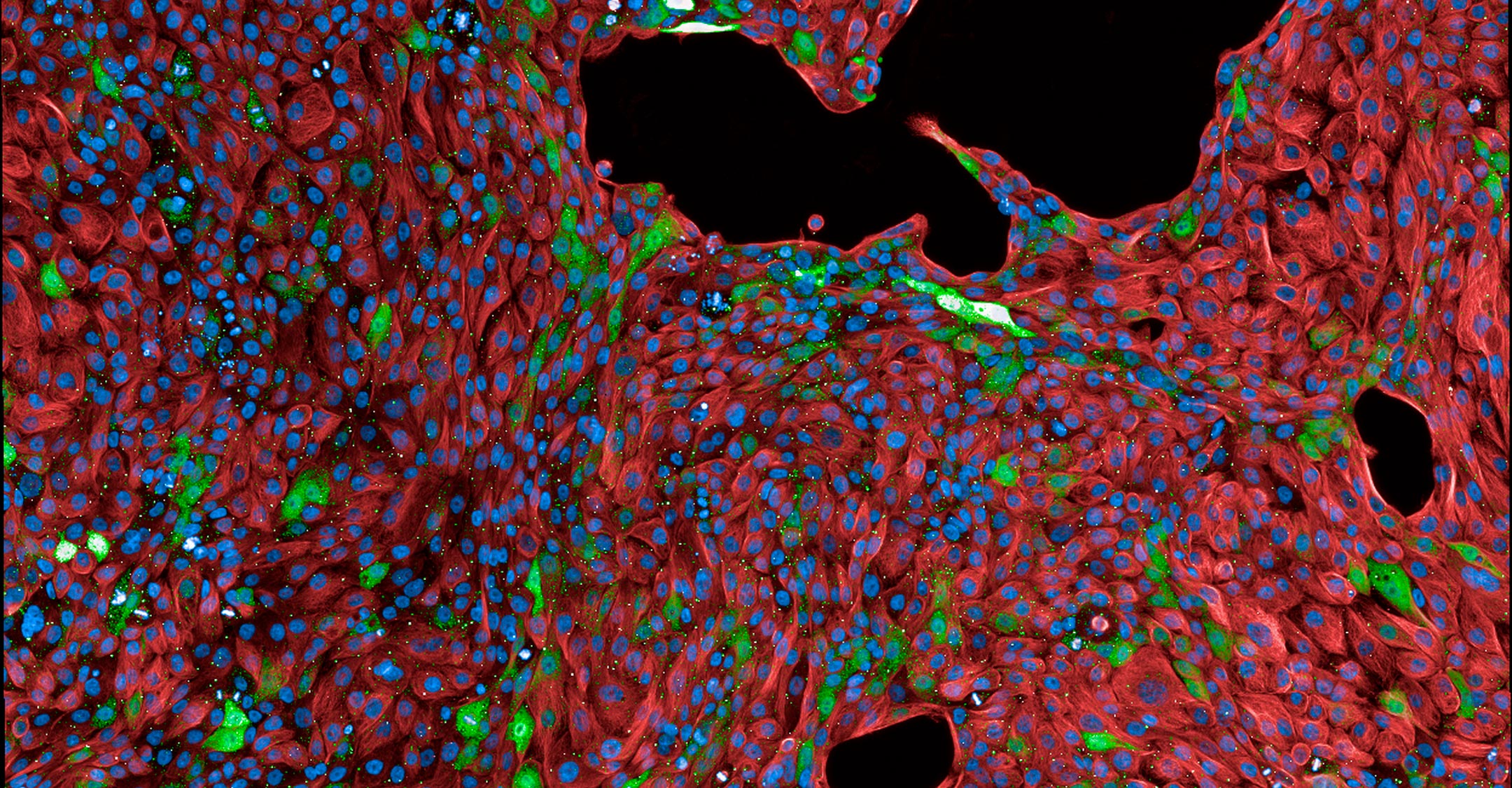
A new computer program allows scientists to design synthetic DNA segments that indicate, in real time, the state of cells. Reported by the Gargiulo lab in Nature Communications, it will be used to screen for anti-cancer or viral infections drugs, or to improve gene and cell-based immunotherapies.
All the cells in our body have the same genetic code, and yet they can differ in their identities, functions, and disease states. Telling one cell apart from another in a simple manner, in real time, would prove invaluable for scientists trying to understand inflammation, infections or cancers.
Now, scientists at the Max Delbrück Center have created an algorithm that can design such tools that reveal the identity and state of cells using segments of DNA called “synthetic locus control regions” (sLCRs). They can be used in a variety of biological systems. The findings, by the lab of Dr. Gaetano Gargiulo, head of the Molecular Oncology Lab, are reported in Nature Communications.
“This algorithm enables us to create precise DNA tools for marking and studying cells, offering new insights into cellular behaviors,” says Gargiulo, senior author of the study. “We hope this research opens doors to a more straightforward and scalable way of understanding and manipulating cells.”
This effort began when Dr. Carlos Company, a former graduate student at the Gargiulo lab and co-first author of the study, started to invest energy into making the design of the DNA tools automated and accessible to other scientists. He coded an algorithm that can generate tools to understand basic cellular processes as well as disease processes such as cancers, inflammation, and infections.
“This tool allows researchers to examine the way cells transform from one type to another. It is particularly innovative because it compiles all the crucial instructions that direct these changes into a simple synthetic DNA sequence. In turn, this simplifies studying complex cellular behaviors in important areas like cancer research and human development,” says Company.
Algorithm to make a tailored DNA tool
The computer program is named “logical design of synthetic cis-regulatory DNA” (LSD). The researchers input the known genes and transcription factors associated with the specific cell states they want to study, and the program uses this to identify DNA segments (promoters and enhancers) controlling the activity in the cell of interest. This information is sufficient to discover functional sequences, and scientists do not have to know the precise genetic or molecular reason behind a cell’s behavior; they just have to construct the sLCR.
The program looks within the genomes of either humans or mouse to find places where transcription factors are highly likely to bind, says Yuliia Dramaretska, a graduate student at the Gargiulo lab and co-first author. It spits out a list of 150-basepair long sequences that are relevant, and which likely act as the active promoters and enhancers for the condition being studied.
“It’s not giving a random list of those regions, obviously,” she says. “The algorithm is actually ranking them and finding the segments that will most efficiently represent the phenotype you want to study.”
Like a lamp inside the cells
Scientists can then make a tool, called a “synthetic locus control region” (sLCR), which includes the generated sequence followed by a DNA segment encoding a fluorescent protein. “The sLCRs are like an automated lamp that you can put inside of the cells. This lamp switches on only under the conditions you want to study,” says Dr. Michela Serresi, a researcher at the Gargiulo lab and co-first author. The color of the “lamp” can be varied to match different states of interest, so that scientists can look under a fluorescence microscope and immediately know the state of each cell from its color. “We can follow with our eyes the color in a petri dish when we give a treatment,” Serresi says.
The scientists have validated the utility of the computer program by using it to screen for drugs in SARS-CoV-2 infected cells, as published last year in “Science Advances.” They also used it to find mechanisms implicated in brain cancers called glioblastomas, where no single treatment works.
“In order to find treatment combinations that work for specific cell states in glioblastomas, you not only need to understand what defines these cell states, but you also need to see them as they arise,” says Dr. Matthias Jürgen Schmitt, the researcher at the Gargiulo lab and co-first author, who used the tools in the lab to showcase their value.
Now, imagine immune cells engineered in the lab as a gene therapy to kill a type of cancer. When infused into the patient, not all these cells will work as intended. Some will be potent and while others may be in a dysfunctional state. Funded by an European Research Council grant, the Gargiulo lab will be using this system to study the behavior of these delicate anti-cancer cell-based therapeutics during manufacturing. “With the right collaborations, this method holds potential for advancing treatments in areas like cancer, viral infections, and immunotherapies,” Gargiulo says.
Reference: “Logical design of synthetic cis-regulatory DNA for genetic tracing of cell identities and state changes” by Carlos Company, Matthias Jürgen Schmitt, Yuliia Dramaretska, Michela Serresi, Sonia Kertalli, Ben Jiang, Jiang-An Yin, Adriano Aguzzi, Iros Barozzi and Gaetano Gargiulo, 5 February 2024, Nature Communications.
DOI: 10.1038/s41467-024-45069-6
Never miss a breakthrough: Join the SciTechDaily newsletter.
Follow us on Google and Google News.