

The ability of intestinal stem cells to preserve the cellular equilibrium in the gut diminishes with age. Scientists at the University of Helsinki have identified a novel interaction between the adaptation of intestinal stem cells to nutrients and the aging process. The finding may make a difference when seeking ways to maintain the functional capacity of the aging gut.
The cellular balance of the intestine is carefully regulated, and it is influenced, among other things, by nutrition: ample nutrition increases the total number of cells in the gut, whereas fasting decreases their number. The relative number of different types of cells also changes according to nutrient status.
The questions of how the nutrition status of the gut controls stem cell division and differentiation, and how the nutrient adaptation of stem cells changes as during aging have not been comprehensively answered. Nutrient adaptation refers to the way in which nutrients guide cell function.
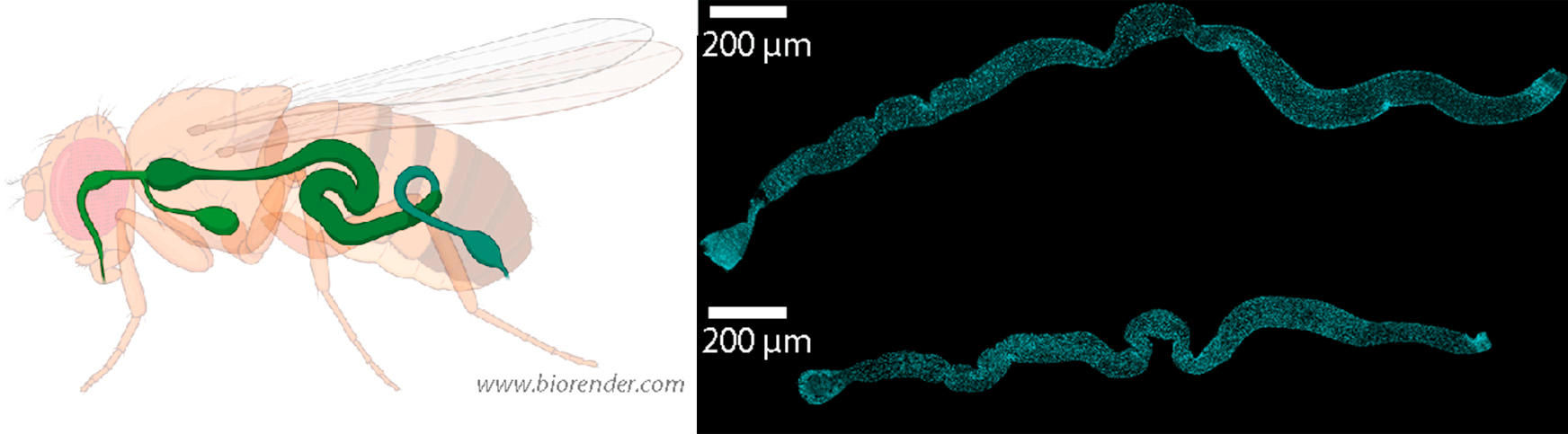
Researchers at the University of Helsinki identified a new regulatory mechanism that directs the differentiation of intestinal stem cells under a changing nutrient conditions. Cell signaling activated by nutrients increases the size of stem cells in the fruit fly intestine. The size of the stem cells, in turn, controls the cell type into which the stem cells differentiate. For stem cell function, flexible regulation of their size is essential.
In other words, the size of the cells dynamically increases or decreases, depending on the dietary conditions. Such flexibility enables stem cells to differentiate in accordance with the prevailing nutrient status. By utilizing intestine-wide cell imaging, the researchers found that the nutrient adaptation of stem cell size and the resulting differentiation vary in different regions of the gut.
“Our observations demonstrate that the regulation of intestinal stem cells is much more region-specific than previously understood. This may be relevant to, for example, how we think about the pathogenetic mechanisms of intestinal diseases,” says Jaakko Mattila, the corresponding author of the research article from the Faculty of Biological and Environmental Sciences, University of Helsinki.
Intermittent fasting may benefit intestinal stem cells
The researchers also observed that the ability of intestinal stem cells to react to a changing nutrient status is greatly reduced in older animals. They also found that, in older animals, stem cells are in a state where they are constantly large in size, which restricts their ability to differentiate. With aging, flexible regulation of stem cell size was markedly better preserved in animals that had been kept under a diet regime that is known as intermittent fasting. In the past, intermittent fasting has been shown to prolong the lifespan of animals, and the results now obtained indicate that the improved preservation of stem cell function may underlie this prolongation.
According to the researchers, the mechanisms associated with the functioning, nutrient adaptation, and aging of human and fruit fly stem cells are fairly similar.
“We believe that these findings have a broader significance towards understanding how to slow down the loss of tissue function caused by aging by controlling the nutrient adaptation of stem cells. However, more information is needed on the effect of the mechanism on human intestinal stem cells. Our work on the nutrient adaptation of stem cells continues,” says Professor Ville Hietakangas from the Faculty of Biological and Environmental Sciences and the Institute of Biotechnology, University of Helsinki.
Reference: “Stem cell mTOR signaling directs region-specific cell fate decisions during intestinal nutrient adaptation” by Jaakko Mattila, Arto Viitanen, Gaia Fabris, Tetiana Strutynska, Jerome Korzelius and Ville Hietakangas, 9 February 2024, Science Advances.
DOI: 10.1126/sciadv.adi2671
Never miss a breakthrough: Join the SciTechDaily newsletter.
Follow us on Google and Google News.