

Pollen records from Lake Baikal indicate early Homo sapiens migrated into Siberia 45,000-50,000 years ago during a warm climate phase. This contradicts prior theories of migration driven by cold conditions.
The mystery of human migration during the Ice Age has long been a subject of debate among anthropologists: When and how did the flow of Homo sapiens in Eurasia occur? Did a cold snap or a warming spell prompt early human migration from Africa into Europe and Asia?
A recent study published in Science Advances explores this by examining Pleistocene vegetation communities around Lake Baikal in Siberia, Russia, compared to the earliest archeological evidence of Homo sapiens in that area. The researchers employ this significant evidence to narrate an in-depth story from 45,000-50,000 years ago, shedding light on how the earliest humans traversed Europe and Asia.
Pollen Data Reveals Surprising Warmth in Siberia
The new pollen data suggest warming temperatures supported forests that expanded into Siberia and facilitated early human migration there, at roughly the same time as more and western areas of Eurasia.
“This research addresses long-standing debates regarding the environmental conditions that early Homo sapiens faced during their migration into Europe and Asia around 40,000 to 50,000 years ago,” said co-author Ted Goebel, professor of anthropology at the University of Kansas. “It provides critical insights into environmental conditions at Lake Baikal, using pollen records to reveal surprising warmth during this period.”
A Well-Dated Chronology of Environmental Changes
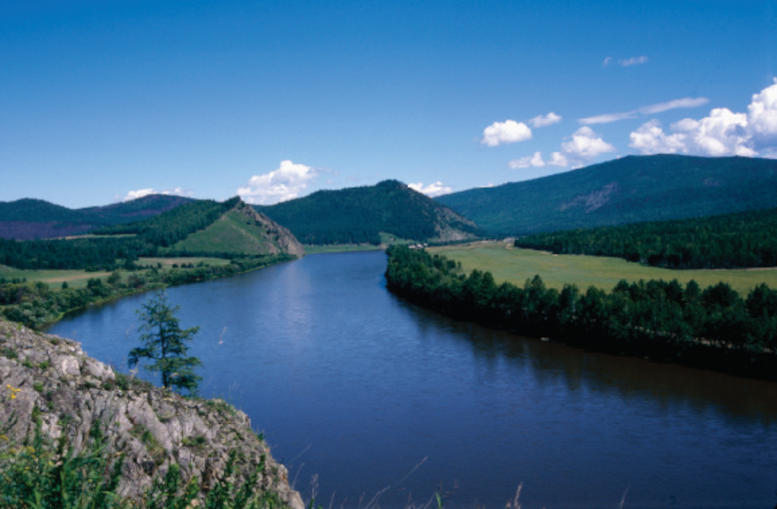
Indeed, the pollen data suggest that the dispersal of people occurred during some of the highest temperatures in the late Pleistocene, which also would have featured higher humidity. The ancient pollen record shows coniferous forests and grasslands characterized the region, able to support foraging and hunting by humans. Goebel said the environmental data, combined with archeological evidence, tell a new story.
“This contradicts some recent archaeological perspectives in Europe,” said the KU researcher. “The key factor here is accurate dating, not just of human fossils and animal bones associated with the archaeology of these people, but also of environmental records, including from pollen. What we have presented is a robust chronology of environmental changes in Lake Baikal during this time period, complemented by a well-dated archaeological record of Homo sapiens’ presence in the region.”
Goebel’s collaborators were lead author Koji Shichi of the Forestry and Forest Products Research Institute in Kochi, Japan; Masami Izuho of Tokyo Metropolitan University, Hachioji, Japan; and Kenji Kashiwaya of Kanazawa University, Kanazawa, Japan.

While the pollen analysis was carried out in Japan, Goebel and Izuho tied the pollen data to important evidence in the archeological record of early human migration. Goebel said the emergence of full-fledged Homo sapiens in the archaeological record corresponds to changes in culture and behavior. Early modern humans of this period were making stone tools on long, slender blades, working bone, antler, and ivory to craft tools — including some of the first bone needles with carved eyelets for sewing and early bone and antler spear points.
“Some of us argue that as the anatomical changes were occurring, as evidenced by the fossil record, there was a simultaneous shift in behavior and cognition,” Goebel said. “These early humans were becoming more creative, innovative, and adaptable. This is when we start to observe significant changes in the archaeological record, such as cave paintings. We also find mobile art, like the early carvings known as Venus figurines. In Central Europe, there’s even an ivory sculpture dating back to this early period, depicting a lion-headed man. It’s not just replicating nature; it’s about creative expression, inventing new things, exploring new places.”
The Ust’-Ishim Fossil: A Glimpse into Early Modern Humans
At least one human bone has been found in the region that dates to the era, according to the KU researcher.
“There is one human fossil from Siberia, although not from Lake Baikal but farther west, at a place called Ust’-Ishim,” Goebel said. “Morphologically, it is human, but more importantly, it’s exceptionally well-preserved. It has been directly radiocarbon-dated and has yielded ancient DNA, confirming it as a representative of modern Homo sapiens, distinct from Neanderthals or Denisovans, or other pre-modern archaic humans.”
Goebel said the earliest human inhabitants of the area likely would have lived in extended nuclear families or small bands, as they seem to have done in other areas of Eurasia. But because so much archeological evidence is degraded, it’s difficult to know with certainty.
“At Ust’-Ishim in Siberia, we have evidence of a fully modern human co-existing with the sites we’ve been discussing,” he said. “However, Ust’-Ishim was an isolated discovery, found by geologists eroding from a riverbank. We lack information about its archaeological context, whether it was part of a settlement or simply a solitary bone washed downstream. Consequently, linking that single individual to the archaeological sites in the Baikal region is tenuous — do they represent the same population? We think so, but definitely need more evidence.”
Reference: “Climate amelioration, abrupt vegetation recovery, and the dispersal of Homo sapiens in Baikal Siberia” by Koji Shichi, Ted Goebel, Masami Izuho and Kenji Kashiwaya, 22 September 2023, Science Advances.
DOI: 10.1126/sciadv.adi0189
Never miss a breakthrough: Join the SciTechDaily newsletter.
Follow us on Google and Google News.
1 Comment
, found by geologists eroding from a riverbank. Funny.